
Key Takeaways
- The Swiss Virtual Campus (SVC) launched in 2000 with the goal of promoting an information society in Switzerland.
- The University of Geneva has been actively involved with building the SVC and the European virtual campus e-LERU, a two-year project in which eight European countries partnered to implement research-based education at a distance.
- Focusing on the SVC experience, this report identifies critical characteristics of such multifaceted projects with the goal of improving their chances for success.
- Among the many challenges, low faculty involvement and lack of integration of "e-modules" within curricula pose a major threat to sustainability of cross-institutional virtual campuses.
The 1990s saw a surge of initiatives focusing on information and communication technologies (ICT) applied to distance education. The Swiss Education and Sciences Ministry mandated a study to assess Switzerland’s efforts, which found:
- Switzerland lagging behind other countries in the application of ICT in higher education.
- Uncoordinated efforts to introduce ICT education in the Swiss universities.1
These conclusions led to a vast national project - the Swiss Virtual Campus (SVC) - to promote an information society in Switzerland. Approved in 1999 by the Swiss Parliament, the SVC project debuted in 2000. At that time, the European commission adopted the eEurope plan, which focuses on "exploiting the advantages offered by the Internet" for the benefit of all European citizens through the European e-learning program that launched in 2001. One of the program’s four action items concentrated on European virtual campuses, with the goal of encouraging new organizational models for European universities, including exchanges and sharing based on virtual mobility.
The University of Geneva was actively involved in building the SVC and, more recently, in setting up the European virtual campus e-LERU (see "The e-LERU Project and its European Context"). These two cross-institutional virtual campuses brought together traditional universities having unequal experience in distance education.
Although many similar initiatives launched about the same time, few succeeded.2 My purpose here is to report specifically on the SVC in an attempt to identify the critical characteristics of these multifaceted projects. The construction and funding phases of the SVC are complete, and the next phase will concern sustainability, which clearly represents a major challenge for virtual campuses. Radical changes in the higher education curriculum might be needed to improve the virtual campuses’ chances for success.
Virtual Campuses
Virtual campuses offer education over the Internet at any time and place. This general definition also covers mixed delivery modes where physical meetings or seminars are held. Virtual campuses can be deployed at different scales, ranging from faculty-level to institution (encompassing regional educational institutes) and up to large national and international consortia. Examples include:
- Faculty level: The distance master’s program of the Faculty of Theology at the University of Geneva
- Institutional level: The State University of New York Learning Network and the University of Illinois
- National consortia: The Canadian Virtual University, Bavaria’s Virtual University, the Finnish Virtual University, and the Swiss Virtual Campus
- International consortia: The Virtual Campus for a Sustainable Europe (VCSE), Global Virtual University, Worldwide Universities Network, African Virtual University, and e-LERU
The classification of open universities remains unclear. These higher education institutions (HEIs) cover a wide range of scales, yet are based on different developmental strategies and learning models than traditional universities. Open universities:
- Mainly target lifelong learning.
- Often enforce no entry requirements.
- Can be a product of governmental planning to fulfill national missions.
- Have successfully applied an industrial model of mass production that relies on separating teaching from the production of study material.3
Initially, open universities were not designed to benefit from Internet technologies, but their introduction did not seem to cause difficulties - they were perceived as natural extensions of earlier methods for digital transmission. Internet technologies actually furthered the industrial model.4 In contrast, most traditional universities engaged in distance education (the focus of this article) target neither mass production nor for-profit programs. Instead, teachers work as artisans controlling the chain of production from conception to delivery.
What, then, are the main challenges in setting up a cross-institutional virtual campus? To answer this question pragmatically, I focus on the nine-year SVC experience, in which traditional universities with varying degrees of ICT maturity have cooperated.
The Swiss Virtual Campus Experience
The studies mandated by the Swiss Education and Sciences Ministry to evaluate distance education in Swiss universities revealed technology ahead of pedagogy and distance learning underdeveloped with respect to other countries.5 The main causes of the problem were identified as geography (Switzerland is about the size of Vermont and New Hampshire combined, with fewer than 8 millions inhabitants) and the correspondingly large density of HEIs - about 13 per million people - along with a lack of coordination between universities in the ICT field. The SVC project was launched to promote the "Swiss information society" using new e-learning environments destined to:
- Improve the quality of teaching and learning
- Encourage the development of new techno-pedagogical practices
- Set up didactic material for wide distribution to encourage competition
This vast program took advantage of the European Bologna Process for guidance on virtual mobility and accreditation. Initially planned for four years (2000-2003), the project was extended another four years to allow consolidation of the initial objectives; it eventually lasted to July 2008 (see the timeline in Table 1).
Table 1. SVC Milestones
| Pre-SVC (1996-1999) | Impulse Period (2000-2004) | Consolidation Period (2004-2008) | Exploitation Period (2008 on) |
|
|
|
|
National criteria for acceptance of the SVC project included:
- Participation of at least three Swiss HEI partners
- Resources provided by project partners to match the funding granted by the Swiss government, either money or a worker’s involvement measured in full-time equivalent (FTE)
- Pertinent pedagogic objectives
- Integration of the online courses into existing curricula
- Number of target students (notion of critical mass)
- Lingual diversity (not counting English, Switzerland has four national languages)
- Use of the European Credit Transfer and Accumulation System (ECTS)
- Innovation in course design and media
- Organizational aspects of the project (planning, milestones, etc.)
At the conclusion of this nine-year project, 112 online courses covering a wide variety of fields have been developed in addition to specific mandates bearing on technology, intellectual property, quality, pedagogical support, and management. Furthermore, most Swiss HEIs (that is, Swiss universities, universities of applied science, and the federal institutes of technology) could benefit from subsidies for setting up local e-learning centers - so-called Competence Centers for Service and Production (CCSP) - most of which are still active and expected to carry on their missions. Total costs of the SVC project amounted to about US$130 million, with almost half paid by the Swiss Confederation.
Lessons Learned
Over the course of the SVC experience, a set of key issues underpinning best practices in setting up virtual campuses were identified. Eight issues were recognized as particularly challenging:
- Administration
- Technology
- Intellectual property
- Faculty
- Students
- Quality
- Language and culture
- Sustainability
Administration
Administrative issues clearly depend on the political context. For instance, Europe has its own specificities, exemplified in Table 2, which are not necessarily as pragmatic and profit-driven as those found elsewhere in the world (like in the United States6). Major administrative issues generally include:
- Integration into curricula.Cross-institutional integration of e-modules (online courses) within curricula relies on both strong collaborations between instructors from the participating universities (bottom-up process) and incentives at the institutional level to support the sharing of those e-modules (top-down process). The failure of the U.S. Open University (USOU), for instance, was blamed on curriculum conflicts.7 Leaving some flexibility on how the e-modules will be dispensed can ease such integration. An instructor speaking about e-module exchange concluded that:
"In order for this [reciprocal] exchange to be effective, we recommend that the teaching modules are explicitly included, as either optional or compulsory courses, in the study programs of the two universities." - Academic calendars. Besides dealing with semester dates subject to national rules, synchronizing several universities’ curricula can easily become an impossible mission.
- Accreditation. Once an e-module from a host university is integrated in a curriculum, students need assurance that their home university recognizes that accreditation. Such recognition usually involves bilateral agreements, often through top-down formal institutional processes. One teacher put it this way:
"Students’ grades were registered under Erasmus. Geneva has an Erasmus agreement with Heidelberg, which means that ECTS [European Credit Transfer System credits] from Heidelberg are recognized by Geneva and vice versa. So we used the existing accreditation method, and that worked without problem." - Tutoring. If the number of students attending an e-module does not balance between the partnering universities, or if the number of students signed up exceeds a threshold, tutoring becomes a resource problem. This problem affects single e-modules (because only one university is dispensing the course) and might be present for joint e-modules, depending on the number of students from each partner institution and the number of tutors available for those courses. One teacher noted:
"The restriction of student numbers I can achieve de facto is by creating a prerequisite and by teaching the e-module in the summer semester, which students tend to avoid (for reasons that are mysterious but real). However, I am legally prevented from placing a formal restriction on student numbers, and we know that e-learning works only with a maximum of 15-20 students."
Table 2. Administrative Issues from the Perspective of Europe’s Bologna Declaration
| Administrative Issue | Bologna’s Cure |
| Integration into curricula | Introduction of a standardized three-cycle schedule |
| Academic calendar | Standardization of the periods of study |
| Accreditation | Standardization of the quality assurance and accreditation system using the ECTS. The basic unit of 1 ECTS credit corresponds to 25-30 hours of student work; a university year corresponds to 60 ECTS credits. |
| Tutoring | Encouragement of mobility (such as through the Erasmus program, described in "The e-LERU Project and its European Context") |
Technology
Two key technological components enable registered students to access online resources:
- A learning management system (LMS)
- Associated authentication mechanisms
Given the many learning management and authentication systems available, one can hardly expect to find the same systems among network partners, particularly at the consortium level considered here - more than 10 different LMSs have been inventoried in the SVC network. One pragmatic solution is to create public web portals through which students can consult the list of available e-modules and their descriptions, and the URLs to access them directly.
To facilitate searching through e-modules requires a uniform description. The Course Description Metadata (CDM) standard is one such European proposal, which so far has not been widely adopted, perhaps because of the multi-language issue still largely unsolved in such universal descriptions. Moreover, the use of a common standard must take into account that most universities have local applications to manage course administration, and those applications are usually embedded in a central management database. This failure to share course descriptions and technology contributes to problematic curriculum integration of distant courses.
As for student authentication, no solution exists at the European level for LMSs. Consequently, those universities hosting distant courses must provide a URL along with a login, which represents additional administrative workload. In Switzerland, however, this login process is not necessary because all Swiss HEIs (including state hospitals) use a common authentication system (described in "Federated Security")
Besides these technical issues, basic usability (and assistance) should not be neglected. Consider two students reporting difficulties with using files and forums when attending e-modules:
"I don’t know why the lectures didn’t work properly on my Mac (I had to open the PDF and the RealPlayer file separately and scroll down the PDF myself), but it was not a big problem."
"I also visited the intuitive forums, but I was not able to delete my thread. In my opinion, it should be possible for the user to modify or even delete an unreplied topic."
Intellectual Property
Intellectual property (IP) applies to all creative works, including PowerPoint presentations, text quotations, conferences, didactic and scientific works, and, by extension, online courses. IP for distance education is complicated by the fact that the Internet is not geographically delimited, and IP law generally changes from one country to another. Also, depending on the domestic law considered, exceptions generally afforded to physical classrooms for educational purposes do not necessarily apply, even if access to e-modules is protected.8
Support from experts in the IP field is generally recommended to deal with legal and economic issues linked to ICT, such as the use, distribution, and reuse of didactic material produced by teachers and administrative staff. Among the various licensing models, the Creative Commons licenses offer convenient frameworks for agreements between universities and their employees (faculty, administrative staff, researchers) without requiring exceptions, which do not always apply. In Switzerland, for instance, teaching exceptions are in principle limited to "live teaching" and thus do not cover digital distance education.9
The Creative Commons licenses Attribution-Noncommercial-Share Alike (by-nc-sa) and Attribution-Noncommercial-No Derivative Works (by-nc-nd) have been advocated when producing online courses. OpenLearn of the Open University U.K., for instance, applies the by-nc-sa license. Both Creative Commons licenses allow students to copy course material and even to further distribute it to students not enrolled in the online course; at the same time, the university cannot modify or commercialize the material (or alter the licensing model).
Faculty
Faculty are principal actors in expanding and anchoring online courses. Accumulated evidence indicates that faculty go through many stages of technology adoption, beginning with slight enhancements to their traditional courses and ending with major redesigns.10 The adoption cycle for e-learning takes years to complete, with gradual changes leading to some sort of blended learning.11 Within the context of virtual campuses, more radical changes are observed for those instructors who actively participate in the development of online courses. Yet, this participation remains marginal - through the duration of the SVC project, only a small percentage (less than 5 percent) of faculty became involved (a ratio in agreement with similar projects12), indicating that most instructors might still be early adopters.
The low faculty participation in the production of online courses results mainly from:
- Insufficient training in ICT
- Lack of time
- Poor institutional coordination of ICT initiatives
- Insufficient recognition of the effort needed to develop ICT-based courses13
Also - contrary to the industrial model of the open universities - faculty in traditional universities can be compared to craftsmen, often working alone. One instructor expressed this as follows:
"I must devote a total of 28 hours to this module in addition to the 24 × 7 teaching that we know from experience is what an e-module requires. Maybe I am willing to do this because of my commitment to the concept of e-learning, but it remains an issue if we want to disseminate this teaching practice among colleagues."
Even though half of European universities apparently cooperate with other universities in their own countries to deliver joint e-modules, and transnational cooperation is steadily growing with up to 90 percent of Europe’s HEI nowadays involved in European education networks,14 instructors lecturing on the same subject and willing to set up joint e-modules remain an exception. As one instructor said:
"[…] in many cases universities work as independent entities and do not communicate much with one another; top science [from the e-LERU Top Science program] is very important to break this trend of working in isolation."
In the same vein, an administrative staff person concluded:
"The main results of this project are the network we have created, the different kinds of expertise the other universities have and [what] we have learnt from them, and the very useful contacts we now have."
Effective networking among faculty, students, and administrative staff can take years to establish and a lot of energy to maintain, which probably explains the low production rate of joint e-modules. (For instance, during the two-year e-LERU project no more than three e-modules were set up.) Yet, appropriate ICT policies and funding can improve this situation, proof being the SVC project, in which more than 100 joint e-modules were designed over nine years, with more than a third of them successfully transferred into curricula (although not necessarily in a sustainable way; see below).
Students
Although not necessarily e-literate, the new generation of students has techno-cultural skills comparable to reading and writing. Also, among the top motivations for using the Internet in education, students cite:
- Flexibility in organizing their studies and preparing for exams while practicing nonacademic activities, such as working to pay for their studies. (This seems more a concern for older students; according to the University of Geneva’s 2006 survey,15 on average 80 percent of students work.)
- The possibility of studying other fields not included in their curricula.
- As another way to learn and to participate in social networks.
A student interviewed on his experience with an e-module (or e-course) at a distance said:
"E-learning courses have many positive impacts on studying because we are freer, […] which means we have to organize ourselves and create a new method of working."
Another student stated:
"I liked this e-course a lot. I could work at my own pace, and I could leave it for weeks when I was busy with my exam-preparation."
In keeping with this student’s point of view, one instructor concluded:
"I felt that the idea [of e-modules] was to replace passive student behavior with a more self-governed approach to learning."
On the negative side, a student observed that working in groups at a distance is not necessarily straightforward (nor is evaluating the effort needed):
"The discussion in the forum hasn’t really worked. I have also worked alone, not in a group. I think the output could have been bigger if everyone had really posted questions in the forum. But […] we were a very small number of students[…]. I also think that the effort for this course was comparatively large, and we only get one credit point in return. So I think everyone just completed the tasks and couldn’t invest more time, although discussions would have been interesting."
Many students have high expectations for the use of Internet technologies in teaching despite the fact that so far no major teaching innovation has taken place.16 A majority (58 percent) of the 1,653 students who responded to the University of Geneva’s 2006 survey favor Internet technologies as a complement to face-to-face teaching (preferred by 65 percent), while about one-third prefer "pure" distance courses. The 2008 ECAR Research Study confirms these attitudes toward online courses.17 Those setting up virtual campuses should not neglect these findings.
Quality
Course content and its electronic distribution raise the issue of quality. Course content quality is a touchy subject, however, as it pertains to both faculty’s and the schools’ reputations. The SVC project ignored this issue, assuming that quality control of the course content relies on exogenous factors like university ranking, participation in excellence networks, and accreditation systems. Content quality is thus "subject to general accreditation arrangements," which does not differ from accreditation schemes applied to traditional learning.18
Distribution of course content to learners involves instructional models, which faculty are more willing to discuss. The pedagogical competences needed to design a course suitable for the Internet are a strategic challenge for virtual campuses, yet faculty devote more time and energy to research than education in most traditional universities. This focus on research stems from faculty’s evaluations based on publication ranking rather than the quality of their teaching. With the Bologna Declaration encouraging European cooperation in quality assurance, agencies such as the European Association for Quality Assurance in Higher Education (ENQA) now play an active role in such evaluations. Institutions have begun to hire teaching staff according to pedagogical criteria that include the minimum necessary level of competence to transmit their knowledge effectively to students in a range of teaching contexts, increasingly encompassing e-learning.
A variety of virtual campus projects have devised methods for process-oriented quality approaches targeting the production of distance courses based on Internet technologies. As a general rule these methods rely on best practices acquired over the years and shared within the e-learning community through guidelines and benchmarks, as illustrated in Table 3. While these methods are not substitutes for professional faculty training, they match the needs of those traditional universities that have not yet invested in pedagogic support centers.
Table 3. Selected Resources for Quality Distance Education
| Resource | Description |
| European e-Quality project | Yielded a guide to quality in open and distance learning19 |
| ISO 19796 | A standard for quality management in education and training; a concrete application of this norm is available20 |
| Institute for Higher Education Policy | Produced a set of U.S. benchmarks to ensure quality distance education21 |
| SVC online handbook | Online evaluation tool from the SVC initiative |
| e-LERU Quality Manual | Outcome of the eLERU project, a manual to ensure quality of e-learning modules |
| MECA-ODL | Methodological guide for analyzing quality; from the European project on quality in open and distance learning delivered via the Internet |
| Quality Matters | A peer review process designed to certify the quality of online courses and online components; Inter-Institutional Quality Assurance in Online Learning, sponsored by Maryland Online |
| EFQUEL, European Foundation for Quality in e-Learning | In existence since 2005, EFQUEL encompasses several e-learning quality projects and more than 60 members from nearly 20 European countries |
Language and Culture
Teachers speaking the same language and living in the same country are likelier to collaborate, which can inhibit cross-border projects. Culture also can affect teaching methods. In Europe, for example, people in southern countries seem to favor synchronous interactions and working with computers in small groups, while people in northern countries stress individual work.22 Distance education promotes a common learning culture. This trend aligns with the Bologna process, which seeks to smooth out differences by making courses understandable to all instructors and students through wider use of English. Not all students agree with this. One German-speaking student found:
"Sometimes it was difficult because the whole course was in English and that’s not my mother tongue. Reading or listening was OK, but writing in English takes getting used to. In general, I had to invest more time."
Language and cultural differences can also add value. European initiatives specifically target the development of e-modules promoting language learning by encouraging communication between students and language practice with native-speaker teachers and tutors. Thus, synchronous interactions typically use the native teacher’s language, while English might be used in a self-paced mode. Switzerland has three main languages (German, French, and Italian), making the degree of multi-language support, including English, an important criterion in selection of the SVC projects.
Sustainability
Sustainability appears on the agenda once the funds dedicated to setting up virtual campuses are used up. Sustainability also includes faculty’s active participation and the effective use, or integration into curricula, of the online courses once the construction phase ends. Yet, absent further grants, other resources are needed to keep virtual campuses going.
From the consortium point of view, the SVC’s sustainability can benefit from the e-learning CCSPs established at each participating Swiss HEI during the course of the SVC project. In most cases they represent sustainable structures, grounded in their host institutions, and are recognized as the most successful outcome of the SVC program.23 Also, in sync with the end of the SVC funding, the managers of the CCSPs set up a national assembly (called the Educational Technology Working Group) with the goal of coordinating virtual campus activities. The group has one representative from each Swiss HEI and is chaired by a two-year elected member. This assembly contains special interest groups that share expert best practices by bringing together specialists on specific e-learning topics (the eduhub forum). At the national level, the assembly lobbies the Rectors’ Conference of the Swiss universities, takes part in internationally funded projects, and gets involved in standardization bodies such as IMS. Participation in the assembly requires no membership fee, and guests are welcome. Following dissolution of the SVC board, one of the rectors was nominated as a permanent e-learning delegate in charge of keeping abreast of e-learning advances in Swiss universities.
Perspectives
None of the issues related to setting up virtual campuses is insurmountable. However, the relatively low involvement of faculty could explain the difficulties, and sometimes the complete failure, of these enterprises. The bottom-up approach means that mainly technology innovators participate, and collaboration between project partners occurs mostly in the production phase (during which grants are allocated), with little sharing of courses afterwards.24 Improving this situation would require top-down incentives to develop consortia and produce new e-modules, which in most cases puts a financial strain on the host institutions. According to evidence gathered during the SVC project, the production costs of a single e-module range from US$300,000 to more than $3 million. Yet, no correlation between costs and results could be established. On the contrary, expensive projects tended to raise unrealistic expectations. Thus, during the second phase of the SVC project (the consolidation period), funding has been restricted to small projects.
Even at the level of single courses, sustainability is worrisome - in most cases, they support educational practices rather than the development of widely used educational materials.25 Two-thirds of the SVC e-modules were used as independent supplementary material, additional self-study material, and so on; only one-third consisted of standalone courses. On the positive side, the leaders of the project and their partners effectively integrated these e-modules into relatively large classes (see Figure 1). On the negative side:
- Only 20 percent of these online courses are transferable into sustainable structures.
- Only 20 percent might eventually be sustainable.
- Over 50 percent face barriers such as curriculum integration, financial needs, technological and cultural challenges, and so forth.
- 10 percent probably won’t survive.26
In addition, about 40 percent of the partnerships already have or are likely to be dissolved in the future.27 According to the same study, online courses developed early in the project (5 years ago) have a higher rate of ending (currently 25 percent) than later ones. After a certain time, online courses must be redesigned to respond adequately to curricula or user requirements. Interestingly, the perceived top risk factors for the demise of online courses cited by their designers (mainly faculty) are inadequate financial support and retirement of key people, rather than lack of integration within curricula or diminishing partner interest.
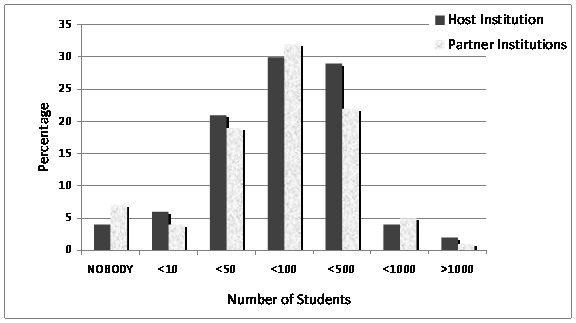
Figure 1. Integration of SVC E-Modules into Curricula (in %) as a Function of Class Size*
* Data gathered during the 2007-2008 academic year for 101 e-modules. Adapted from Lepori and Probst.28
Today, pure distance learning represents less than 25 percent of all SVC projects, with most educational materials produced for the SVC used in hybrid courses. About half the online courses produced are compulsory for students within those curricula (and are ECTS compliant), while the other half are optional.29
The SVC provided an opportunity for distance teaching to diffuse into higher education, but essentially resulted in small-scale effects in single courses rather than large-scale restructuring of curricula for distance learning. That the dominant mode emerging from the SVC is blended learning rather than distance learning raises major sustainability issues. This mixed approach weakens the establishment of a virtual campus per se despite the SVC program’s support for e-learning at a national level. Failure of the U.K. e-University in 2004 resulted mainly from the belief that universities would adopt pure e-learning.30 The same can be said of the first phase of the SVC project, which has been corrected in the second phase.
In the case of international partnerships such as e-LERU, the situation worsens because setting up transnational joint courses depends on the probability of two instructors from geographically distant institutions knowing each other and wishing to collaborate. Virtual campuses based on specific themes (for example, the Virtual Campus for a Sustainable Europe, VCSE) seem to have more potential for such collaborations, but the way they are set up implies that e-learning is an add-on. On the other hand, success of some "national" virtual campuses (such as the German Virtual University of Bavaria, the Canadian Virtual University, or the University of Phoenix Online) seems to rely on combinations of web-based and face-to-face learning; a "can do" culture; and, for some institutions, application of the open university industrial model or explicit, well-thought-out business models.31
Conclusions
Despite the demand for e-modules, setting up cross-institutional virtual campuses remains a risky business. Key to improving this situation is giving more attention to curricula through a top-down approach, one involving universities’ governance. A successful top-down approach asks for explicit strategic plans, shared between faculties and practiced on a large scale, along with international cooperation to foster interdisciplinarity and the exchange of ideas on curricula and teaching practices. Saudi Arabia, for instance, launched a major ICT plan targeting the transformation of the country into an information society. This plan includes preparing teachers to use innovative teaching methods (through a new national center for e-learning and distance teaching) and placing more emphasis on scientific and technical training to meet the future needs of the labor market.
Changes in the curricular landscape should stimulate reflection among academic communities about the fundamentals of their disciplines. For research-oriented HEIs especially, such changes could promote mobility in crossing both disciplinary and national borders and encourage students to think outside the discipline-bounded limits of traditional universities. Europeanization of higher education, as initiated by the Bologna Process, could lead to establishment of a core curriculum based on international standards for courses and study programs.32 Physical and virtual mobility would play a central role, facilitating mobility in the job market as well.33
While large-scale consortia like the SVC are relatively easy to set up, cross-institutional involvement of faculty in the long term clearly is not. Top-down approaches to rationalize and valorize the many bottom-up initiatives from individual instructors are needed to improve the present situation, in which resources for designing e-modules are scarce while the demand for them is growing. The necessary further development of common technological standards and the development and sharing of learning material (through learning object repositories, for instance) will remain ineffective without dissemination of more advanced projects that involve a rethinking of pedagogy. The lessons learned from the SVC project can inform future efforts to establish international virtual campuses that succeed in meeting their goals of providing distance learning across borders and disciplines.
Acknowledgments
I would like to thank Alain Jacot-Descombes, director of the University of Geneva’s IT department, for his support and valuable feedback in this work; Pascal Praplan for his expertise in redaction; the SVC team members of the SUPPREM and CALIS projects for supplying data; the participants of the e-LERU project for sharing their insights on virtual campuses; to an anonymous referee for beneficial comments on the original document; and to the journal editor, Nancy Hays, for her professional expertise. Special thanks also to Abdulla Almegre, director of the National Centre for E-Learning and Distance Learning of Saudi Arabia, and Ali Almogbel, head of the e-learning team at Taibah University, Madinah, for offering me the opportunity to give the talk "Challenges in Setting Up an International Virtual Campus" during the seminar "E-Learning at Universities in Saudi Arabia: Active Steps Toward Collaborative Success" (Madinah, May 2008), which provided me with the impetus to write this article.
- Daniel Peraya and Bernard Levrat, "The Swiss Virtual Campus: History and Perspectives," Educational Media International, vol. 36, no. 2 (June 1999), pp. 97-109.
- Antonio Cartelli, Mark Stansfield, Thomas Connolly, Athanassios Jimoyiannis, Hugo Magalhaes, and Katherine Maillet, "Towards the Development of a New Model for Best Practice and Knowledge Construction in Virtual Campuses," Journal of Information Technology Education, vol. 7 (2008), pp. 121-134; see also Re.ViCa, Reviewing (traces of) European Virtual Campuses.
- Distance Education: New Perspectives, Keith Harry, Magnus John, and Desmond Keegan, eds. (London: Routledge, 1993); Sarah Guri-Rosenblit, "Distance Education and E-Learning: Not the Same Thing," Higher Education, vol. 49, no. 4 (2005), pp. 467-493.
- Tony Bates, "Transforming Distance Education Through New Technologies," in International Handbook of Distance Education, Terry Evans, David Murphy, and Margaret Haughey, eds. (Bingley, UK: Emerald Group, 2008), pp. 217-235.
- Peraya and Levrat, "The Swiss Virtual Campus."
- Tom Kennedy, "Online Distance Learning: An Idea for the Times," EDUCAUSE Quarterly, vol. 29, no. 4 (2006), pp. 67-69.
- Katrina A. Meyer, "The Closing of the U.S. Open University," EDUCAUSE Quaterly, vol. 29, no. 2 (2006), pp. 5-7.
- Raquel Xalabarder, "Copyright Exceptions for Teaching Purposes in Europe," working paper, Internet Interdisciplinary Institute, July 2004.
- Ibid.
- Robert Zemsky and William F. Massy, "Thwarted Innovation: What Happened to E-Learning and Why," final report for the Weatherstation Project of the Learning Alliance for Higher Education, University of Pennsylvania, 2004.
- Betty Collis and Marijk van der Wende, eds., "Models of Technology and Change in Higher Education: An International Comparative Survey on the Current and Future Use of ICT in Higher Education," Center for Higher Education Policy Studies, December 2002; A.W. Bates, Technology, E-Learning, and Distance Education (London: Routledge, 2005); and Franziska Zellweger Moser, "Formulating eLearning Support Strategies in Research Universities or The Strategic Management of Faculty Support at American Research Universities," thesis, University of St. Gallen, 2006.
- Sabine Seufert and Dieter Euler, "Sustainable Implementation of eLearning," Final Report SVC Mandate, Swiss Centre for Innovations in Learning, Universität St. Gallen, 2006.
- Charalambos Vrasidas and Gene V. Glass, eds., Preparing Teachers to Teach with Technology (Greenwich, CT: Information Age Publishing, 2005); Sarah Guri-Rosenblit, "Eight Paradoxes in the Implementation Process of E-Learning in Higher Education," Distances et savoirs, vol. 4, no. 2 (2006), pp. 155-179; and Bjorn Stensaker, Peter Maassen, Monika Borgan, Mette Oftebro, Berit Karseth, "Use, Updating, and Integration of ICT in Higher Education: Linking Purpose, People, and Pedagogy," Higher Education, vol. 54, no. 3 (September 2007), pp. 417-433.
- PLS Ramboll, "Studies in the Context of the e-Learning Initiative: Virtual Models of European Universities (Lot 1)," Final Report to the EU Commission, DG Education and Culture, Aartus, PLS Ramboll Management, 2004; and Eric Beerkens, "The Emergence and Institutionalization of the European Higher Education and Research Area," European Journal of Education, vol. 43, no. 4 (2008), pp. 407-425.
- Gail Salaway and Judith Borreson Caruso with Mark R. Nelson, The ECAR Study of Undergraduate Students and Information Technology, 2008 (Research Study, vol. 8, 2008) (Boulder, CO: EDUCAUSE Center for Analysis and Research, 2008), available from http://www.educause.edu/ecar; and the University of Geneva’s survey "Students 2006" (in French), http://www.unige.ch/rectorat/observatoire.
- John G. Hedberg, "E-Learning Futures: Speculations for a Time Yet to Come," Studies in Continuing Education, vol. 28, no. 2 (2008), pp. 171-183.
- Salaway and Caruso with Nelson, The ECAR Study of Undergraduate Students and Information Technology, 2008.
- Robin Middlehurst and Steve Woodfield, "Quality Review in Distance Learning: Policy and Practice in Five Countries," Tertiary Education and Management, vol. 12, no. 1 (March 2006), pp. 37-58.
- Juha Holma and Suvi Junes, "Trainer’s and Professional’s Guide to Quality in Open and Distance Learning," WP4-D4, University of Tampere, e-Quality project, 2006.
- Jan M. Pawlowski, "The Quality Adaptation Model: Adaptation and Adoption of the Quality Standard ISO/IEC 19796-1 for Learning, Education, and Training," Educational Technology & Society, vol. 10, no. 2 (2007), pp. 3-16.
- James P. Merisotis and Ronald A. Phipps, Quality on the Line: Benchmarks for Success in Internet-Based Distance Education, Institute for Higher Education Policy, May 2000, Washington, DC.
- Jef Van den Branden and José Lambert, "Cultural Issues Related to Transnational Open and Distance Learning in Universities: A European Problem?" British Journal of Educational Technology, vol. 30, no. 3 (1999), pp. 251-260; and Kyong-Jee Kim and Curtis J. Bonk, "Cross-Cultural Comparisons of Online Collaboration," Journal of Computer-Mediated Communication, vol. 8, no. 1 (October 2002).
- Benedetto Lepori and Carole Probst, "II Background Report," in Evaluation of the Swiss Virtual Campus Consolidation Programme, USI-SUPSI, Lugano, Switzerland, November 2008 (French, German, and English).
- Benedetto Lepori, Sibilla Rezzonico, and Chiara Succi, "eLearning in Swiss Universities: Recent Developments and Future Prospects," presented at the European University Information Systems Conference (EUNIS) 2004, Viljan Mahnic and Boštjan Vilfan, eds., Bled, Slovenia, 2004.
- Lepori and Probst, "Swiss Virtual Campus Consolidation Programme."
- Seufert and Euler, "Sustainable Implementation of eLearning."
- Lepori and Probst, "Swiss Virtual Campus Consolidation Programme."
- Ibid.
- Ibid.
- Richard Garret, "The Real Story Behind the Failure of U.K. eUniversity," EDUCAUSE Quarterly, vol. 27, no. 4 (2004), pp. 4-6.
- A. Frank Mayadas, John Bourne, and Paul Bacsich, "Online Education Today," Science, vol. 323, no. 5910 (2009), pp. 85-89; and Tim Mazzarol, Geoffrey Norman Soutar, and Michael Sim Yaw Seng, "The Third Wave: Future Trends in International Education," International Journal of Educational Management, vol. 17, no. 2-3 (2003), pp. 90-99.
- In medieval times, the curricula in the universities were common across Europe, and students did not belong to one university but could attend the courses of all existing universities. See M. A. Garito, "Content Sharing Between NETTUNO and the Italian and Mediterranean Universities," in European Networking and Learning for the Future, A. Boonen and W. van Petegem, eds. (Antwerp: Garant, 2007), pp. 185-197.
- Ian P. Bache, "The Europeanization of Higher Education: Markets, Politics, or Learning," Journal of Common Market Studies, vol. 44, no. 2 (2006), pp. 231-248.
© 2009 Pierre-Yves Burgi. The text of this article is licensed under the Creative Commons Attribution-Noncommercial-No Derivative Works 2.5 Switzerland license.