
Online learning has made great strides in higher education in the past five years, with wide adoption of course management platforms such as Blackboard, WebCT, eCollege, and Angel, as well as emerging open source solutions. Many institutions are still unclear about how this new technology fits with their mission, however, and have found that achieving widespread adoption by faculty is difficult. They have also found it challenging to achieve faculty use that truly enhances the learning interaction between faculty and students as opposed to simply posting materials online. Some studies have reported dramatic growth of online courses, but what is really going on?
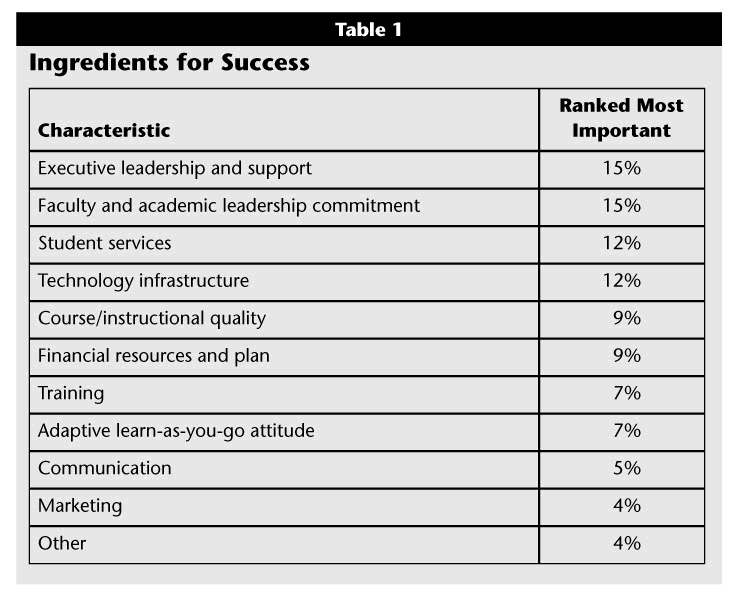
A recent study by the Alliance for Higher Education Competitiveness, Achieving Success in Internet-Supported Learning in Higher Education: Case Studies Illuminate Success Factors, Challenges, and Future Directions, pulled from the experiences of 21 institutions across all Carnegie classifications to provide insights into best practices for achieving success in online learning. More importantly for higher education leaders, the study identified some potential root causes of success (or lack of success). These common denominators of success (see Table 1) provide a framework for understanding why some initiatives succeed while others do not—and what conditions can be created to make improvements.
Click image for larger view.
Motives and Leadership
The 21 institutions selected to participate in the research described themselves as being successful in online learning: five community colleges, seven baccalaureate/master’s institutions (five private, two public), and nine research/doctoral institutions (one private, eight public). While success in online learning is clearly a subjective indicator, participants included institutions ranging from Penn State, which supports some 62,000 students with online technology, to Peirce College, which—while much smaller—generates 46 percent of its revenue from online programs.
Successful institutions had compelling reasons to support online learning. The primary motivation is a desire to increase service to students in a way consistent with their needs and the mission of the institution. This alignment between student service and mission can take many forms:
- The mission component to serve working adults coupled with the strong need of these students to have more flexibility in receiving effective instruction.
- The mission component to serve more students coupled with the need to keep costs reasonable for students. This can be achieved in a number of ways, one of which is to use online technology to eliminate the need for additional physical classroom space.
- The mission component to provide a more personalized learning experience for students by using online technology to support things like increased collaboration, ability to replay lecture portions on demand, or bring in subject experts virtually to increase the breadth of the learning experience.
The study also indicated a predominant leadership style that most likely contributed to the success in achieving mission alignment. The key leadership elements were
- A long-term commitment to the initiative
- Investment of significant financial and other resources
- Prioritization of expenditures on high-impact programs
- A clear understanding by faculty of why the institution is implementing online learning
In particular, the involvement of key leaders in prioritizing where to focus online learning development activities was critical and highly correlated with perceived success in these institutions.
What form did prioritization take? Study participants repeatedly said that the best strategy was to start with your strongest programs, ideally the ones for which you are nationally ranked (or have some other distinguishing characteristic) and have a proven demand. Do not look for a market where you do not have a track record of success. In essence, most institutions already have the best market research—their existing record. Some did benefit from national market research to decide whether to expand beyond the local area. A renewed focus on a once-growing program now losing enrollments was also a strategy that worked for some.
Study participants, when asked if a widespread perception existed that the institution was committed to online education, answered that there was no doubt. They also indicated that past financial support was adequate and future financial support was apparent. In other words, online learning was not a one-time event or investment.
Focus on Programs
Probably the most significant finding was that institutions that focused on putting full programs online were about four times as likely to perceive that they had achieved "overwhelming success" as institutions that focused their efforts at the individual course level. Putting a full program online, when done correctly and focused on student learning, involves teamwork within the academic department and among several units of the institution. For the online program to succeed, it must be thought through carefully and perhaps reengineered to serve students differently and, hopefully, better.
The most common success factors of those institutions implementing the "programmatic approach" include
- Support resources dedicated to the selected program(s) (93 percent)
- Development of a project plan, including schedule and milestones (87 percent)
- Prioritization from institutional leadership to choose programs having the most impact (86 percent)
- Program redesign sessions to help faculty leaders create a better program (74 percent)
- Pedagogy defined to reflect the uniqueness of the program(s) (73 percent)
- Involvement of enrollment management in the program planning (67 percent)
- Development of success measures, such as enrollment targets (67 percent)
Looking at the factors, one could say that much of this was just good management, but it is also clear that these institutions are implementing new course and program formats to reflect the unique pedagogy of their program and/or institution. In other words, they are doing a lot more than just posting course notes or syllabi online. They are creating a more effective learning experience at the program level.
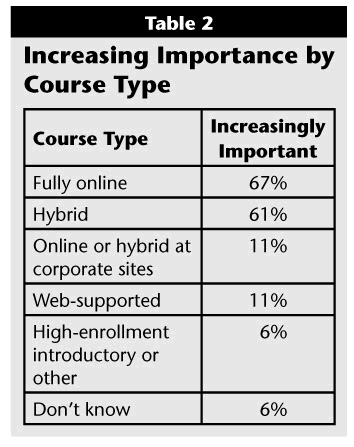
While the predominance of online activity today is of the simple syllabi-posting type, referred to in the study as "Web-supported" courses, this was not true in the study institutions. When asked where they expect to spend more effort in the future ("Which of the online course types do you see gaining in relative importance at your institution in the next three years?"), they responded as shown in Table 2.
Click image for larger view.
Faculty Support and
Student Services
In online learning, faculty are asked to make the biggest changes, with unclear rewards. The programmatic approach provides a framework that supports faculty working together to create a better student experience. Today, a quality online learning experience still has much more to do with the faculty member teaching the course than anything else. It’s still the teaching, not the technology.
So, how can an institution support faculty involved in online learning endeavors? The study elicited the following best practices:
- Nurture grass-roots faculty ideas. Make sure they are at the center as programs move online, and ensure that all faculty who want to venture online have the support services they need.
- Provide frequent and clear communication on why the move to online is important to the institutional mission.
- Provide faculty with support in online technology and pedagogy so that they can focus on using the tools to enhance their interactivity with students.
- Provide one-on-one instructional-design consultations along with staff-development classes that require faculty to experience online courses from the student perspective and to develop their own online courses.
- Recognize the scholarship of teaching and the improved quality it promotes.
Several study participants indicated that one of their most important lessons was to take into account the complete set of student services required for students to receive more of their education online. Across all the participants, student services tied for third for an open-ended question regarding the most important factors in achieving success.
Course materials must be available and easy to use, and students must have someone to call when they need technical help. A new trend was to establish a contact point for resolution of any student issue. This individual went by many names, such as program coordinator or advisor. Other student support services predominant at the successful institutions are discussed in the full study.
Goals and Measurements
The majority of institutions in the study felt they had done better than they initially expected. Generally, they expected growth in the range of 15 to 25 percent. Most explicitly stated the paramount importance of balancing quality with growth.
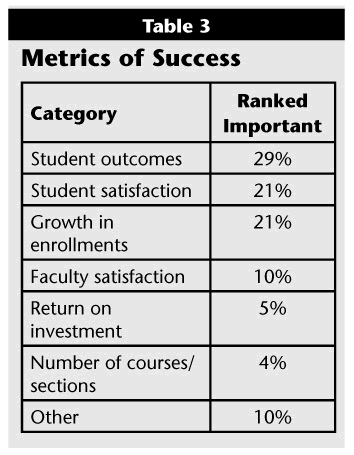
What measures of success did the study institutions use? As shown in Table 3, fully 50 percent focused on student outcomes and satisfaction.
Click image for larger view.
Key Lessons
How can you tell if your initiatives stack up? The following questions should give you important insights into where you can improve:
The study results imply that, taken in total and roughly in order, positive answers to these questions will result in substantial progress and success in online learning in higher education.
The full study is available online at <http://www.a-hec.org/e-learning_study.html>. It contains profiles and contact information for each of the 21 participating institutions, 60 pages of in-depth results, and a bibliography of 25 references. A follow-on study—open to all institutions—that facilitates a self-audit is described at <http://www.a-hec.org/IsL_2005.html>.