Copyright 1998 EDUCAUSE. From CAUSE/EFFECT Volume 21, Number 2, 1998, pp.10-14. Permission to copy or disseminate all or part of this material is granted provided that the copies are not made or distributed for commercial advantage, the EDUCAUSE copyright and its date appear, and notice is given that copying is by permission of EDUCAUSE. To disseminate otherwise, or to republish, requires written permission. For further information, contact Jim Roche at EDUCAUSE, 4840 Pearl East Circle, Suite 302E, Boulder, CO 80301 USA; 303-939-0308; e-mail: [email protected]

Guaranteed Access to Campus Network Resources: Policies and Issues
by Ardoth A. HasslerCampus constituents have become accustomed to robust access to wide-area and local-area networks in their offices, residence halls, and labs. They expect similar access from home and other remote locations. Technology budgets, if they are growing at all, are not keeping up with the exponential growth in user demands. How is remote access best provided? Participants in a Current Issues discussion session at CAUSE97 in December 1997 in Orlando, Florida, discussed options and issues about providing access to campus resources, and there have been subsequent discussions on the EDUCAUSE CIO electronic discussion list. The options discussed include departmentally owned modems, university-owned modems, contracting with a third-party provider for local and/or national service, or using a wireless access. Some of the issues include providing authentication to the campus network, assuring network security, assuring privacy of information, keeping equipment current, charging or not charging users, separating personal e-mail from institutional business, and using institutional resources wisely.
Vision
The vision students, faculty, staff, and administrators have for campus network resources is one of ubiquitous access to technology resources. They expect access from classrooms, labs, libraries, offices, residences on and off campus, lounges--even from the campus green spaces. Constituents want high-speed connectivity for electronic communication, to access files on their local-area networks, to access library and Internet resources, etc. Industry seems to be working toward a goal of providing "anytime, anywhere" access to technology. Such access must be robust, providing access to local, national, and international resources. It must be accessible from a variety of platforms and equipment--Windows, Macintoshes, and UNIX, to name three. It must be readily available twenty-four hours a day. And above all, it must be fast. In addition, because resources on most campuses are tight, solutions must be cost effective.
Today's situation
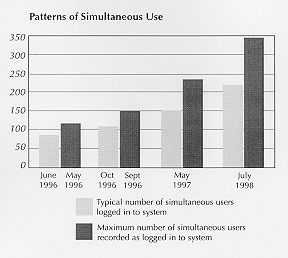
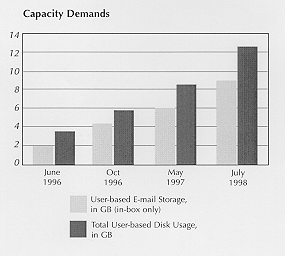
Most chief information officers (CIOs) and directors of computing facilities report both anecdotally and quantitatively that they are dealing with exponential growth. K. C. Green's report of the 1997 National Survey of Information Technology in Higher Education articulates how the use of e-mail, the WWW, and multimedia are becoming "common components of the instructional experience�."1 For example, Green's 1997 survey reports that nearly one-third of all college courses make use of e-mail; this is up from 25 percent in 1996 and 8 percent in 1994. Numerous campuses report an increase in the numbers of students bringing computers to campus. At Georgetown University (GU), the academic HelpDesk sees an increase every summer, the traditionally "quiet" time, in the number of calls and an explosion of calls when the students and faculty return in the fall. Similarly, use of the Web at GU is growing exponentially. System utilization data tracked by the author at two institutions historically have shown that server use each spring is higher than fall and that increased use the following fall is equivalent to the previous spring.
How did we get here?
In the Current Issues discussion, the prevalent situation was one of "traditional" technology services being provided from a central organization. Some institutions charged back these services to departments; others funded them centrally. In most cases, the institution paid for technology except where researchers had external funding. The end user typically paid nothing, except, of course, that students paid tuition and occasional fees. These same institutions reported operating modem pools that were increasingly busy and often inaccessible. Complaints from users escalated.
There are many factors that make it difficult to keep pace with demand. Those discussed included:
New products and new versions of products are being introduced continually. These rapid changes in technology make it difficult for institutions to keep current. Keeping a modem pool up to date, for example, is a particular challenge. As soon as many institutions upgraded to 28.8 modems, 56kb modems were introduced. Of course, the user's expectation is that the higher speed modems will be available the day after they are announced.
Technology budgets are finite. All too often, institutions have funded the purchase of equipment with end-of-year or other one-time monies. Fortunately, Green's survey reports a decline in those using one-time monies to finance information technology. This is indicative that many institutions are recognizing the need to shift technology expenditures from capital to operating expenses. This process usually requires long-range planning and budgeting multiple years into the future. At GU, for example, in fiscal year 1997, the academic computing operating budget was approximately $1.8 million. The long-range planning process identified an additional $2 million of expenditures that were needed annually to maintain the installed base, that is, upgrading servers, replacing computers on faculty desktops on a three-year cycle, upgrading labs and classrooms, etc. To provide for growth, an additional $2 million is needed. (See http://www.georgetown.edu/acs/CSAC/techplan/.)
Users have a "free" mentality. The constituents at numerous institutions, especially students and faculty, are accustomed to having computing resources provided on a "library model" where they do not pay for specific services. At many private institutions where students pay high tuition, technology fees or charges to contract with an Internet Services Provider (ISP) are often viewed as another form of tuition increase. While most schools charge for local telephone calls and meter long-distance use, no one is charging for e-mail messages, and no one wants to. Users often do not realize the cost for the infrastructure to support their "free" access. As one example, at the author's institution the Internet connection in 1987 cost approximately $10,000 per year for a 56kb connection. By 1992, it was close to $30,000 for a T-1 connection. Today, the cost is approaching $125,000 per year for a high-speed, scalable Switched Multimegabit Data Service (SMDS) connection. These costs do not begin to address the connectivity required to achieve Internet2 speeds.
Use of home offices. There was discussion in the Current Issues session about the changing nature of some campuses. All too often, faculty come to campus to teach, hold a few office hours, attend a few meetings, and leave. As more and more campuses wire their residence halls, reports of 70 percent of the students bringing computers to campus are not unusual. With increased computing power available in personal computers, the technology resources available on campus are desired at home.
Service options
Representatives from the schools attending the CI session articulated several options for providing connectivity and/or establishing alternative funding models. Among them are:
Allow distributed access. Central computing organizations, especially at large institutions, are increasingly unable to be "all things to all people." Technology support is more and more frequently being provided in schools and departments closer to the end-user. Sometimes this distributed support is managed centrally; however, many departments fund their own. Some departments provide their own modem pools. Network security and integrity is a major concern, as staff in an individual department often do not have the expertise or technical resources to provide such services as network authentication.
Continue to operate university-owned modems. Some institutions continue to operate their own modem pools, and each institution must decide whether it can provide the services at no cost to the end user or whether users will pay a subscription or monthly charge. The University of Texas at Austin successfully operates a modem pool containing 2,960 modems and has developed a sustaining model based on charges their users pay. Similarly, Baylor University offers modem access for a monthly fee. Their models, however, do not address the "traveling scholar" issue of accessing the campus from local phone numbers in major cities. Outsource remote access. Many institutions have chosen to outsource remote access to local or national Internet Services Providers (ISPs). An article in the Winter 1996 issue of CAUSE/EFFECT by Hassler and Neuman reports the experiences of seventeen institutions that have chosen to outsource remote access.2 It also articulates many of the issues an institution must face when it chooses to outsource remote access. Several sample RFPs are available on the EDUCAUSE Web site at http://www.educause.edu/asp/doclib/. The CREN Virtual Seminars on Networking also provides instruction on outsourcing remote access (see http://www.cren.net/)
Establish more robust connectivity. Wireless access, use of ISDN or leased lines, and cable modems are other options institutions may choose to provide or contract for. Some major metropolitan areas have wireless services commercially available and have made arrangements for special rates and services with companies such as Metricom.
Issues
Whether an institution decides to outsource access or to provide it in-house, it must address numerous issues. These may be broadly grouped into issues of authentication, security, and privacy; appropriate use; equity; and the changing nature of the university. Each involves a complex of considerations, a few of which are described here.
Authentication, security, and privacy
Authenticating users. Authenticating authorized users is probably the biggest challenge institutions face when providing access to campus resources. Many of the databases to which libraries subscribe determine whether a user is authorized to access it by looking at the IP address from which the connection originates. If the user enters the campus network from an ISP and does not go through some type of authentication server, it looks as though s/he is coming from the ISP's domain and is denied access.
More and more administrative information is being made available through the Web, and the number of institutions offering courses over the Web is increasing. Some institutions feel that the traditional use of passwords and personal identification numbers (PINs) is not adequate. Even with authenticated user identification and passwords, how do we know that it is Suzy Smith and not her sister?
Assuring network security. Networks and computer systems are only as secure as the least secure system on the network. Thus, allowing individual departments to operate modem pools is an option that most central computing organizations prefer to discourage.
Assuring privacy of information and intellectual privacy. Institutions have an obligation to assure and secure information about individuals, storage of files, etc. Often in partnering with an ISP an institution must make information about its user base available, including ID numbers, which are often Social Security numbers.
Appropriate use
Separating personal use, including e-mail, from institution business. Some institutions are beginning to think seriously about the ramifications of having university-owned equipment used for personal purposes. A statement of intent of use is often included in an institution's computer systems acceptable-use policy. For example, the GU policy states, "Georgetown University computing and network resources are to be used only for University-related research, instruction, learning, enrichment, dissemination of scholarly information, and administrative activities." (See http://www.georgetown.edu/technology/use/use.html) Faculty or staff members would not think of having their monthly bills sent to their business address, yet today not many people have separate e-mail addresses for personal use. For GU students, personal Web pages are limited to academic purposes.
Using resources for non-institutional purposes.Questions that are increasingly being asked relate to increasing demands for more bandwidth for casual, often personal, Net surfing? Should the institution bear the cost of non-academic chat and games? Often the cost of monitoring this use is greater than the cost of letting it go.
Using institutional resources wisely. An institution with finite money for technology must continuously promote prudent use of resources and strive for administrative excellence. Thus, it may face the tough decision of having to either outsource or charge for services that were once "free." Georgetown University was fortunate that a faculty committee actually recommended seeking a partnership with an ISP to provide remote access (See http://www.physics.georgetown.edu/~serene/report/report.html). Indeed, upgrading the modem pool at GU was estimated at costing between $500,000 and $1million. Most faculty preferred to see money spent on a better campus infrastructure for academic use and for newer and better equipment for faculty, classrooms, and student labs.
Equity
Defining "mission critical" work. If an employee's work is considered "mission critical" to the institution but requires remote access to campus resources, should such access be provided by the institution? Departments have the option of paying the connection fee to the campus provider or contractor. However, how this is determined and old issues of the "have and have not" departments are again raised.
Providing different levels of service on and off campus. For faculty? For non-resident students?
Supporting part-time employees who do not have offices. Should they be provided with complimentary remote access?
Changing nature of the university
Alumni access. Should alumni have access? Should there be lifetime forwarding of e-mail? It is noted that alumni can often benefit from the institution's good deals with ISPs.
Distance education. E-mail may provide the only access to some professors and courses. With e-courses and the growth of distance learning, what access must/should the institution provide? How are "real-time" needs addressed? Is there a difference between graduate and undergraduate students?
Recommendations
In the CI discussion, some recommendations came forward.
Prepare for an increased demand for help desk services. Several institutions report that up to one-half of the calls to their help desks are related to modems and configurations for remote access.
Impose time limits. Several institutions report that modem pools with ten- to fifteen-minute time limits on some modems improve service. This type of service permits users to quickly check e-mail or the Web.
Begin cost sharing with users. Using an ISP or imposing a charge for remote access is moving into this category, and helps institutions stretch their technology budgets while improving services. One of the sentiments articulated by a participant in the Current Issues session was, "The institution does not pay for the gas for a faculty member or student to drive to the campus." And, once they get to campus, most institutions charge them to park! Most people today accept cable TV as another utility bill; the ISP may well be viewed as a utility bill within the next three to five years.
Offer tiered services. Continuing the analogy to television, television over the air is free, but one pays more for cable services, presumably of better quality. The University of California at Berkeley offers three tiers of service. In the first tier, access to the modem pool is free, but it is heavily oversubscribed. In the second tier, UCB offers a better service for $10 per month that promises "infrequent busy signals." The third tier offers the user the option of contracting with a local or national ISP for ISDN, cable-modem service, and leased lines as well as access from national and international locations.
Summary
The demand for technology is growing. It is incumbent on institutions to plan for access just as they plan for servers and desktops. Access to campus resources, and specifically authenticated remote access to campus resources, is an issue that requires broad, strategic thinking. Each campus must address the issues of access in the context of its own situation.
The author wishes to acknowledge and thank John W. McCredie, associate vice chancellor, Information Systems and Technology, University of California at Berkeley; Clair W. Goldsmith, deputy director, Academic Computing Services, University of Texas at Austin; and Donald L. Hardcastle, director, Information Technology Center, Baylor University, for information they provided to her via e-mail, internal documents, and the CAUSE CIO discussion list.
Endnote
1 K. C. Green, The Campus Computing Project. The 1997 National Survey of Information Technology in Higher Education. See http://ericir.syr.edu/Projects/Campus_computing/index.html.
2 Ardoth Hassler and R. Michael Neuman, �Guidelines for Outsourcing Remote Access,� CAUSE/EFFECT, Winter 1996, 14-21.
Ardoth Hassler ([email protected]) is associate vice president for University Information Services and executive director for Academic and Information Technology Services at Georgetown University. Because of her previous presentations and papers on remote access, she was asked to chair the Current Issues session on this topic at CAUSE97. She will be chairing further Current Issues discussions on this topic at CAUSE98.