Cost (and Quality and
Value) of Information Technology Support in Large Research Universities
by Christopher S. Peebles and Laurie Antolovic
Sufficient
data can be cited to support the following proposition: "Information
technology (IT) adds value to the work of most enterprises." Equally
abundant data, which Paul Strassmann offers in his book The Squandered
Computer,1 support the opposite conclusion: "IT destroys
value in most of the enterprises where it has been deployed." Poorly
designed applications, uninformative World Wide Web (WWW) pages with
their inevitable broken links, opaque decision-support systems, and
poor-quality hardware not only can frustrate users but can destroy value
and increase costs by consuming large, unproductive blocks of users'
time. One of the crucial defenses against such destruction of value
by IT is a strong organization for the education and support of those
who use computers and who gather information from various network resources.
The cost and the
perceived quality of user support services are another matter. Emily
Paulsen's article in Support Management in 1997 asked the question:
"What Does [IT] Support Really Cost?"2 The answer
is, in large measure: We do not know. A similar question can be posed
about the quality of IT support, and the answer is similar. User perceptions
of the quality of IT services have not been measured in most enterprises,
including higher education.
To measure organizational
performance, Robert Kaplan and David Norton developed the Balanced Scorecard
as an antidote to the narrow focus and outright "fadism" of many management
methods and tools popular in the 1970s and 1980s. Their approach, backed
by case studies, was published in a series of articles in the Harvard
Business Review, and a full presentation was made in 1996 in their
book The Balanced Scorecard.3 A subsequent book by
Kaplan and Robin Cooper, Cost and Effect, amplified the strategic
and operational uses of financial measures within the broader suite
of the Balanced Scorecard.4
As its name suggests,
the Balanced Scorecard measures the performance of organizations in
terms of their strategic plans and operational goals along several dimensions.
It assesses the internal health of the organization and measures such
items as the length of the product development cycle, the ability to
reach order-of-magnitude changes in the effectiveness of processes,
the rate of improvement in the quality of products and services, and
benchmark comparisons against competitors. It looks at the renewal of
intellectual capital in the organization, the effectiveness with which
these abilities are allocated, and the rate at which new products and
services are developed and deployed in comparison with the rates of
the competition. The Balanced Scorecard, like the Baldrige Award criteria,
takes special note of customers and their perception of quality (in
Joseph Juran's terms,5 the quality of a product or service
equals its fitness for use and its freedom from defect). One of the
most relevant measures, beyond customer satisfaction, is the number
of successful cooperative efforts -- customer partnerships -- created
in a year and sustained over the years. The final dimension, the financial
perspective, takes Activity Based Costing (ABC) and Activity Based Management
(ABM) as central to strategic and operational measurement as well as
to control of the production of IT services.
Traditional accounting
systems reveal the financial state of an enterprise at some point in
time so that the enterprise fulfills its legal requirements and so that
it can be compared with other firms. These accounting systems serve
neither operational nor strategic roles at levels below those of major
divisions and product lines within an enterprise. They can value inventory
and distribute the costs of plant, equipment, and management over major
products, but they cannot specify the costs required to run a process
that produces discrete products and services. Moreover, such accounting
systems cannot provide the information through which processes can be
reengineered to reduce cost and increase quality. ABC and ABM -- the
former measures the real costs associated with a product or service,
the latter uses these costs to catalyze quality improvement and cost
reduction -- were designed to do just that: to identify processes and
products that add value and those that destroy value.
ABC measures and
allocates all the costs that are incurred in the production, sale, and
after-market needs (warranty, for example) of a product or service.
Once costs have been determined, the processes that produce these goods
and services can be redesigned for greater efficiency. Moreover, products
and services can be designed to minimize production costs and maximize
quality when they are in the planning stages (for example, consider
the changes in the North American automobile industry over the last
twenty years, or better yet, look at the design for Amazon.com). Relationships
with customers can be established to minimize the cost of serving customers
while at the same time increasing the quality of the service they receive;
relationships with suppliers can be changed from adversarial to cooperative,
and joint engineering and just-in-time delivery can be instituted (again
Amazon.com can serve as a positive example). Without knowledge of the
"real" costs incurred throughout the life cycle of these goods and services,
such efforts would not be effective.
In the case of
a college or university IT organization, all of the "products" are services.
Moreover, as most of the readers of this article will know all too well,
incremental increases in demand for services are not met with proportional
increases in revenues. Higher education institutions all deal with "flat"
budgets as a matter of course. Our organizations might receive some
increase in resources from time to time; however, whatever additional
funds are offered usually are not tied to levels and quality of service
but are based on some arcane formula or new initiative that appeals
to legislatures, trustees, and deans. In effect, although tied to the
traditional missions of the university, these financial decisions are
based on traditional accounting systems that serve the same functions
in higher education as they do in the business world. They offer a financial
condition report that is good for accountants and is within legal requirements
but is not much use for strategic planning or operational management
of the educational institution. Thus, given effectively static funding,
the only way that college or university IT organizations can offer either
increased levels of services or new services is to eliminate some current
services or to reduce the unit costs of those services provided currently.
Measurement of the cost and the quality of these services is a necessary
first step.
University Information
Technology Services (UITS) has measured the quality of IT services offered
on the Bloomington campus of Indiana University (IU) for the last decade.
This quality survey was designed by the UITS Center for Statistical
and Mathematical Computing in collaboration with the IU Institute for
Survey Research. Administration of the survey itself is done exclusively
by the IU Institute for Survey Research, guaranteeing objectivity in
and anonymity of respondents. ABC began for IT services offered on the
Bloomington campus in 1995.6 The quality survey, which draws
from a sample of 2,000 students, faculty, and staff on the Bloomington
campus and which gets more than a 40 percent return of the questionnaire,
asks users to rate each service offered by UITS on a scale of 1 to 5.
On this scale, 1 = very bad and 5 = very good. The summary measure used
here, user satisfaction, is the percentage who used the service and
who rated it either 3 = acceptable, 4 = good, or 5 = very good.
The components
of the ABC measures are sketched in Figure 1. The methods used in these
calculations are those advocated by Kaplan and his colleagues, described
by John Shank and Vijay Govindarajanin their book Strategic Cost
Management, and ably summarized by Jeremy Hope and Tony Hope in
chapter 6 of their book Competing in the Third Wave.7 Wages
and benefits are fully allocated to the design, deployment, and operation
of each service throughout its life cycle. If individuals work on more
than one service, they are asked to estimate the percentage of time
they spend on each. These estimates are usually accurate within a few
percent and are sufficiently accurate for ABC calculations. The costs
of training are allocated to appropriate individuals and services and
are registered as a cost in the year they are completed.
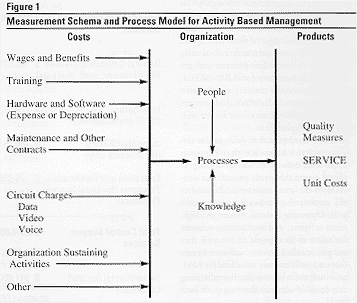
The hardware that
delivers the service and the hardware that supports those who deliver
the service are depreciated over a three-year period, and one-third
of the total expense is allocated to the services the hardware supports
each year. Operating systems, system management software, and applications
software are taken as an expense in the year they are purchased. Likewise,
software license fees and maintenance contracts for hardware and software
are distributed among the costs of services they support each year.
Where apposite,
charges for telephones and voice networks are allocated to particular
services. The costs of local area networks are distributed among the
services they support. Costs for the campus networks and for Internetworking,
on the other hand, are calculated on a per-packet basis and taken no
further. For example, an e-mail message "costs" less than $0.0017 per
message (almost 300 million messages were delivered on the Bloomington
campus in the last fiscal year), but that figure does not include Internet
and campus network costs (together less than $0.02 per thousand packets).
At the moment, the intercampus video network stands on its own, and
the ABC figures are given in a cost per hour for its operation (approximately
$100 per hour).
In general, the
direct costs for producing these services have been covered in the categories
discussed above. However, some costs span the entire organization, and
some costs are not included in the UITS budget but are borne by the
campus and the university. The former we have designated "Organization
Sustaining Activities," and in the choice of this term we follow general
ABC practice. Included among these activities are the costs of the senior
leadership of UITS -- the vice-president and the CIO, the associate
vice-presidents, and the deans -- plus the Human Resources Office and
the Business Office. The costs for these offices and their internal
services are distributed proportionally among the several external services.
If a service, such as e-mail, receives 10 percent of the total budget,
then it is allocated 10 percent of the total costs for the Organization
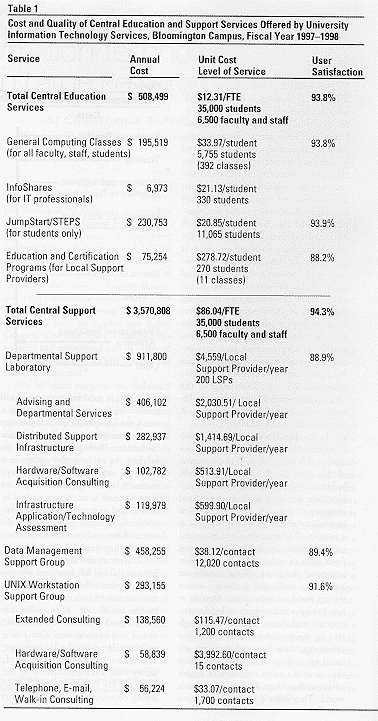
Sustaining Activities. The ABC figures in Table 1 are inclusive of these
sustaining costs.
These ABC figures
do not include the cost of facilities and utilities. IU does not bill
UITS for the buildings it occupies, the maintenance of these buildings
and their grounds, and the cost of electricity, heat, and chilled water.
If the ABC figures given here are compared with ABC figures for private-sector
companies (few of which offer public benchmarks), then 13 percent must
be added to the UITS costs. This percentage is not arbitrary but has
been derived from an IT industry average for facilities and utilities
costs.
Measures of cost
and quality for central IT support on the Bloomington campus can be
apportioned among three major areas: (a) education and (b) support for
those who provide support for departments, institutes, and schools;
(a) education and (b) support to assist users in supporting themselves;
and a General Support Center, which serves as a foundation for the first
two elements. This trio is the foundation for the "Leveraged Support
Model" developed by IU.8
The costs for these
services can be presented in a manner that is consistent with traditional
accounting practice but that is generally useless for strategic or operational
management. For example, in the last fiscal year, UITS allocated a bit
more than $500,000 for education and $3.5 million for support on the
Bloomington campus. Put another way, UITS spent approximately $12 per
capita for education and $86 per capita for support (Table 1). These
aggregate and per capita amounts describe neither what services were
produced nor what their quality might have been. They are fit neither
for assessment nor accountability by those who ultimately paid these
bills: the citizens of Indiana and the students and their parents, who
paid through tuition and taxes. The changes we advocate focus on services
rather than technology and on measures of the cost, quality, and value
of these services to our scholarly community.
The customer base
for IT services on the Bloomington campus includes 35,000 FTE students
and 6,500 FTE faculty and staff. The number of individuals, rather than
FTEs, is greater than 48,000. Of this total, 99 percent use computers
and network services routinely, and 77 percent have computers in their
place of residence. Although entering undergraduate students are not
required to own a computer (campus Student Technology Centers have more
than 1,400 machines, most of which are available around the clock),
almost all will have to use e-mail and the WWW in their first term.
The STEPS classes offered by UITS are designed to introduce students
to the major applications -- e-mail, word-processing, spreadsheets --
that they will be required to use as part of their curriculum. These
courses, which last between ninety minutes and three hours, are offered
either in UITS facilities or, at the request of the instructor, as a
part of the regular academic course. For the last several years there
have been more than 10,000 separate registrations for these courses
each year. These courses are very cost-effective (about $21.00 per student)
and are highly rated by those who take them (with a satisfaction score
of almost 94 percent). They are doubly effective because they introduce
the students to the UITS Knowledge Base -- a collection of more than
10,000 answers, solutions, and links to common questions and problems
that can be searched in terms of key words via a very friendly Web front-end
-- so that they can further help themselves. Similar courses are offered
to the campus community as a whole, with similar cost and quality measures
(Table 1). Seminars on current topics in IT are offered for the campus
professional computing community, and they too cost about $20.00 per
participant.
The most effective
components of the education program are the courses designed for Local
Support Providers (LSPs). Now some 200 strong on the Bloomington campus,
these support personnel, who are paid by the units they serve, work
with faculty, staff, and students in departments, centers, and schools.
Courses in Intel (Windows and NT), Apple (MacOS), and UNIX system administration
and hardware configuration are given on a regular basis. These rigorous
courses last one week and, on the participant's successful completion
of the exam at the end of the course, provide certification of knowledge
in platform and operating system fundamentals. Although the UNIX and
MacOS courses are locally developed and their certifications have local
significance, the Microsoft courses are part of the Microsoft Certified
Support Engineer (MCSE) program and their certification is recognized
internationally. Most departments now require such certification before
they will hire a local support person. The average cost for this training
is $278 per student (UNIX costs a bit more, MacOS a bit less), and 88
percent of those who have taken a course rate it as adequate or better.
In turn, users' satisfaction with their LSPs is above 85 percent. The
support of LSPs by the central IT organization goes far beyond this
training and greatly amplifies the effectiveness of both local and central
IT support personnel.
In addition to
LSP training, a bit more than $900,000 per year is dedicated to LSP
support. The Departmental Support Laboratory offers expert advice, maintains
servers with common software, operating system, and system management
tools, conducts software and hardware evaluations, and performs technology
audits and IT plans for departments and schools. This figure comes to
approximately $4,600 per LSP and $3,800 per department, center, institute,
or school. These services are all designed to make the LSPs more effective
and to reduce support costs overall. Moreover, the collective choice
of recommended computers, peripherals, and applications covered by site
licenses goes a long way to reduce support and training costs.
There are five
specialized user-support organizations within UITS. Some are partnerships
with other units, in which case the ABCs are those incurred by UITS
activities, not those costs borne by the partners. Other support services
are wholly within the UITS organization.
- The Data Management
Support Group offers its services to faculty, staff, and research
students. Services include the support of local data managers who
employ such data-management tools as large relational databases (e.g.,
Sybase and Oracle), midlevel and desktop database engines (e.g., Microsoft
SQL Server, Access), and desktop data-extraction tools (e.g., spreadsheets,
client/server development, Web applications). This group supports
a growing number of research and pedagogical users of Geographic Information
Systems (GIS) and is the home of second-level support for a variety
of Web-authoring tools (e.g., FrontPage). Although the group's primary
function is support of the users of these tools, it also administers
and supports the central pedagogical database environment, used by
faculty in teaching, and the use of these tools and databases by students
across the disciplines. This work with the wider IU community costs
about $38 per contact, and 89 percent of the group's customers are
satisfied with the service they receive.
- The UNIX Workstation
Support Group provides specialized consulting with UITS and offers
its expertise to the wider campus community. In this latter role it
offers front-line consulting on the Bloomington campus. The cost for
this service is about $33 per contact. Extended consulting costs over
$100 per contact, and technical evaluation of hardware and applications
costs almost $4,000 per project and report. The group's WWW server,
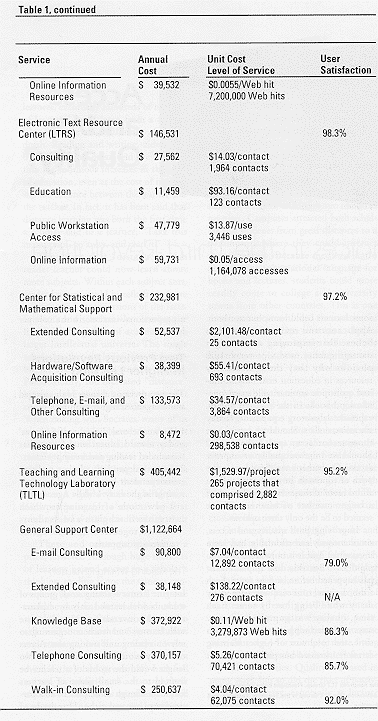
which has UNIX support material, was accessed more than 7 million
times in 1998 at a cost of $0.0055 per Web hit. More than 91 percent
of those who use the UNIX Workstation Support Group are satisfied
with the service they receive.
- The Electronic
Text Resource Center (LTRS), a partnership with the IU Libraries,
offers applications and operating system support as well as specialized
hardware for humanities computing. Short-term consulting costs approximately
$14 per contact; classes cost $93 per student; use of the center's
hardware and applications costs nearly $14 per session; use of its
collections of texts, bibliographies, and multimedia materials, which
are available over the WWW, costs about $0.05 per use. Of those who
used LTRS last year, 98 percent rated it good or better.
- The Center for
Statistical and Mathematical Support, a partnership among the Graduate
School, the Department of Mathematics, and UITS, offers general consulting
on statistical and mathematical software and maintains the site licenses
for software such as SPSS, Mathematica, and SYSSTAT. It does a brisk
business in short-term consulting and works with faculty and graduate
students on the design of courses and on the use of statistics and
mathematical applications in research and dissertations. The short-term
consulting costs approximately $35 per session; the work on courses
and dissertations costs a bit more than $2,000 per project. Slightly
more than 97 percent of those who use this center are satisfied with
its services.
- The Teaching
and Learning Technology Laboratory (TLTL), a partnership with the
Dean of the Faculties Office on the Bloomington Campus, works with
faculty and graduate students as they create and code course material
for delivery via the WWW and in the classroom. An IT specialist, a
specialist in teaching and learning, and a faculty member work together
to create these multimedia course materials. During the last fiscal
year, TLTL participated in 265 projects at a cost of more that $1,500
per project. More than 95 percent of those who use TLTL are satisfied
with the service they receive.
The five support
services discussed above are all "handcrafted." Each project is unique;
each problem is recondite. Each UNIX problem, by the time the user is
ready to ask for help (because UNIX users are a hearty and independent
lot), is truly vexing. Each database question is complex because the
consultant has to understand not only the application but the database
schema as well. Each use of a new collection of texts and concordance
programs is demanding and requires expert assistance. Thus the costs
for solutions to even the most casual problem and for answers to even
the smallest questions are on the order of tens of dollars. IT support
costs for large projects in these areas run into the thousands of dollars.
Whereas the specialized
support centers deal with a few people each week, the General Support
Center serves hundreds of people each day, and its Knowledge Base (http://kb.indiana.edu/)
offers online help to hundreds of people each hour. Whereas the specialized
support centers employ a few IT professionals and a few part-time hourly
student assistants, the General Support Center employs thirteen full-time
professionals and up to thirty part-time professionals and students.
Given limited funds, the General Support Center is open only from 8
a.m.to 5 p.m. Monday through Friday. A request for support for additional
evening and weekend hours has been made and has some chance of being
approved in fiscal year 2000.
Each year individuals
initiate approximately 150,000 contacts with the General Support Center.
Some walk into the center, and others telephone or send e-mail. The
IT Knowledge Base received more than 3 million "hits" last year. In
terms of costs (Table 1), the Knowledge Base is "dirt cheap." If one
figures four clicks to an answer, then problems can be solved for approximately
$0.44. Walk-in consulting costs $4.04 per contact, telephone contact
costs $5.26 per call, and e-mail problems cost $7.04 per contact. The
difference in cost between telephone and walk-in contacts is subsumed,
in large measure, by the cost of the telephone. The root cause in the
greater cost of e-mail consulting is the number of back-and-forth exchanges
required to get a clear statement of the problem and a succinct solution
for it.
The yearly quality
measures for these four general support services are likewise instructive.
The highest level of user satisfaction, 92 percent, goes to the walk-in
service. Telephone consulting and the Knowledge Base produce approximately
86 percent satisfied customers. Consulting via e-mail satisfies only
79 percent of the customers. Because the same group of individuals with
the same training and knowledge offer all these services, face-to-face
communication with the walk-in customers is likely the cause of the
additional 6 percent in customer satisfaction. When e-mail is taken
as the benchmark, there is a 13 percent rise in satisfaction; this is
a result of both the medium and the messenger placing the customer at
greater social distance.
The current manager
of the General Support Center, Sue Workman, has instituted a daily quality
check to give real-time rather than once-a-year data. Each day thirty-five
customers who ask the support center for help are chosen randomly and
sent an e-mail that asks the following three questions: Did you get
a solution to your problem? Did you receive this solution in a timely
manner? Were you treated courteously? The response rate to this quality
check is close to 100 percent. For the last question, that of courteous
treatment, almost 100 percent answer "Yes." The question of a timely
response gets approximately 97 percent "Yes" answers. The question about
solutions averages near 90 percent "Yes," but the e-mail service receives
only a 79 percent "Yes" response regarding solutions. The Knowledge
Base also has a quality check. At the end of a session the user is asked,
"Did you get an answer to your question?" Of 8 million "hits" and perhaps
2 million customers who used this service in the last twenty-four months,
of those who took the time to answer the question, fewer than 3,300
answered "No." Each "No" answer is reviewed by General Support Center
staff and leadership to discover if changes in the Knowledge Base are
required by adding new topics to those covered already, by increasing
the amount and accuracy of information available, or by refining the
method by which information is delivered to the user.
These cost and
quality data form the foundation on which UITS engineers and manages
its organization and services. These concepts of service, quality, and
value are at the center of the UITS culture. Distributed support and
LSPs offer users familiar, friendly, and knowledgeable support services
backed up by a fast path to the specialists and specialized software
inside UITS. Although costly, the custom-made support for faculty and
research students creates value far in excess of the costs. The general
measures for the perceived quality of these services run from approximately
85 percent satisfied users to over 99 percent satisfaction. Though we
would like all quality measurements to be in the mid-90s (actually we
would like all customers to be 100 percent satisfied), we would be remiss
if we did not stress that these measures are almost 20 percentage points
higher than the average given, for similar services, in national satisfaction
surveys. Although far from personal, the Knowledge Base, which is available
twenty-four hours per day, 365 days per year, is nonetheless effective
and generally user-friendly. It has received a number of national awards
for excellence in online IT support.9 Clearly, e-mail is
neither a friendly nor an effective way to deliver IT support. The center
is trying to redirect those users seeking support from e-mail either
to access the Knowledge Base -- which offers the option of e-mailing
any question not answered -- or to make a telephone call to the General
Support Center to speak directly with a consultant. E-mail use is a
holdover from the days of inefficient response to telephone inquiries
and of an abortive short-term strategy that sought to downsize the General
Support Center in the late 1980s. It also reflects both the reliance
of the user population on e-mail for communication and the lack of extended
evening hours of telephone support. Though we want to eliminate e-mail
support, rather than doing so by dictate or by use of negative incentives,
we will do so by making the Web-based Knowledge Base even better than
it is today and by expanding the hours of telephone support as we fold
in support of students in residence facilities within the larger UITS
support operation.
This mix of support
services and the partnerships forged with departments and schools do
add value to the work of students, faculty, and staff at IU. Without
the focus on users helping themselves through education and through
resources like the Knowledge Base, however, IU could not afford to offer
timely and knowledgeable IT support. In the past fifteen years, the
number of computer users on the Bloomington campus has grown from a
few hundred to more than 50,000 and the number of computers from a few
to more than 50,000 as well. Over the same time, the computing support
budget, when adjusted for inflation, has remained more or less flat.
The cost and quality
measures presented here can degenerate into mere "bean-counting" and
serve as the means for invidious comparisons. Conversely, they can become
central empirical elements in the adoption of the Balanced Scorecard
and ABM. If the latter occurs, then they are measures of progress toward
the strategic goals of the IT organization. They provide feedback and
link individuals, processes, and services with the goals and the culture
of the organization. In brief, they are part of the text for strategiclearning
and management.
First, the foundation
of all IT services is the intellectual capital that the staff brings
to work each day (and that leaves with them when the staff goes home,
usually late in the evening). Thus the learning and growth of the skills
and knowledge of the staff is fundamental. Second, the ways that this
knowledge is combined with networks, hardware, and applications to produce
IT services is highly dependent on the ways that processes are organized
and on the culture of the organization. What is valued and attended
to internally is vitally important to what is offered externally. If
processes are tracked for their ability to create value, their ability
to design quality into their operations, and their capacity to respond
to novel demands, then they will offer services that are fit for use
and free from defect. Third, customers are always the best judge of
the quality and value of the IT services they are offered. It is important
to measure their satisfaction with current IT services and to use their
desires and visions as catalysts for the design, development, and deployment
of new services. Finally, we all work with limited resources and ever-increasing
demands for IT services. Knowledge of the real costs for each IT service
-- using the financial measures that are at the core of ABM -- makes
the choices among services rational and the improvement of services
mandatory and measurable. Recall the words spoken by the character of
John Glenn in the movie The Right Stuff when he threatened to
go to the media if changes were not made in the Mercury capsule so that
the astronauts would be pilots rather than passengers: "No bucks --
no Buck Rogers." University and college IT organizations are in the
same position: No resources -- no cycles, storage, and bandwidth. The
measures we use to assess the services we offer, and the ways these
facts are presented to our communities of customers and other stakeholders,
are crucial to the future of IT organizations in higher education.
Endnotes
1. Paul A. Strassmann,
The Squandered Computer: Evaluating the Business Alignment of Information
Technologies (New Canaan, Conn.: Information Economics Press, 1997).
2. Emily Paulsen,
"What Does Support Really Cost?" Support Management (May/June
1997), 14 - 22, 113.
3. Robert S. Kaplan
and David P. Norton, The Balanced Scorecard: Translating Strategy
into Action (Boston: Harvard Business School Press, 1996).
4. Robert S. Kaplan
and Robin Cooper, Cost and Effect: Using Integrated Cost Systems
to Drive Profitability and Performance (Boston: Harvard Business
School Press, 1998).
5. Most recently,
in sections 2.1 and 2.2 of Juran's Quality Handbook ,5th ed.
(New York: McGraw Hill, 1999).
6. A full public
accounting can be found at http://www.indiana.edu/~uits/business/
for the ABC and at http://www.indiana.edu/~uitssur/
survey/index.html for the quality survey.
7. John K. Shank
and Vijay Govindarajan, Strategic Cost Management: The New Tool for
Competitive Advantage (New York: Free Press, 1993); Jeremy Hope
and Tony Hope, Competing in the Third Wave: The Ten Key Management
Issues of the Information Age (Boston: Harvard Business School Press,
1997).
8. This trio is
fully described in Brian D. Voss, "Coalition for Networked Information
-- Institution-Wide Information Strategies Project 1997 - 98: The Leveraged
Support Model," paper delivered at the CNI Spring Conference, April
1998, Washington, D.C. (http://www.indiana.edu/~ucs/tlit/cni/a.html).
For more information, see also Christopher Spalding Peebles, Laurie
G. Antolovic, Norma B. Holland, Karen Hoeve Adams, Debby Allmayer, and
Phyllis H. Davidson, "Modeling and Managing the Cost and Quality of
Information Technology Services at Indiana University: A Case Study,"
in Richard N. Katz and Julia A. Rudy, eds., Information Technology
in Higher Education: Assessing Its Impact and Planning for the Future
(San Francisco: Jossey-Bass Publishers, 1999).
9. Among other
awards, the Knowledge Base was recognized by PC World Magazine as
among those resources offering the "best free stuff online," was named
"Distinguished" in the International Online Competition hosted by the
Society for Technical Communication, was judged one of the top technical
support sites by Windows Magazine, and was designated a "Cool
Site" in the Netscape Open Directory Project Web site.