This paper is the intellectual property of the author(s). It was presented at CAUSE98, an EDUCAUSE conference, and is part of that conference's online proceedings. See http://www.educause.edu/copyright.html for additional copyright information.
Practical Process Engineering for Higher Education
Dr. Kristin Bruno, Dean, Information and Technology Services
Glendale Community College
Glendale, California
Dr. Barbara Vrana, Chief Information Officer
Oklahoma City Community College
Oklahoma City, Oklahoma
Linda Welz, Project Manager, Process Engineering Program
Glendale Community College
Glendale, California
Abstract
The Glendale Community College (GCC) and Oklahoma City Community College (OCC) process engineering programs are working to increase the efficiency of college processes, thereby reducing the overhead cost per student, while providing higher quality services. GCC�s project, PEP, applies the discipline of systems engineering to processes creating a highly structured methodology; employs a proactive change management program; uses existing college resources; and integrates the program into planning and management activities. OCC�s Project VIRGIL, applies a different strategy, but also utilizes a highly-structured design model. This model is influenced by cross-functional teams with limited outside resources to support the process engineering endeavors.
Introduction
Postsecondary education is now facing numerous challenges. Many external sources are placing pressures on colleges and universities. Enrollments are rising at the same time that colleges are experiencing increased competition for limited dollars. This is especially true for community colleges with new programs such as Welfare to Work. Also, the Chronicle of Higher Education (1991) noted an increasing number of well prepared students that plan to contain educational cost by attending a community college and then transferring to a four year institution. Further, student expectations of community colleges are rising. Students have become more discriminating consumers who expect more value and services from colleges. An increased emphasis on technology is also placing financial pressures on higher education. Adding to these financial pressures is the fact that higher education processes are often labor intensive. Heterick (1993) estimated that 80% or more of the operations budget is allocated to personnel services.
Reengineering emerged as a discipline in the 1980's to meet similar challenges in industry. In their book, Reengineering the Corporation, Michael Hammer and James Champy (Hammer and Champy, 1993) proposed that business throw out the old notions of how it should be run, abandon organizational and operational principles and procedures currently in place, and create entirely new ones. Their formal definition for this new business model was "the fundamental rethinking and radical redesign of business processes to achieve dramatic improvements in critical, contemporary measures of performance, such as cost, quality, service, and speed." Others, for example Manganelli & Klein (1994), Carr & Johansson (1995), and Lowenthal (1994), joined the initiative by developing procedures and methods for applying reengineering and expanding the concepts based on hard earned experience.
Many postsecondary institutions have recently turned to reengineering as a strategy to meet their new challenges while containing costs (Penrod and Dolence, 1992). A quick survey through college and university web sites as well as recent literature results in a large list of institutions embarking on reengineering programs.
Both Glendale Community College (GCC) and Oklahoma City Community College (OCC) have undertaken reengineering projects, termed process engineering programs, enabling the colleges to serve more students within current space, time and staffing resources allocation by dramatically improving their processes. GCC�s project, the Process Engineering Program (PEP), applies the discipline of systems engineering to processes, thus creating a highly structured methodology; employs a proactive change management program; uses existing college resources; and integrates the program into planning and management activities. OCC�s Project VIRGIL utilizes a highly-structured design model, influenced by cross-functional teams. This paper describes the methods and tools of process engineering as applied to these educational institutions and discusses the lessons learned by both organizations. The following section outlines the process engineering methodology. An overview is then presented of the each college's program.
Process Engineering Methodology
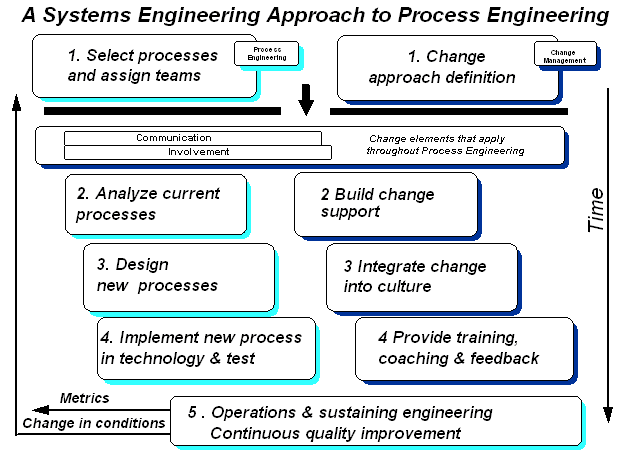
The process engineering methodology incorporates two parallel tracks essential for success, Process Engineering and Change Management, which run throughout the methodology. Change management includes building program sponsorship; actively addressing concerns about the change; enabling input from all parts of the organization; ensuring adequate communication and understanding of changes; and coordinating teams throughout the change process. Process engineering applies systems engineering to process design. This ensures well designed and implemented processes, as well as adequate documentation to allow for understanding and future modifications. Each process addressed by the program undergoes the systems engineering rigors of requirements development, high level and detailed process design, structured implementation, testing, piloting, and structured rollout.
A diagram of the process engineering methodology is presented in Appendix I. Step 1 for both tracks of the methodology is conducted once for a program. This step builds the overarching guidelines for process engineering and change management. The remainder of the tasks (Steps 2 -5) outlined in this methodology are conducted for each process engineered. This distinction is indicated in the diagram by a heavy horizontal line that separates Process Engineering and Change Management Steps 1 from the rest of the diagram. Immediately following this line is a Change Management task box. The tasks in this box are carried out in all the remaining stages and include communication planning and implementation and ensuring that employees are involved in all stages of process engineering.
Process Design Teams (team roles are presented in Appendix II), composed of the people who currently do the process work and customers who use the process, apply the process engineering methodology to redesign assigned processes (Process Steps 2 and 3). Implementation Teams, comprised of members from the Design teams and technology experts, then develop the detailed process architecture and plans to carry out the implementation of the newly designed process (Process Step 4 and Step 5). The task of the process engineer is to lead these teams of varied disciplines from diverse organizations and fuse their efforts to meet a common goal. The program coordinates and works with the departments of Information and Technology Services and Human Resources throughout the program.
Step 1
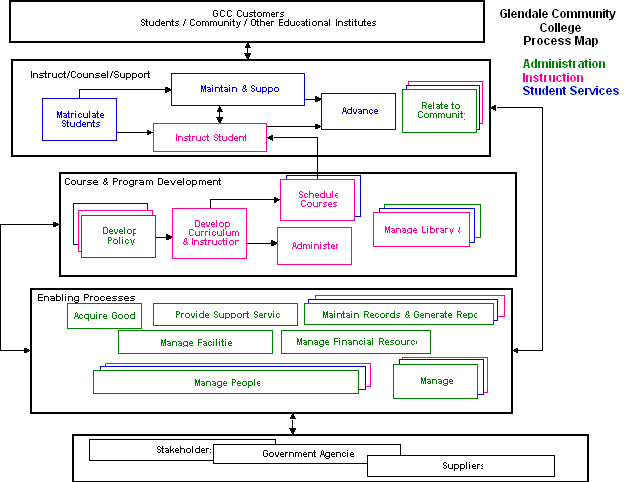
In the Process Engineering Track, the first task is to define the parameters for the program by describing the environment, constraints and resources. A process map is drawn which describes the organization and the relationship between major processes (see Glendale College Process Map, Appendix III). This map defines the work of the college in relation to its customers and stakeholders and illustrates how the processes of the college integrate to provide an overall process picture. From this map, processes can be selected for process engineering based on criteria relevant to the college. It is recommended that 3 - 6 processes be worked on at a time. Too many processes would drain resources of organization, while working on one process at a time requires too much rework to retrofit previously worked processes with each new one engineered.
A process owner is designated for each process to be reengineered. The process owner is the person who manages the current process and will manage the new process once in place. The responsibilities of the process owner are defined in Appendix II. The Process Owner works with the process engineering program manager to set the initial scope for the process. The Process Owner also assists in the selection of the design teams for that process. The last task in this initial process engineering step is to train the newly formed Design Team in the process engineering methodology.
In Step 1 for the Change Management track, the first task is to build and communicate a compelling case for change. Associated with this is the need to build sponsorship beginning with top management. An effort as large and far reaching as process engineering cannot be conducted as a "grass roots" program, and top management must embrace and support the program and the need for change. In parallel to this task, the environment is assessed to develop a picture of the culture of the organization so that change can work with the culture rather than against it. The change environment assessment also indicates areas where resistance may surface, allowing the program to proactively address concerns and issues. Finally, the program develops a plan for change that can be applied throughout each process engineering task.
Step 2
The second step of the Process Engineering Track is the analysis of the current process. The focus of this step is the creation of a GAP Table (see example in Appendix IV) which defines the requirements for the new process design. This table documents customer performance objectives and issues, current process measures, and best practice measures. To gather the data for the GAP Table, the design teams have three tasks: 1) create a process flow chart to capture the current process and define current process measures; 2) conduct focus groups to document customer performance objectives and issues; and 3) perform best practices benchmarking to identify best practices measures. The GAP, the difference between what is currently done (current process measures) and what is possible (best practice measure), can be calculated. The job of the design team is to design a process which reduces this GAP as much as possible, while meeting the customer performance objectives and staying with the realities of the current culture and environment of the organization.
Design teams use process flow charts to capture the current process and define current process measures. Without understanding the current process there is a good chance of inadvertently replicating unwanted aspects of the old process in the new design. Also, without documenting the current process, there is no way to measure the extent of process improvement. Creating the current process flow also enables the design team to verify that the scope of the process has been correctly defined by the Process Owner. If the scope does not seem appropriate, either too small to include all process steps or so large that it incorporates multiple processes, then the design team works with the Process Owner to redefine scope.
Once the current process is understood, design teams conduct best practices benchmarking to learn how other organizations implement the same or a similar process. Benchmarking can be accomplished though literature research; via email; by teleconferencing; or by site visits.
Focus groups, conducted to gather customer input, are moderated meetings with minimal structure established by using open-ended questions. In essence, a focus group is similar to interviewing an individual to collect information. The design teams have to identify the customer groups and conduct the meetings. The rules for focus group meetings used at GCC are presented in Appendix IV. The format of the focus groups allows, the teams to gather both a large volume of ideas from the customers as well as the priorities expressed by the customers.
Change Management Step 2 emphasizes understanding the population that will be required to change with the new process. The tasks for this step are integrated into the same activities carried out for the Process Engineering.
In creating the current process flow diagrams, the design teams draw not only on the knowledge of the design team members, but also incorporate the expertise of other employees that utilize the process. This is done by having small groups review the process diagrams and provide updates and corrections. These meetings serve a change management function in that they provide an opportunity for employee involvement beyond the design team. The meetings are also an opportunity to look for employees who support change and can become change agents, helping to implement the new process in their home organizations.
The focus groups present the design team with the opportunity to understand the process customers. Hearing the concerns and needs directly from the customers, listening to their stories and anecdotes, deepens the understanding of the design team. Then during the design of the new process, the Design Team can proactively address the customer needs.
Step 3
In Stage 3 the focus of Process Engineering is the design of the new process.
With input from the GAP Analysis Table completed in Step 2, the requirements of the to-be process can be completed. The Design Teams create new process flow diagrams showing not only the process steps, but also input, outputs, technologies, and applicable policies. If necessary, new organizational structures and job tasks are defined at this time with the help of the Human Resources Organization.
This is the point where tradeoffs are made between process and technology. In the design, technology is an enabler not a driver. The design team does not necessarily implement a new technology just because it exists, but must choose to implement new technology ideas and concepts because they make sense given the culture of the organization.
When the initial new process design is developed, the Design Team reviews the design. Two tools are used for this task: the Implications Wheel and the Opportunity Tradeoff Table. The Implications Wheel (Barker, 1994) is a tool that provides a structured method for a group to brain-storm possible positive and negative implications resulting from the introduction of the new process. The team can use this knowledge to modify the new design if desired to either avoid negative implications or enhance positive ones. This information can also be applied in the planning strategy for the deployment of the new process design.
The Opportunity Tradeoff Table (Manganelli & Klein, 1994) assists the design team in identifying benefits and risks of the new process design. Again, the team has the option to modify the process to avoid risks and enhance benefits. This table is shown in Appendix IV.
During this phase, process alternatives must be explored based on culture. Options that can be developed within the existing culture, the behaviors, values and "unwritten" rules of the organization, have a much higher probability of being successful than those that do not. If the choice is made (for good processing reasons) to select an alternative that does go counter to the current culture, then the deployment planning must take this into consideration.
As with Step 2, Change Management tasks for Step 3 are integrated into the same activities carried out for the Process Engineering. Working to build cultural fit into the process design is one main task. Another is to incorporate performance measurement metrics for both process and jobs into the new design. A college's Institutional Research (IR) group should assist in defining these measures. Planning for training should begin in this phase. Planning should address both technology as well as process training. A very successful format for process training is a train the trainer program. One individual from each work group is thoroughly trained in the work processes. Those individuals then return to their home organizations, and train co-workers on the new process.
Step 4
At Step 4 the Design Team transitions to an Implementation Team. The major steps of design are complete and the work now is to implement the design. This work follows standard software implementation practices such as those defined by the Software Engineering Institute of Carneige Mellon University (Paulk et. al., 1993).
During implementation, technology may need to be customized to meet process needs. Prototyping process and technology together can assist in this effort. Along with technology implementation and testing, any new management structure and job definitions need to be implemented at this time.
Once tested the new process should be piloted to validate the design in a limited-scale but real world environment. Piloting consists of deploying the new process in a small part of the organization for an extended period, several weeks to several months. Piloting not only facilitates testing that cannot be done in simulation, but it also builds organizational commitment and support, and experience for full scale deployment.
The key Change Management task in Step 4 is the deployment of training for all employees on new process and technology. Process and employee performance measures are also implemented. In addition to the formal training, coaching is given to employees on how well they are doing based on performance measures.
Step 5
After deployment, the process enters operations and sustaining maintenance. At this point, the process engineering effort transitions to a continuous process improvement (CQI) program. The role of process management and monitoring can now be transferred to the college's Institutional Research group. IR monitors process metrics to see that the process stays within acceptable limits. If metrics indicate that the process is beginning to function outside these limits, a CQI team can be formed by IR to address the problem.
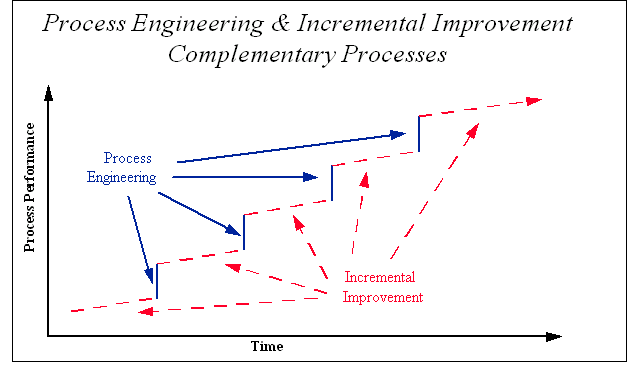
IR can also watch for a process engineering trigger. If a drastic change in external conditions occurs such as changes in competition, funding profiles, customer base or needs, the metrics may move outside of acceptable ranges. Under these conditions, a CQI program may not able to cope with the magnitude of the change. At this point, a new process engineering team may be initiated. Process engineering and CQI thus become complimentary tasks, each addressing a process needed for the organization (Appendix V).
Glendale Community College Process Engineering Program: PEP
The administration at Glendale Community College (GCC) has recognized that its work processes must change for the College to remain financially competitive and student service oriented. Thus, the Process Engineering Program, PEP, was initiated in June of 1997. The primary goal of the program is to reengineer the college processes so that the work of the college can be performed more efficiently, thereby reducing the overhead cost per student, while providing higher quality, more effective services for more students.
PEP began by defining the College in terms of processes. The executive body of the College, the Administrative Cabinet, created a Process Map (Appendix III). The Administrative cabinet then chose the initial processes to be reengineered.
Five processes were chosen for the initial reengineering effort: 1 ) general ledger, to put in place the centerpiece to all financial processes; 2) technology support, to assist and enable the transition to a new enterprisewide system; 3) technology development, to provide the infrastructure for the implementation and deployment of the enabling technology; 4) resources scheduling, to replace the current scheduling processes that are paper and work force burdened; and 5) student recruitment, to establish a comprehensive and coordinated effort for bringing students to the college. These design teams began work during the spring semester of 1998 following the methodology outlined above. This fall, two new design teams, financial aid and acquisition began work. All of the teams are still working in Step 2 of the methodology.
From its inception, PEP has had the full support of the college leadership including the superintendent/president, and the three college vice presidents of instruction, finance and college services. Both the superintendent/president and the vice president for instruction spoke at the first PEP Town Hall meeting. As the initial change management task, meetings were held with all deans, associate deans and division chairs to introduce the program. PEP also coordinated with the academic senate, the faculty guild and the classified staff union. Keeping the leadership of these organizational informed builds support for the program.
As with many institutions, working space is a scarce resource at Glendale College. PEP was fortunate in having a large meeting space dedicated for its use. This facilitates planning for all program tasks including design team meetings, working sessions, and change management meetings. It also establishes an identity for the program and, since space is limited, emphasizes the management support that the program enjoys.
The PEP design teams are composed of college staff and faculty. All of these individuals are serving on a design team as part of their normal jobs, and PEP activities have to be coordinated with other work tasks. Timing is therefore critical to enabling staff and faculty to participate in PEP. The program has adapted to the cycles of the academic year, reducing the design team work loads during the first weeks of the semester and finals weeks, while increasing efforts in the middle and between semesters. Despite the effort, it has been difficult for faculty to serve on design teams due to constraints of their teaching schedules. To overcome this problem and keep them involved in design work, faculty can participate in ad hoc meetings such as focus groups and design review meeting. Faculty may also be asked for design input through surveys and one time one-on-one meetings with design teams.
All of the design teams follow the steps of the process engineering methodology outlined above. However, since each team has its own unique characteristics, a key to the success of each team is the ability to adapt tasks to the composition of the team. Some teams require a very structured work environment, while others can be productive with less formality. For this to happen each team depends on skilled facilitation and strong team leadership. The team leadership is provided by a team member chosen by the process owner with input from the PEP program manager. Team facilitation comes from the process engineer who assists the team leader in planning and organizing the team meetings, and facilitates team meetings as required.
The first task of each design team, creating process flow diagrams, has been educational for all team members. Capturing on paper the extent and volume of work, and being able to see the complexity of the process provides an "eye-opening" experience. Each team member feels validated as an essential member of the college. The comment often heard is, "Can I show this to my managers so they understand how hard I work?" Putting the diagram down on paper also makes the process more objective. The teams are able to review the work effort as a process, seeing the delays and redundancies objectively and not associating the problems with a person or work group. This objectivity enables the design teams to address the process problems and facilitates redesign.
Continuing to build this objectivity and insight for the entire campus community is a major change management task for PEP. All of the PEP activities provide an opportunity to educate the campus on process engineering and its enabling technology. In the seven design teams currently working at GCC, there are now 56 design team members. Close to 200 members of the campus community including faculty, staff and students, have attended design team focus groups. More than 50 individuals have participated in small group discussion meetings held at lunch time and termed "Brown Bag Lunches". Finally, over 200 attended two town hall meetings which defined the project and reported on the work of the design teams. Each of these experiences provides new information, and an opportunity to ask questions and builds further program support.
Another change management task that PEP has facilitated is the expansion and coordination of staff and faculty training. Since training is an essential component of a process engineering program, PEP initiated coordination meetings between the existing Staff Development office, GCC’s Professional Development Center (PDC), and the Information and Technology Services (ITS) organization. Training was being conducted by all three of these organizations, but had not previously been coordinated. Bringing the three groups together enables them to coordinate and support each other’s training efforts. For example, Staff Development and the PDC have developed a 20 week basic technology training program for staff members. Staff Development and ITS now coordinate formal classroom training with on-the-job training.
As a continuation of the process effort, PEP has supported the initiation of a Continuous Quality Improvement Program at Glendale. A small grant was awarded from the California Community College Chancellor’s Office to support CQI training. As part of this training, two CQI teams are working on tasks for student equity. The goal of these CQI teams is not only to improve student outcomes, but also to institutionalize CQI skills and methods. The impact for PEP is that a CQI methodology and mind set will be in place when the current process engineering program is complete.
GCC’s IR group is also essential to the continuation of process work at the college after the completion of PEP. PEP has therefore been working with IR since the beginning of the process engineering program. IR has helped with the focus groups. A member from IR is participating on each of the CQI teams. As each design team begins to finalize the redesign and begin implementation, IR will work with the teams to ensure that the correct process measures are in place and that data can be easily collected and analyzed.
Oklahoma City Community College - Project VIRGIL
Oklahoma City Community College (OCC) has had a long history of being innovative in its approach to education. Student-centeredness is and continues to be one of the core values of the institution. Organizational change happens frequently, but deep-rooted change is difficult for an institution like Oklahoma City Community College. Using the opportunity to implement a new administrative information system as a catalyst, the President and the Board of Regents committed their support and resources to improving the lives of those in the college community. Thus, Project VIRGIL was born.
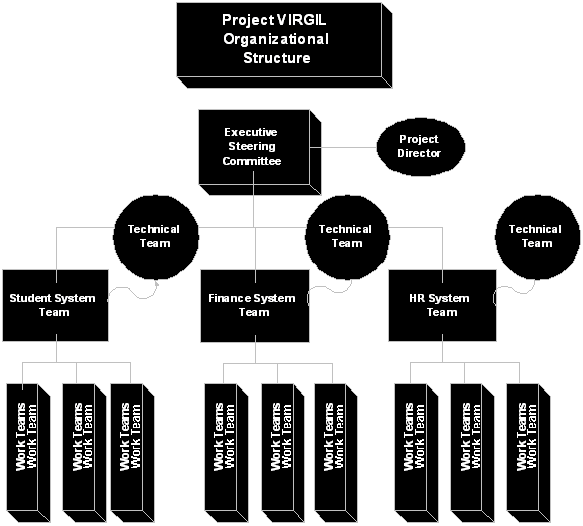
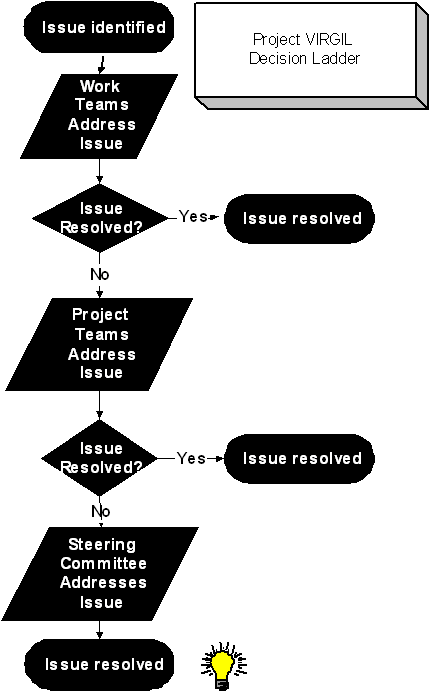
A methodology was developed that incorporated both process engineering and change management. Because the President of the college recognized the need for a new approach, his leadership enabled the change process to occur more smoothly. A cross-functional team approach to manage change was established. Appendix VI illustrates the organizational structure utilized for Project VIRGIL. While the structure appears to be hierarchical, recommendations for change come from the teams. The decision ladder can be found in Appendix VII.
It is important to note that great attention was paid to the development of the guiding coalition for the project. A group known as the "Executive Steering Committee" comprised of the executive leadership of the college and the team leaders of each working team were formed to make the hard decisions which could not be made at an operational level. Subsequently teams were carefully selected to ensure that there was a strong, compatible yet diverse team with critical knowledge of the organization. Some of the team members selected had day-to-day experience with the processes they were reviewing, while others had little or no experience, giving good balance to the teams.
As an overlay to the organizational structure, Oklahoma City Community College utilized the process engineering methodology discussed above to: analyze current processes, design new processes, develop new processes in technology, and operationalize those newly-designed processes.
To begin the actual work of change, the college first needed information about the current processes. Often institutions utilize consultants in this phase of the process called "knowledge acquisition." Oklahoma City Community College selected five individuals to be trained in the art of knowledge acquisition. These five served to facilitate and document current processes. This task required individuals to be reassigned approximately one-half of their time to assist. Training sessions with outside experts in knowledge acquisition and domain analysis were held prior to beginning the venture.
To ensure that current and correct information was gathered, interviews were held with individuals who actually perform the work processes. In addition, interviews with those who utilize services were also part of the information gathered. Documents were compiled and validated, and then sent to the cross-functional teams to begin process redesign. Cross-functional teams or "work teams" were utilized to give a new perspective, while maintaining the intrinsic knowledge individuals in the area have about the current process. The teams took the documents which contained not only the current process, but suggestions and comments related to barriers, and utilized this information to perfect a design.
Much healthy contention occurred during the design phase. Individuals were pressed to look beyond the current constraints toward more open, accessible processes. The team leader’s role was critical in determining the degree to which change was realized. When a team reached a disagreement point that it could not overcome, the issue was immediately moved to the Executive Steering Committee. Once the teams had finalized the new processes, the recommendations for change moved through the decision ladder for institutionalization. Currently, Oklahoma City Community College is ready to integrate the new processes to the technology and begin testing.
Appendix I - Process Engineering Methodology
Appendix II - Process Engineering Team Roles
Process Owner
Process Engineering Team
Team Leader
Appendix III - Glendale Community College Process Map
Appendix IV - Process Engineering Tools
GAP Analysis Table with Example
|
Customer Performances Objectives & Issues |
Current Process Measures |
Best Practices Measures |
"GAP" |
Performance Requirements |
|
Fast Turn Around |
30 days ± 6 days |
1 day |
29 days |
2 days |
|
Eliminate redundant data |
3 databases |
1 database |
2 databases |
1 databases |
|
One point of contact |
4 contact phone |
1 point of contact |
3 contact points |
1 contact point |
Focus Group Rules
Working in small groups, perform the following steps for each question:
1. Working individually, write down as many responses to the question as you can think of using large "post-it" notes. Write 1 idea per note.
2. When finishes writing, post all notes on the flip chart paper.
3. When everyone has posted all their notes, read through all the notes as a group. Place all notes with similar ideas together.
4. Within your group, discuss the ideas. Make sure everyone in the group understands each idea.
5. Vote for you top choices! Everyone votes. You will have 5 votes to use. You can spread the votes out over different ideas or put all five votes on one idea. You will be using "dots" to vote. Just place the dots on the idea you want to vote for.
6 . Repeat Step 1 - 5 for the remaining questions.
Design Opportunity Tradeoffs
|
Opportunity |
Change |
Difficulty |
Benefits |
Costs |
Support |
Risks |
|
What is possible - the breakthrough design concept
|
What is the change required to reach that new goal - the "Gap" |
What stands in the way of getting there - culturally, technology, resources |
What will be gained - what is the difference between what the old process provides and what the new process will offer |
What will it cost to get there - in terms of dollars, time, people |
What support do we have in place or what will be needed - people included |
What are the risks we will be taking |
Adapted from Manganelli and Klein (1994).
Appendix V - Process Engineering and Continuous Quality
Improvement as Complementary Processes
Appendix VI - Project VIRGIL Organizational Structure
Appendix VII - Project VIRGIL Decision Ladder
Appendix VIII - References
"Academic Leaders Predict Major Changes for Higher Education in Recession’s Wake," Chronicle of Higher Education, November 20, 1991, p.1.
Barker, Joel. 1994. The Implications Wheel Video Workshop, Facilitators Guide, Version 1.0. Infinity Limited, Inc.
Carr, David K., and Henry J. Johansson. 1995. Best Practices in Reengineering. McGraw-Hill, Inc., New York, New York.
Dolence, M. G. (1998, May). How emerging issues are shaping higher education’s future. Presentation at the 1998 Annual Forum of the Association for Institutional Research, Minneapolis, Minnesota.
Hammer, Michael, and James Champy. 1993. Reengineering the Corporation. Harper Collins Publishers, Inc., New York, New York.
Heterick, Robert C. Jr. 1993. "Reengineering and Teaching". In Reengineering Teaching and Learning in Higher Education: Sheltered Groves, Camelot, Windmills and Malls. Edited by Robert C. Heterick, Jr. CAUSE Professional Paper Series, #10. CAUSE, Boulder, Colorado.
Lowenthal, Jeffery N. 1994. Reengineering the Organization. ASCQ Quality Press, Milwaukee, Wisconsin.
Manganelli, Raymond L., and Mark M. Klein. 1994. The Reengineering Handbook. American Management Association, New York, New York.
Paulk, Mark C., Bill Curtis, Mary Beth Chrissis, and Charles V. Weber. 1993. Capability Maturity Model for Software, Version 1.1. Technical Report. CMU/SEI-93-TR-024. ESC-TR-93-177.
Penrod, James I., and Michael G. Dolence. 1992. "Reengineering: A Process for Transforming Higher Education". CAUSE Professional Paper Series, #9. CAUSE, Boulder, Colorado.