 [Previous] [Next]
 [Previous] [Next]
The resolution of these questions will define much of the scope of the project ahead and will also drive decisions about the roles and responsibilities that people will associate with the project.
One method of resolving these questions is to create a "vision" of the institution's future financial environment. The process of creating a vision is one in which the steering committee in a concentrated period (one to two days) assesses and organizes the information collected from the stakeholders and makes fundamental planning assumptions about the nature of the future academic focus, the envisioned institutional "business model," the institutional financial model, and the nature of the institution's future information and technology architectures.
The process of establishing a vision is an essential one, and one that is both difficult and exciting. Setting the context for discussion at some realistic time in the future (often five years) usually invokes people's creative instincts and reduces some of the territorial "politics" of the present day. The difficult aspect of this process in the higher education context is the typical lack of explicit institution-wide plans or visions for the core academic enterprise. Ideally, the development of sound financial systems that will serve the institution for a decade or more depends on the explicit linkage between an academic plan and vision, its envisioned business and financial model, and its envisioned information technology architecture. The relationship of elements of such an integrated vision can be described as a hierarchy, with the financial system and campuswide network forming essential elements of the base infrastructure (see Figure 2).
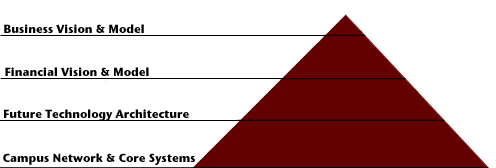
While the creation of such a vision is a consensus-building exercise, the nature, decentralized structure, and even mission of most colleges and universities make it unlikely that senior planners will "uncover," in any one place, explicit institution-wide academic visions and plans. (It is more likely that a future information technology architecture has been articulated in a vision or planning document, including strategies for the campus network and core systems.) The absence of clear guidance at "the top of the pyramid" weakens vision exercises, but neither dooms them to failure nor consigns the results to the realm of irrelevancy.
Steering committee members will need to resist the temptation to abandon or delay the vision-setting exercise owing to the lack of an articulated institutional vision. Instead, the committee should develop a surrogate (and loosely defined) vision of the institution's future by making some well-informed assumptions through discussion with the president or chancellor, and with key academic opinion leaders.
Each institution's vision process will be different and will yield very different results. This processing can be structured around answering a number of high-level questions in four areas: the academic enterprise, business and financial enterprise, cultural and organizational environment, and information technology enterprise and architecture. (See sidebar on vision process.)
In many cases, the vision process can benefit from the use of a professional facilitator. Most effective vision activities are supported by a moderate amount of staff data collection and analysis and, as suggested earlier, can be concluded in a brief, one-to-two-day retreat.
The key to success in creating a vision is not only to ask the right questions, but also to keep the dialogue at a very high level. There will be pressures to "dig deep," but this is not the time to do that. Keep in mind that the primary objective of the vision session is to establish the general shape and direction of the project. Teams appointed later in the project -- to undertake business process evaluations and a detailed information technology evaluation -- will test the assumptions and beliefs established in the strategic overview stage.
Having completed the vision exercise, the steering committee should develop a simple, concise vision statement to serve as the foundation for the financial systems project. For example, the University of California is developing its financial systems based in part on the following vision:
"In the year 2000, most or all of the University's internal and external commerce will take place electronically. Electronic funds transfers will help [the University] pay its employees and vendors, while electronic data interchange will simplify a host of financial processes (e.g., order entry) that link [the University] with our customers, trading partners, and regulatory agencies. The focus of University financial operations will be on the elimination of transactions that demand cash, checks, invoices, or other labor-intensive transactional intermediaries." 2A vision such as this has significant design implications and can galvanize interest and support across the institution in powerful (good and bad!) ways.
[Previous] [Next]