 [Previous] [Next]
 [Previous] [Next]
As part of this activity, the committee or an ad hoc subcommittee will want to do a quick scan of the commercial marketplace as well as "best practices" at peer institutions to identify viable solutions that could be evaluated in more depth later. (A note of caution here: the steering committee or subcommittee undertaking these external scans must be careful not to investigate these potential solutions to the extent of product demonstrations or campus visits; not only is the level of detail inappropriate in this strategic planning phase, it also opens the door to committing to a solution before requirements have been fully articulated by later project teams.)
The steering committee cannot, at this early juncture, make a final decision regarding whether the institution should buy, develop, or partner to develop a financial system solution. The committee can, however, simplify the downstream analysis and decision-making by providing an overall strategic direction in this regard to guide the work of the project teams and to be validated or revisited later in the selection process after business processes and the technology environment have been evaluated, requirements have been articulated, and potential external solutions have been carefully investigated.
At the steering committee level, the build-buy-partner decision is a function of: (1) the institution's culture, (2) initial scope (incrementalism versus fundamental change), (3) technical capabilities, and (4) project resources.
In many ways the cultural decision driver is the key one. Many institutions have a tradition of maintaining highly integrated, vendor-developed packages and have well-founded fears of developing core institutional applications on their own. Similarly, many institutions believe that their size, complexity, and uniqueness preclude the implementation of an off-the-shelf solution. These institutions often have large technology development organizations and take pride in a "built-here"culture.
Another important aspect of culture is the set of values and norms surrounding teamwork at the institution, the prevailing attitudes about vendors, and what might be called the "culture of deadlines." The management of strategic partnerships is not a trivial undertaking and the steering committee should evaluate the campus readiness to engage in significant partnership activity, including identifying the barriers to creating successful partnerships with industry and/or with other institutions.
The decision to engage in business process redesign also will affect the build-buy-partner decision. A mandate from the steering committee to engage in a major rethinking of core financial practices should be accompanied by the realistic expectation that it may take an in-house development or partnership with a vendor to build a system that can support uniquely redesigned business processes. Similarly, a decision to encourage fundamental change in combination with a strong bias for an off-the-shelf solution must be accompanied by a realistic understanding that with such an approach, the change in business processes will necessarily be driven by the commercial solution. For some institutions, adopting the business process changes mandated by a commercial process may enable a rapid leap forward in functionality, even though that functionality has not been designated by an institutional process reengineering effort. In either case, it will be important for the steering committee to communicate the chosen strategy to help manage project expectations.
One strategic model, developed by UC Berkeley economist Oliver Williamson (see Table 4 below), looks at two primary variables: the specificity of the product or solution sought and the frequency of its use.6 Using guidance such as this, an institution that is willing to adjust its operations to fit an existing software solution might be advised to use the commercial market in this way. If the system requirements are highly unusual, the institution might be advised to build a custom solution. Where moderate customization is sought but tradeoffs are possible, joint ventures or other contractual arrangements may make sense.
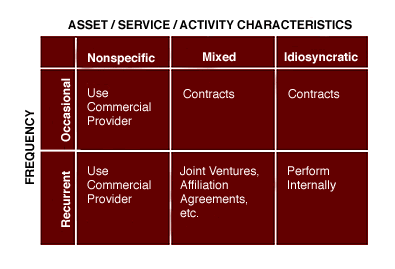
Another approach to the strategic view of the build-buy-partner assessment includes charting the institution's complexity along the dimensions of size and diversity (which will influence how complex the system needs are), as well as along the dimensions of the availability of and willingness to commit human, technological, and financial resources. For example:
Another critical factor -- raised earlier in the steering committee's evaluations -- that will bear heavily on the acquisition strategy is how urgent the need is for the new system(s) and thus how quickly the solution needs to be and can be implemented.
Most institutions today would agree that a buy option is a very desirable outcome, both initially and over time -- provided that the product meets the functional needs at an acceptable level and cost. The advantages of a supported product or having other institutions using the same product as yours, with the attendant user-group leverage on a vendor, are compelling. However, it is also clear that this option is not always workable for an institution, so the other choices need to be explored as well.
At this point in their process, the steering committee can probably make a good estimation as to whether resources, time constraints, and other factors preclude in-house development or entering into an intensive external development partnership. In this case, such a strategy must be stated at the very outset of the project, to avoid raising expectations that all needs identified in the requirements definition phase will necessarily be met through an existing vendor product.
[Previous] [Next]