 [Previous] [Next]
 [Previous] [Next]
Financial systems projects can be managed successfully from nearly any organizational platform -- information technology, administration, finance, budget. What is critical is that the project manager be an individual who has the confidence and respect of the leadership of these organizations, credibility within the institution, strong people skills, and the ability to navigate, integrate, and communicate the broad interests of the campus stakeholders in the planned system. In the ideal situation, the project manager will emerge from the ranks of the steering committee members so as to ensure continuity of thought between the early steering group planning activities and the downstream work of the project management team. If this cannot be the case, the project manager must be made an ex-officio member of the steering committee once he or she has been named.
In addition to a variety of technical and/or application/functional skills, communication ability, and project management skills and experience, the project manager must possess the judgment and political acumen to understand the key turning points of the project and to invoke the aid of the steering committee and various project teams at appropriate times.
In general, the project manager will rely on the steering committee to garner resource support and to retain the support of the institutional leadership for the project. Similarly, this manager will need to work with a project management team to formulate, ratify, communicate, and support important decisions of a primarily business process and technical nature throughout the course of the project. In general, the steering committee most effectively will act in situations where there are high-level political concerns, while issues related to technical and business requirements will be more appropriately evaluated by the project management team (see Table 5 below).
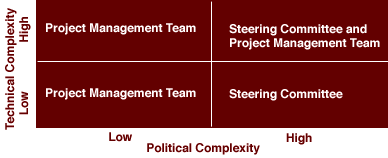
The project management team will have overall responsibility for the success of the financial systems project, from planning through implementation. Thus, members of this team should be selected for their interest in and commitment to the goals of the project and should represent a broad cross-section of the campus community. Whenever possible, members of this team should include individuals whose opinions are frequently consulted at the institution, whether or not such individuals are known to be supporters of the central financial or technology offices.
The collective credibility of the members of the project management team will have a considerable influence on the project's eventual outcome. Particularly in smaller organizations, it is likely that the members of the project management team will also be involved in the implementation process. Indeed, the same group of people may make up the core of several different functional teams, such as the project management, some of the business process review teams, the technology evaluation team, and the implementation teams. Note that all of these teams do not necessarily need to be created as separate entities, but all of the functions ascribed to the teams suggested must be achieved in order to have a successful project. (Figure 1 provides an overall view of project roles and structure, while Table 6 lists the functions of the suggested teams.)
The effectiveness of the project management team will be the decisive factor in the success of the project, and thus the roles and responsibilities of this group must be made clear from the start. Everyone who is engaged on the project management team must be a contributing member who is able to bring his or her own departmental expertise and allegiances to the table, while also being able to integrate those needs with the larger institutional vision spelled out by the steering committee. Team members must be given enough time away from their primary responsibilities to perform appropriately in these roles, and must have the support of their management in this participation. Such support could perhaps include rewards for participation, but at the least must include an acknowledgment of the burden imposed by this additional task and the importance of some redistribution of ongoing responsibilities.
Examples of typical members of the project management team might include key consumers of financial services (major academic departments, separate schools, divisions) as well as consumers of financial data (institutional research, budget office), representatives from key parts of the financial organization (internal audit, payroll, capital projects, purchasing), and staff from the technology organization who are knowledgeable about the institution's financial systems. Staff and user training are too often not addressed early enough in the project, so having the person who will later function as training coordinator serve as a member of the project team will help the team focus on strategies to meet training needs. Ideally, the "core" standing project management team should be kept to eight to ten people to facilitate frequent and constructive discussions; however, it is more important to ensure adequate representation for input and buy-in than to limit the size of this team, so a larger team may be necessary.
The project manager must be able to work with the variety of individuals represented on the team in order to move the group toward accomplishing its common goal, taking maximum advantage of the skills of each individual member of the team and helping each member contribute all that he or she can toward achieving the project ends. At the same time, sensitivity to the team's needs for support, guidance, and refreshment is also required, so that burnout does not occur before success.
Throughout the process, the project management team will report back to the steering committee, to ensure that its work is continuing to meet the institutional needs and goals that were initially articulated. In addition, these periodic reviews will give the steering committee an opportunity to reshape or redirect the project, should needs shift.
In addition, the project manager -- in concert with the project leaders -- will have to align and integrate the disparate and complex elements of the project by managing the composition of and appointments and charges to the various additional teams or subsets of project team members that will need to be appointed throughout the project. The membership of these teams needs to be flexible, and in many cases the same individuals will have a role to play on several of the teams. Having some duplication of team membership can improve alignment of action and intent throughout the project. It is particularly helpful when selected steering committee members serve on appropriate project teams.
It is important also to ensure that the roles of the various teams are well understood and that reporting and communication lines are clearly delineated so that each major component of the project is appropriately managed and staffed. The work of the teams needs to move forward in a synchronized way; several of the teams may be working at the same time, and information must pass between them efficiently.
[Previous] [Next]