Copyright 1996 CAUSE. From CAUSE/EFFECT Volume 19, Number 2, Summer 1996, pp. 28-31. Permission to copy or disseminate all or part of this material is granted provided that the copies are not made or distributed for commercial advantage, the CAUSE copyright and its date appear, and notice is given that copying is by permission of CAUSE, the association for managing and using information resources in higher education. To disseminate otherwise, or to republish, requires written permission. For further information, contact Julia Rudy at CAUSE, 4840 Pearl East Circle, Suite 302E, Boulder, CO 80301 USA; 303-939-0308; e-mail: [email protected]
Founded in 1868 by AndrewDickson White and Ezra Cornell as an institution where "any person can find instruction in any study," Cornell University today encompasses thirteen undergraduate, graduate, and professional colleges and schools. Eleven of these are located on the Ithaca, New York, campus, while two medical units are in New York City.
Cornell is a unique combination of public and private divisions, being both a private, nonsectarian university and the land-grant institution of New York State. The first university in the eastern United States to admit women, Cornell currently enrolls 13,300 undergraduates and 6,200 graduate and professional students, served by a faculty of 2,300 teachers and researchers.
Prior to the University's strategic planning effort, a visionary report, Cornell in 10 Years: The Influence of Technology, had been issued late in 1992 by the 2001 Committee. This committee had been charged by the president with identifying and assessing trends in electronic technologies that could affect the University, describing a feasible vision for the next century, and suggesting how that vision might be achieved. The report drew heavily on a vision document that had been created by the Cornell Information Technologies organization, under the leadership of M. Stuart Lynn, then vice president for information technologies. A Vision for the Nineties: At Any Time, from Any Place -- Collaboration through Technology formed the basis for the strategy that is still in place at Cornell today.
Major recommendations of the report of the 2001 Committee included:
A second planning document related to technology, Planning for Learning Technologies Services, was issued in January of 1995 by the Faculty Advisory Board on Information Technologies (FABIT), a high-level faculty body that advises the vice president for information technologies and the provost. The FABIT report identified three areas that needed to be addressed: (1) faculty support, (2) student access to information resources, and (3) "teaching spaces."
Taken together, these various planning documents have provided a clear blueprint for Cornell's information resources directions and investments over the past few years.
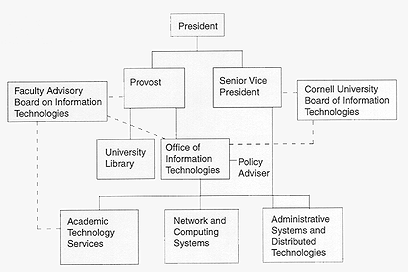
Clearly information technologies support not only Cornell's educational, research, and outreach mission, but also its effective administration. With the vice president for information technologies reporting to the provost, to ensure balance in policy guidance, CUBIT is chaired by the University's enior vice president.
According to David Lambert, vice president for information technologies, this structure works to ensure that information technologies are applied to the effectiveness of both education and administration at Cornell. Thus he sees his job as facilitating the effectiveness of both the provost and the senior vice president, and leading institution-wide technology initiatives that call for mobilizing the broad campus community, including faculty within the colleges. Lambert refers to this as his CIO (chief information officer) role as head of the Office of Information Technologies, as compared to his chief operating officer role as head of the centralized information technologies divisions. While he provides leadership and seeks resources for central technology operations, he has a responsibility to work to get resources for distributed investments, as well.
Cornell has been described as a "federation of strong disciplinary units, linked together through centers and other structures that allow innovations and advances to be shared across units." In this highly decentralized environment, FABIT provides strong faculty input to the information resources planning process and is broadly representative of the kinds of diverse intellectual interests at work on campus.
Lambert sees FABIT as not only an advisory body, but also a working group, charged with making decisions that impact information technology investments. For example, $2 million in funding in the provost's budget has been earmarked for classroom upgrades, and a FABIT subcommittee has been created to set priorities for how the funds will be spent, including recommending site licenses. The subcommittee will review proposals from colleges concerning classroom upgrades and its recommendations will be presented to broader University bodies dealing with financial allocations. Professor Ronnie Coffman, chair of FABIT, says, "This is not a centralized place, but there's a great appreciation that we have to hang together in the area of information technology or we'll hang separately -- or invest a lot of dollars needlessly."
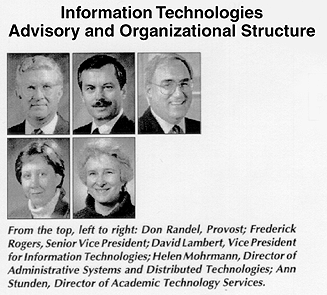 As technologies have changed dramatically over the past decade, so has Cornell's central information technologies organization. One of the first Research-I institutions to bring academic and administrative computing and networking into the same line organization in the mid-eighties, Cornell continues to reinvent its approach to supporting technology. A recent reorganization has established three primary line management divisions, each of which has two charters, one oriented toward the missions of the University and the other oriented toward technology.
Lambert believes that having strong directors in these three divisions will allow him to concentrate on his CIO facilitation and coordination role, leaving operations to the divisions.
A major focus of the FABIT report was on finding a way to rationalize the relationship between central technology divisions and the related efforts that occur at the college and school level. According to Lambert, "We have done a good job of distributing technology, but we have not done as good a job of distributing the support infrastructure. Central staff and faculty work well together, but we haven't achieved a level of organization that is efficient; too often we practice in the same area, sometimes creating duplication while leaving other areas unaddressed. A major challenge for us to address is, How can the faculty get the support they need where they work?"
Lambert hopes to effect a formalization of responsibility for information technologies in each college where it does not already exist, beginning with identifying a chief information officer within the college and then bringing all of those individuals together in a kind of CIO Council to promote communication and collaboration.
Lambert also believes that "virtual organizations" -- temporary support structures built quickly to serve immediate needs -- are the way of the future. Such organizations are more project oriented, serving as homes for major initiatives. This approach does not limit the responsibility of the information technologies divisions, but spreads accountability and ownership. Project 2000, the University's plan to become a "best-managed university," is a good example of this approach. While the administrative systems division is a major player in the core administrative systems project, it does not own the project; rather, the University has established a separate accountability structure through which an institution-wide effort is under way to reevaluate business processes and achieve a unified vision (see below).
Activities resulting from this directive are articulated in a report released last fall, Project 2000: Creating a Best Managed University. Senior Vice President Frederick Rogers, who spearheaded both the strategic planning task force and the executive group that studied the issues the task force raised, says Cornell considered several possible models for replacing its core administrative systems and opted for the strategy of partnering with one vendor to jointly develop all core systems. This will likely be in partnership with other institutions who have selected the same vendor (PeopleSoft, Inc.). These conclusions were drawn only after a great deal of work had taken place to establish a vision and set of goals and objectives that the campus could buy into, work that Rogers orchestrated through Cornell's Administrative Data Systems Policy Advisory Committee.
Rogers and Lambert co-chair the Project 2000 Council, which functions as a forum for the difficult policy issues that arise in a major systems project, while a project steering committee is responsible for managing the project. The President's Council has taken ownership of the project, and President Hunter Rawlings has gone on record as strongly supporting its goal of making Cornell's administrative processes more effective and efficient, and thus attaining financial equilibrium for the University.
To facilitate communications on this and other administrative systems matters, the director of Administrative Systems and Distributed Technologies, Helen Mohrmann, reports not only to Lambert but also to Rogers, a relationship she thinks makes sense: "To me, this indicates that both are interested in this agenda, so the dual reporting lines will only make my job easier."
According to Mohrmann, Project 2000 encompasses other activities besides reengineering the core business systems and replacing the core information systems -- human resources/payroll, student information, sponsored programs, finance, and alumni/development -- with client/server systems. These include developing a data warehouse, adopting departmental good practices at the University level, and fostering more shared or cooperative systems and fewer shadow systems, including defining a common data model. In all, the project is expected to take five years to complete.
Provost Don M. Randel comments in this same vein: "The aim of engaging the technology is not to make music historians into technologists, but to make them into better music historians. What we have done quite well is to take that kind of burden off people --provide them with tools to liberate them to think about what they need to think about, not worry about the tools themselves."
According to Ann Stunden, director of the Academic Technology Services (ATS) division, all of the recommendations of the FABIT report, except in one area, have been implemented. There is more permanent funding for computer labs, the proposed student orientation program to educate students about information access was launched last fall, and a major effort is under way to outfit classrooms across the campus with the most appropriate and best of new technologies. The missing piece is how to most effectively provide faculty support, but Stunden's division will be working closely with FABIT on this challenge in the coming months.
What about current uses of technology by faculty for teaching? Carrie Regenstein, who heads the Academic Technology unit of ATS and works closely with Cornell faculty, says many faculty are reaching out to students in new and innovative ways: teaching with the World Wide Web, collaborating with listservs, teaching across universities, and using digital libraries. An appendix of the FABIT report lists many special projects that creatively use technology -- for example, the computer-driven "dry laboratory" at the College of Veterinary Medicine and the "virtual design studio" in which architecture professor Kent Hubbell has participated for several years -- as well as the many projects that have been recognized beyond Cornell by national publications and awards programs.
An excellent example of using the Web effectively is found in the work of Andree Grandjean-Levy. This modern languages senior lecturer has created a Web page that provides many links to resources she has found of value in several levels of teaching. "At the more advanced level," she says, "I use the page to send the students to France to look at online French newspapers and to look for information on French politics. From the cultural point of view, it brings them right smack into contact with what's over there; the culture and the language all of a sudden are brought to life much more. It's extremely enriching; I am almost ready to do a course simply using the Web."
Today, the formerly mainframe-based CUinfo resides on a World Wide Web server and is one of many information resources available through Cornell's Web site.
Perhaps one of the best known of Cornell's technological innovations, Project Mandarin has created a set of tools to build applications that use networks and point-and-click interfaces to move information from databases into the hands of students, faculty, staff, and administrators. The project has become a consortium of more than two dozen colleges and universities. Mark Mara, who leads the Project Mandarin team, says the consortium has been excellent in keeping the goals of the project realistic and the technology from becoming provincial. Many of the consortium members have built applications with the Mandarin tools similar to the Bear Access application in use at Cornell.
Bear Access is a simplified interface application -- a menu of Cornell-supported network services -- that allows users to easily access those services using their individual network ID and password. The application makes it easy for people to connect to information sources such as the Cornell Library Online Catalog, Just the Facts, and CUinfo. Graham Hall, Bear Access project manager, says this was the first project emanating from the central information technologies organization that actually reached out and touched "true" end users in a significant way.
Registrar David Yeh agrees: "Students love it. We are one of the few universities that allow students full access -- from seeing grades and financial aid information, to actually having the ability to change their addresses, to now enrolling for courses online. We are continually asking, 'How can we reduce lines and production of paper, and provide information to students when they need it, wherever they are?'"
The University Library is also being transformed by the networked environment. Over 100 Macintosh-based kiosks in library buildings use Bear Access and other gateway software to make a vast collection of bibliographic information available.
Collaborative projects include a pioneering effort to both preserve and electronically distribute books across the Internet; the CUPID project, aimed at using the Internet to create a distributed printing environment for high-quality documents; and the Making of America project, the purpose of which is to digitize and electronically distribute primary source material on nineteenth century American history. The latter project is in cooperation with the University of Michigan, but eventually this project will engage additional campuses and be a good case study for what it will take for institutions to participate in a consortially developed digital library.
The library is also using the World Wide Web to deliver undergraduate library instruction, having developed a tutorial that is available on the Web, and library staff provide instruction in the use of the Web, teach classes on HTML, and work with faculty who use the Web in their classes. All divisions of the library are engaged in the effort to build electronic libraries and will be part of a strategic planning effort that will begin after the appointment of a new University Librarian.
Currently using the NOTIS automated library system, the library is in the process of evaluating vendors who have or are developing distributed systems products, in concurrence with Cornell's move toward client/server systems.
In response to tremendous interest shown by other institutions in Cornell's work in this area, the policy-development process and experience will be shared in a program called "Computer Policy and Law," to be held August 6-8, 1996, on the Cornell campus.
From effective organizational strategies, to creative use of technology in instruction, to use of the network for easy information access and dissemination, to innovative technological developments -- Cornell University has received much well-deserved recognition from its peers as well as several higher education associations and agencies. Its approach to information resources management and use has surely contributed to its being referred to by the Middle States Association Commission on Higher Education as a "world treasure."
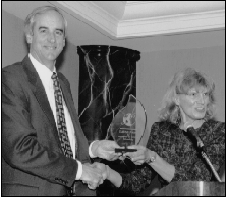
Cornell President Hunter Rawlings is shown here accepting the 1995 CAUSE Award for Excellence in Campus Networking from CAUSE President Jane Ryland. The award recognizes Cornell's exemplary campuswide network planning, management, and accessibility, as well as effective use of the network to enhance teaching, learning, research, administration, and community service. Cornell has become an information age institution, where 95 percent of the faculty, almost 100 percent of the students, and 90 percent of the staff are connected to and use the campus network. Cornell is known for innovative technology application development, such as CU-SeeMe, a real-time desktop videoconferencing program used widely in higher education.
This article is based on a visit to Cornell University by editor Julia Rudy. The magazine's Campus Profile department regularly focuses on the information resources environment -- information, technology, and services -- of a CAUSE member institution, to promote a better understanding of how information resources are organized, managed, planned for, and used in colleges and universities of various sizes and types.
Most of the documents described in this article are available through the CAUSE Information Resources Library ([email protected], 303-939-0310).
![[Comments]](/ir/library/html/cem/comments.gif)
![[Search]](/ir/library/html/cem/search.gif)
![[Home]](/ir/library/html/cem/home.gif)