

Copyright 1996 CAUSE. From CAUSE/EFFECT Volume 19, Number 4, Winter 1996, pp. 27-29, 34-36. Permission to copy or disseminate all or part of this material is granted provided that the copies are not made or distributed for commercial advantage, the CAUSE copyright and its date appear, and notice is given that copying is by permission of CAUSE, the association for managing and using information resources in higher education. To disseminate otherwise, or to republish, requires written permission. For further information, contact Julia Rudy at CAUSE, 4840 Pearl East Circle, Suite 302E, Boulder, CO 80301 USA; 303-939-0308; e-mail: [email protected]
Although the nature of the workforce is changing and the demands of higher education make it clear that institutions need to reach students both on and off campus, the way that information technology service units support faculty, staff, and students has not kept pace with these changes. Furthermore, the ability to improve instruction by integrating digital technologies across the curriculum is becoming a reality. To effect these changes, the support paradigm of information technology service units -- academic computing, user services, libraries, network services -- will need to be transformed. This article describes plans and support models at Virginia Commonwealth University and Randolph-Macon College aimed at enabling such a transformation.
After decades of promises based on overhead projectors, classroom video, teaching machines, and other instructional technologies, the ability to improve instruction by integrating digital technologies across the curriculum has now become a reality. Incorporating digital text, audio, graphics, animation, and full-motion video into lecture, laboratory, self-study, and interpersonal and intergroup communication activities that are fundamental to teaching and learning promises to improve the quality of instruction.
Education in the future will support both synchronous and asynchronous interaction between the learner and the sources of knowledge and information. Real-time, simultaneous two-way video presentations, multimedia presentations, and "education on demand" can be delivered to students on the campus, in their homes, or at their work places. Connectivity to the Internet and World Wide Web already is allowing students and faculty to access educational resources. Escalating costs, declining financial support, increasing demand, and diverse demographics have placed significant pressures on higher education to become more productive. The focus for productivity improvement must be on learning.
It is this realization that is leading to increasing use of a teaching model in which students gain access to information resources, faculty lectures and demonstrations, conferencing, and tutorials over networks from content organized by the faculty. Productivity gains occur in information retention, more efficient use of the student's time, easy access to group study over networks, better feedback to faculty, and organized self-assessment and self-pacing. Faculty and traditional classrooms are not replaced, but another dimension is added that greatly improves learning efficiency. As this new process develops, more students will be able to take advantage of this type of instruction.
At large research institutions such as Virginia Commonwealth University (VCU) and at small liberal arts colleges such as Randolph-Macon College (R-MC), technology is enabling new teaching and learning models that are designed to improve learning productivity, reduce labor intensity, and provide new ways of delivering education and service to students while improving the quality of instruction.
The vision that has emerged at both institutions recognizes that technology can benefit learning when it:
Plans at both institutions envision that instructional computing in the next decade will be symbolized by communications using network connectivity between machines -- office to office, classroom to library, teacher to student, and the campus to the world. The next revolution will be about access to information and ways of sharing information. Consequently, this revolution will involve most members of the college and university communities, not only those who have been traditional beneficiaries of technology. In the new environment, every instructor or student working alone at their office desk or working with others in any campus classroom will access not only the powerful tools of the desktop computer, but also the networked applications and information resources of the campus and the world beyond.
These plans include providing high-bandwidth network connection to faculty offices and classrooms, network ports distributed throughout the campus, and high-bandwidth or telephone access from off-campus sites or residences. Classrooms will be equipped with systems for displaying prepared lecture material and sharing information resources and there will be online processing of grades and other student records. From the desktop, the user will search and retrieve a wide variety of library materials, including multimedia, international journals, databases, reference works, and scholarly discussion groups. Envisioned is a new methodology for faculty to conduct and publish research, create and deliver lectures, and interact with students.
The speed and scope of change in instructional methods promised by the new technology is unprecedented in educational history and will require unequivocal institutional support, not only to create the infrastructure to make this possible but also to meet the need for faculty motivation and training. These plans call for institutional policies to encourage individual faculty to make the required investment of time and effort. The institution could provide incentives for faculty development, such as release time or direct pay to conduct and/or attend training; consider professional development in this area for retention, promotion, and tenure purposes; or support faculty with well- defined projects for experimenting with new technologies and innovative ways of employing them in the teaching, learning, and research processes.
Achieving these goals will move our institutions toward becoming fully integrated "virtual universities," utilizing asynchronous learning networks in which students, faculty, and staff are linked by electronic mail, two-way interactive video, online processing, electronic databases, library services, multimedia on demand, and other information technologies, without regard to physical locations. The potential benefits of moving in this direction include:
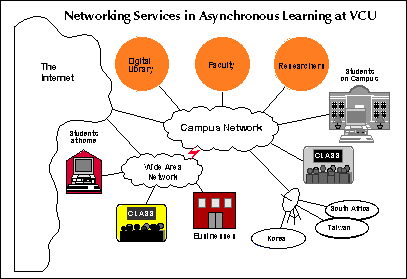
Figure 1: The infrastructure for the "virtual university"
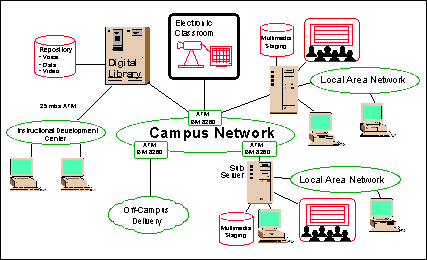
Figure 2: Electronic classrooms
Virtual Classrooms The evolution of the digital library and products such as VCU's Web Course in a BoxTM (WCB) are extending teaching and learning beyond the walls of the classroom.1 The authoring workstations provide the capacity to digitize lectures, which can be edited, indexed, and stored along with course materials. Both the lectures and materials can be retrieved later to supplement existing classroom instruction, either as stand-alone video, or more likely integrated with interactive multimedia presentations. Several systems for interactivity are being used to encourage conferencing and interaction between participating faculty and students. Initially, this was accomplished through electronic mail, bulletin boards, and newsgroups.
Today both VCU and R-MC are actively promoting the use of the Web for instruction and using WCB to create these courses. To date VCU has delivered slow-motion video over an ATM network to a multimedia classroom in the School of Pharmacy, and there are approximately 100 courses that distribute instructional materials on the Web, half of which were created with WCB. With these tools, students and faculty can communicate electronically whenever they like. Assignments can be given and received electronically. Faculty can hold virtual office hours, freeing them from rigid schedules, and enabling students to obtain information quickly. Although the method for student/faculty interaction will change, these technologies should enhance the quality of interaction or improve it over current levels. VCU has experienced tremendous success with an accredited master's degree program in Health Care Administration, which utilizes the virtual university concept.
The infrastructure requirements continue to change with rapid advancements in technology, and to take advantage of innovation, higher education must restructure information technology services. The traditional academic computing or library services role in audio, visual, or media instructional support faces significant restructuring to support asynchronous learning and other non-traditional instruction.
At VCU and R-MC the increased demand for IT service is beginning to change the IT units in many ways.
VCU and R-MC are now developing ways to provide intense hands-on training for all interested faculty members in all the newest technologies of multimedia and asynchronous learning. Workshops and institutes have been developed to provide instructional support to faculty to create content that can be accessed over the University's data network, the Internet, and the World Wide Web. Faculty members come away from training ready to take an active role in planning and implementing changes in the way they teach. At both VCU and R-MC, strategies are being developed to support a faculty mentoring program. These programs seek to provide the tools, training, and release time for interested faculty to develop multimedia programs and serve as future expert resources to other faculty within their own schools and colleges.
Given its limited staff, the IDC strives to maximize the assistance it can offer by creating tools to enable faculty themselves to create computer-based learning materials (such as Web Course in a Box, described earlier). IDC is committed to helping faculty become knowledgeable about innovations in instructional technology and find effective ways to use technology to enhance learning. Each summer a series of seminars is hosted by IDC; summer and winter institutes offer longer-term learning opportunities. IDC's Web site features a "self-study lab" with information on learning resources as well as locally created demos and tutorials.3 VCU is evaluating Lotus Notes Domino as a hybrid approach to deliver MPEG4 standard video through the integration of a CD-ROM in a client with Internet access.
Although R-MC is just planning a multimedia studio, their Website is creating an online support and learning environment.
VCU, with the majority of students living off campus, has, in addition to wiring their campuses, outsourced Internet access from home to a private Internet provider. This piece of the infrastructure offers additional support challenges. The infrastructure to create this function for 2,000 faculty, 5,000 staff, and 20,000 students is prohibitively expensive in today's changing market. In fact, it is likely that the entire infrastructure will need to be changed in two years. Today's 28.8 kb modem over analog dial-up may be the current technology choice, but ISDN and the 56 kb modem are likely to replace it in the next several years as the need for higher and higher bandwidth to the desktop is dictated by the emerging technologies of the World Wide Web and the digital library (e.g., full-motion video and high resolution imaging). VCU and R-MC are both exploring higher bandwidth alternatives to deliver integrated video, data, and telephony with both voice and cable companies.
The role of technology support has changed because the level of access to information has become so pervasive. In a brief twenty years, requirements have increased from supporting a few mainframe users with terminals on campus to supporting students, educators, and staff who demand better service from their office, home, or residence hall.
The current economic restructuring is being combined with unprecedented growth in demand for higher education, and will require colleges and universities to mirror business and industry by delivering "just-in-time" rather than "just-in- case" education and support. We will also have to pursue cooperative efforts with other higher education institutions and the private sector to achieve this vision. Institutions like Virginia Commonwealth University and Randoph-Macon College will proceed deliberately, with a careful eye on changes in technology that may change the goals, and on vicissitudes in the economy that enable them to implement the new pedagogical paradigm. Still, colleges and universities must begin proceeding now toward a networked learning environment and a new faculty and staff support model if they are to deliver the education the students will need and demand, and provide the level of faculty and staff support to enable this change.
2 See http://www.rmc.edu:80/administration/ITS/schedule.html and http://www.vcu.edu/vcu/ucsac/services/servic2.html
3 See http://www.vcu.edu/mdcweb/
4 MPEG refers to a standard for data compression and storage of full-motion video produced by the Motion Picture Experts Group.
Dr. Arthur S. Gloster II ([email protected]) assumed the position of Vice Provost for Information Technology at Virginia Commonwealth University in August 1994. He is responsible for communication services, computing, and libraries. Previously he was Vice President for Information Systems at Cal Poly, San Luis Obispo for eight years. He has over twenty-five years experience in information systems in both the public and private sectors.
Steven A. Saltzberg ([email protected])has been Director of Information and Technology Services at Randolph- Macon College since July 1996. Prior to that he served as Director of Multimedia Development and Director of Academic Computing at Virginia Commonwealth University, and previous to that was Assistant Director of Computing at California State University, Fresno. He holds BA and MS degrees from the University of California at Los Angeles.
![[Comments]](/ir/library/html/cem/comments.gif)
![[Search]](/ir/library/html/cem/search.gif)
![[Home]](/ir/library/html/cem/home.gif)