

Copyright 1997 Patricia Battin and Brian Hakwins. This article appeared in CAUSE/EFFECT Volume 20, Number 1, Spring 1997, pp. 22-30. Permission to copy or disseminate all or part of this material is granted provided that the copies are not made or distributed for commercial advantage and that this block of information appears as part of the article. To disseminate otherwise, or to republish, requires written permission from the authors. For further information, contact Patricia Battin ([email protected]) or Brian Hawkins ([email protected]).
|
| In a general session address at CAUSE96 last December, Brian Hawkins and Patricia Battin presented their shared view that college and university information resources professionals must assume active leadership in higher education's transforming environment. Their dialogue, excerpted here, explored both the mythology and reality of cultural issues that separate librarians and information technology professionals and inhibit enlightened leadership as their changing roles effect a professional convergence. Hawkins and Battin, who served together on both the Educom and CAUSE Boards, have jousted with each other about the role of the information resources professional in higher education for more than fifteen years. |
|
[Brian]: While librarians and information technologists come from different worlds, and thus have different perspectives, we have reached the point where we have to start to develop common perspectives for the common good of our institutions. What are some of the challenges we face together, some of the inhibitors to working together, and some of the things we need to do to create a world where information resources professionals are truly people working together for the advancement of the academy?
The present shape of our organizational structures and their somewhat myopic and restricted-range views are doomed. In fact, we need to create a different kind of structure, a different kind of approach. Rather than advocating a specific organizational direction, it is more important to emphasize that there is a different role for the professional who tries to integrate technology services that support faculty and student scholars on our campuses and provide the information they need.
The change CAUSE made several years ago in its mission statement defined our role as managers of information resources -- information, technology, and services -- and we can't manage these resources from "stovepipe" organizational structures any more. We need to reconceptualize our role and think about it more as supporting the transformation of our institutions. We need to determine what that requires from us as professionals.
[Pat]: Gerald Holton, in a 1978 essay describing the fruitless contemporary search for a unity of knowledge-a synthesis of science and the humanities-concluded that as a result of the lack of such a unity, "the need is greater than ever to recognize how small one's own portion of the world is, to view from one's own narrow platform the search of others with interest and sympathy, and so attempt to re-establish a community of learning on the recognition that what binds us together is perhaps chiefly the integrity of our individual concerns."1
Today, the higher education community resembles a dysfunctional family, passing back and forth from the library to the information technology division the blame for dysfunction instead of admitting the pathology of the total family structure. For years the library was the scapegoat -- scorned by the purveyors of the new "paperless society" and labeled as the "black hole" of budget deficits because of escalating journal prices. Now the honors for the "bad seed" have passed to the information technology divisions, accompanied by anguished cries for more speed, more accessibility, more reliability, and howls of dismay over the ceaselessly spiraling costs. Our persistent attempts over the last decade to force the characteristics of digital technology to conform to the print-on-paper family organization have now reduced us to fighting over who gets to preside over the funeral -- because funeral it will be, unless we join together in a collaborative and enlightened resuscitation.
[Brian]: I am convinced we are going to break out of those compartments, because now we're experiencing a different kind of change. It's no longer incremental. It's no longer even exponential. It's discontinuous. It's transformational. And this is why it's causing some real costs to our institutions, to each of us personally, and to all of us professionally.
Transformational change occurs when something comes about that is so radical it alters the way we must do business. In remaking our environment we have to start to do things in altogether different ways, with probably different sets of skills, altering our human behavior, and altering the way our systems work.
Let's talk about where we have seen some of the kinds of transformational change occur. When we moved from mainframes to micros, we certainly saw a different set of demands, a different audience. The sleeping giant of the humanists and many social scientists woke up and started to become demanding users. We found we needed a different kind of support structure. We moved from a handful of applications that we could support to myriads of applications that we can't support. This called for different kinds of support structures on the technology side, and that pressure in turn called for new resources and new skill sets. We've seen the same thing happening on the library side.
[Pat]: Yes, and at first the technology didn't really seem to transform anything. We started out with computers to automate our backroom activities, acquisitions, and cataloguing. But we were still producing catalogue cards. Then we began to move toward the online catalogues and we found that we had created a lot of site-independent information access without realizing that's what we were doing. But the real transforming change for librarians came with the capacity to create, disseminate, store, and use information in different formats and media at the discretion of the user -- no longer at the discretion of the library and the library staff -- in the same way that the mainframe facilitated centralized control before the advent of PCs.
One of the biggest issues that has come about -- that should be bringing us together -- is the growth of site-independent information access and what, in the library profession, we call "the tension between access versus ownership." Are we going to continue to build collections so we own the material on campus, or are we going to find a way to provide access to information in electronic form? And this dilemma is counterbalanced by the continuing increase in book production. The paper has not gone away. What the technology has enabled us to do is to generate more and more volumes of paper. And as we are able to buy less and less of that, the anxiety level rises.
A second issue we are dealing with is the importance of the library and the information technology division as "space" for intellectual exploration and discovery in interaction. There's a lot of talk about everybody sitting alone at their PCs and accessing all kinds of information, but it's not happening. We're finding that there's a whole new kind of intellectual interaction that takes place when people come together in a space that has all kinds of information available from that site. Those are very puzzling issues that we have to deal with.
A third transformational issue is the need to understand better how students and scholars use information, both print and electronic. We have been in a traditional situation for so many hundreds of years that we haven't thought much about how people used information because they only had one kind -- paper. Well that's all changed, and how do we work together in understanding what the new needs are? And I don't mean just the technology, of how to deal with a machine; I mean how to deal intellectually with information resources in a particular discipline. I think both information technologists and librarians must do much greater work with the user population than we are accustomed to.
[Brian]: We are starting to see more emphasis on the learner-centric model and less on the traditional faculty-centric, space-finite model, but we don't know what that means. We don't have libraries online. Nor do we see them so in the foreseeable future. We don't know what kind of pedagogical support and user-help processes will be necessary with these kinds of orientations.
[Pat]: One of the toughest issues we are already facing is how do we move from a traditional intra- and inter-institutionally compartmentalized acquisitions budget to new collaborative ways of sharing money to provide information access -- when we don't know who owns it, we're all paying for it, and we're nervous about what's going to happen in the future. These are challenges of the future that are simply not going to go away. And to date, we don't have those collaborative organizations in place to try to solve those problems. We need to move from straightjacketed budgets, to convince our financial support people to create a superfund which begins to provide a venture capital mechanism to transform this financial bind that we're in, and to accelerate the process of providing individualized services to multiple audiences because there no longer is -- if there ever was -- "the" faculty. We are dealing with a very broad range of information users, and I sometimes think my colleagues in information technology divisions do not understand that. There are a lot of people out there who don't think like you do, and we have got to find a way to serve all of these groups.
[Brian]: Certainly outmoded funding formulas are an issue. The way that we look at our budgets confines the way we think. Maybe what we ought to do is take the budgets and rip them up. Take the same number of dollars available and start to rethink, to look across boundaries. That's going to take involvement beyond just the information technology and library organizations. That's going to take the involvement of fiscal officers and many others.
When the budget's not working, it's not enough to say we need more. We've got to look back at mission, at what's important, what the priorities are, what the tradeoffs are. We need to fund networks and have ongoing capital to do that to deal with the continuing capitalization of the technical infrastructure. Very few of our institutions really have stepped up to that ongoing, base-budget funding. If information technology is central to the mission, then we have to readjust budgets accordingly. Old budget structures inhibit transformation.
We're also identifying issues about who's really responsible for the information archival role, that has historically been the shop over on the other side of the campus. Now, if it's electronic, who's deciding what's saved? Think about how many Web sites you can't get to that were there yesterday. Think about the kind of information that's legitimate and important information for which the broad academy of higher education hasn't figured out how to address archival issues. Whose responsibility is it?
[Pat]: Another issue, actually a theme running through the literature recently, is the sense of a discontinuous future. Running beneath this discontinuity is a strong web of connectivity where each new development builds on what went before, and the discontinuity hasn't yet happened. For example, in the 1960s we were going to have the library on the desktop. Then in the 1970s we were going to have a microfiche library in a shoebox. Then in the 1980s we were going to have a paperless society. In the 1990s we talk about agile libraries and hybrid systems and in the 2000s it's the digital library. But what really has happened is this: each new technology predicted monolithic simplicity, ease of access, and relief from steadily increasing costs and cumbersome management of books and buildings. Each new technology resulted in increasing heterogeneity of media and format, complexity of access, increased expenditures, and a chaotic spectrum of choices. No formats, media, or communications technologies disappeared or superseded each other; rather, they continued to appear in new combinations and evolving functionalities.
What is critical to understand from these last fifty years is that there are two key transforming changes. The first is that the digital format, the bucket of bytes, can create any of the other media. And that is very new and very much a significant change in the way we deal with information resources. And the second transforming change is that because of that capacity our management systems must respond to the characteristics of digital technology and not to print-on-paper.
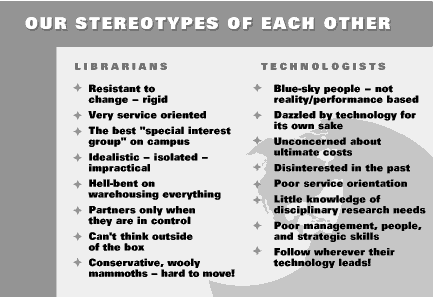
[Brian]: Much of what we've talked about is not new. So why aren't we doing something about it, then? There are a number of reasons, but one of them is our own human behavior, our own sets of attitudinal biases. In preparation for this dialogue, we conducted an extensive survey -- Pat called half a dozen of her friends and I called about a half a dozen of mine. We wanted to find out what the one group thinks about the other.
I asked my technologist friends, "What are your stereotypes? What do you think of when you think of librarians?" They responded that librarians are very resistant to change and very rigid. They also said they're very service-oriented, probably the most of any group on campus. They said librarians were also the best special-interest group in lobbying forces with the faculty of any group on campus. Idealistic, yes. But isolated and sometimes impractical. Hell-bent on warehousing everything. Partners only when they're in control. They don't think outside of the box; they don't expand their views. The most picturesque description was "conservative wooly mammoths that are hard to move."
[Pat]: And I called some friends in the library community and asked, "What is your knee-jerk reaction to the technologist?" Well, they said, they are blue-sky people. Rather than being based in reality and performance, they're just talking about this stuff that might be. They're dazzled by technology for its own sake, never mind what it can do for you. Follow where the technology leads, not the institutional mission. No comprehension of service to multiple audiences, only to those who think as they do. Little knowledge of disciplinary research needs, outside their own. Total lack of interest in the past, as well as archiving. Poor service orientation -- put it out there and they'll use it. Poor management and strategic skills. Poor people skills -- they like their machinery. And unconcerned about the ultimate cost.
What we established in this little telephone survey is that we have two distinct cultures: control freaks versus anarchists. So, what do we do with that? We both believe that those of us in information services have a real obligation to the future of higher education to solve these issues. We have to recognize that despite these cultural myths of control freaks and anarchists we do share a reality of converging responsibilities. And we have to recognize that not only do we need each other, but we need the involvement of scholars and students as well. There's going to be increased interdependency in higher education brought on by this technology that we love so well.
So what we need to ask ourselves then is, "What are the strengths that we each bring to the table?" The technologists' strengths are a real technical expertise that we desperately need, a specialized knowledge of connectivity and communications and interoperability and all those things that librarians tend to roll their eyes about because we do not like to deal with them; an understanding of the appropriateness of best practices rather than the long, long analog process of establishing standards before you make a move; those blue-sky, broad-thinking attributes, which are really very valuable, if restrained a bit; and shared interests, especially with the systems professionals who have been dealing with administrative databases and security and authentication issues.
[Brian]: Which, incidentally, is similar to the kind of cultural issues that librarians have been facing for a long time, albeit from a very different perspective. Librarians bring to bear issues on information discovery and retrieval that we now need, experience with the organization of knowledge that has a strong user-service orientation, and a history of collection building and archiving. (That's the problem with the Web. There isn't an organized collection, and it certainly isn't archived.) The library community has an awareness of preservation dilemmas because the preservation issues of acid paper, albeit severe, probably are nothing compared to trying to transform the digital library we might try to create today -- with all of the images, all of the text, all of the tagging -- into whatever the new standards and new issues will be decades from now. And, again, the librarian's focus on authentication of information is key. Are we recreating library organization systems with the technology?
[Pat]: Yes! There's great value in bringing different skill sets to a common problem of the academy. I think we have to look to our scholarly colleagues to contribute, as well. They must work with us in ways that we have not either invited or wanted in the past. They bring an in-depth knowledge of the discipline and an understanding of how disciplinary scholars frame questions and seek information and organize their research methods, which we need if we are going to serve their needs, and an understanding of the relevance of various information artifacts and formats and media. We can no longer make those decisions on our own. We have to give up some of this control. Faculty also bring an understanding of the different cognitive styles and how they relate to teaching and learning. All of us have to expand the horizons of the current concept of the information professional. We have to learn new skills, establish new decision-making mechanisms, and enlarge our circle of colleagues.
[Brian]: Mostly we have to decide that our role isn't about books, and it's not about technology! It's about support of the academic enterprise. It's about support of the students and faculty. We need to rethink our skill sets and our mindsets and our entire roles in terms of doing that function. We've shifted from technical doers in 1980 to service providers in the mid-'80s to resource managers in the mid-'90s. We recognize now that we have a finite number of resources, and a lot of different constituencies out there. We have to start to assess what we are trying to achieve, and begin to put it into much more of a resource-management perspective, managing information resources of the institution in the same coherent fashion as the budget and human resources are managed. What is it that the community is calling upon us to do? A key factor is that we're moving from a very specialized effort to increasingly generalist roles in the leadership of these issues. Is there a similarity in terms of the kind of focus that we need, as we move to this greater generalist role?
[Pat]: I think that is similar to what has been the pattern in libraries, except that the timeline is out of whack: the Alexandria library flourished from 300 to 30 BC! The one thing missing in that overview is the importance of the past to scholarship and society. Librarians have always had as a primary responsibility the stewardship of the intellectual heritage, and I think that there is a way to make sure that is a part of our new responsibility. But I would like to say also that despite the huge chronological gap in our respective origins -- and that is huge -- chronology does not confer ownership on territory, nor does being the new kid on the block confer relevance. If we are going to move ahead, we're going to have to do it together.
[Brian]: Resource managers also have to manage expectations. They hold significant functional roles within universities and colleges, but they also must shape what is reasonable to expect among various constituencies. At my institution, what we could feasibly offer in our wildest dreams is inadequate, according to many of our campus constituencies. The shaping of expectation is key, but it's not enough. We also have to be boundary spanners, to sell beyond the traditional arenas. We have to become a partner in the broader organizational schema. Instead of just librarians and technologists talking, where's the dean of the faculty? Where's the provost? Where's the dean of student life? How do we start to break those boundaries as well? If we're going to start to talk about an increasing electronic environment, there are many other service support structures that deal with information that have to be integrated as well. That's another change in role.
There are also changes in skills. A resource manager has to have the ability to deal with capital budgeting and forecasting and a whole series of issues that many of us have had to learn throughout our careers. Thus we have to define our priorities and also be driven by those priorities that we don't set. We can shape what those costs tradeoffs might be, but we have to be at the table to do that. Historically, most of us haven't been at the table.
We have to talk about the ability to horizontally integrate functions and manage all assets, not just budget and people which are traditionally in our job descriptions. How do we manage the information asset as well?
We've got to start to think about dealing with some of this discontinuity. If we are going to sit at the table, we have to become literate in multiple languages. We need to be able to talk fund accounting, to talk circular A-21 and what that means in terms of research funding that supports the library or the technology infrastructure. We have to start to become academic managers and know at least what parameters these other communities are dealing with.
Finally, we need a change in mindset. Changes in skills and roles are incremental add-ons, but a change in mindset means we have to do things differently. We need to integrate to achieve mission versus control. It's not about control. We've got to give up control. Instead we've got to sit at the table, so that we can participate in the process. Instead of accepting the institutional goals and the loudest faculty committee, we need to be active participants in that discussion, helping them understand and to learn as well. We need to manage the budget, yes, but more importantly, we have to start to shape the discussion about how to budget to mission. What is the mission? How does this role of information, or the role of technology, fit into what the institution is doing? This is a re-definition. This is participating with a very different mindset.
The changing role is not about technology, it's about support of instruction and of research and of the core mission. We've got to want to explore other cultures enough to appreciate the diversity, and the values which diversity brings to the table, and then perhaps we can participate more meaningfully. This exploration and appreciation of cultures clearly hasn't worked yet, or we wouldn't have gotten the kind of responses we got in our little survey. While there is a recognition that we have to work closer together, there is also a deep, visceral difference that is about attitude that has got to be overcome as we start to look at people in very different ways about what they bring to the partnership. This kind of anthropological approach means a different organizational structure and a different way of defining boundaries in terms of decision-making in our institutions. This is the only way we'll be able to cope with the kind of transformational pressures that are facing in our institutions.
[Pat]: What are some ways to break the impasse? Of course the first one is to accept the integrity of each other's concerns, to move out of this cultural, mutual contempt that we have somehow gotten ourselves into, and to understand that we both have valid points of view and what we need to do is to bring those together. We have to learn each other's business, and there are a lot of ways to do this: internships in either side of the organization, cross appointments. We have to understand what we're both about and not fall prey to stereotypes.
[Brian]: The issue of accepting the integrity of the others' view -- if we can cross that threshold, we probably have done more than anything. To do that, we get into issues of turf. We need to practice by finding new decision-making processes that cross boundaries. When we run into conflicts, when we run into the turf issue, let's challenge the boundaries. Instead of "it's mine" or "it's yours," step back and say, "What is it that the students and faculty need? What is it that the institution needs?" We can worry about how we allocate the resources and under whose domain at a different time. We need to focus on the discontinuous change. What things are killing us? What are the things over the boundary, over the horizon, that we can anticipate coming at us? It is this longer-term, anticipatory approach that is needed to shape that discussion and shape our environments, rather than just react to them.
[Pat]: And we need to think critically, to analyze what's really going on, to look at these crazy dysfunctions that we continue to try to ignore. And this is the hard one: to engage in enlightened self-interest and not territoriality. To look ahead, to look at the user's perspective. To ask users what they want and need -- not to continue to do what we have been doing and what fits our skills and abilities. Enlightened self-interest is a major leadership challenge because it could well mean that your job might go away -- but there might be another one there for you. We also have to recognize multiple audiences. I think that is just critical -- that we are no longer dealing with a monolith out there.
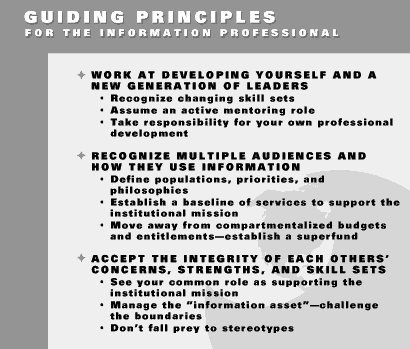
[Brian]: At Brown almost a decade ago, we came up with a set of guiding principles, approved by the faculty, that are still in effect today. They say, "Here's what we believe." One of the guidelines is that a common baseline for everybody is more important than specialized support for a few. That may not be appropriate for all campuses. But for our campus, that then allowed a group of people to emerge into the mainstream of support. What are your guiding principles? What are the issues of entitlements? If we don't start to understand that we have to manage these resources to the mission and goals defined by the academic infrastructure, ultimately we'll fail.
[Pat]: That's something that has been a concern of mine for many, many years -- we have to establish a baseline of services to support the institutional mission. I think it's the same in IT divisions as it is in libraries. We're expected to provide everything to anybody who wants it, and we can't do that anymore, yet nobody wants to take on that hot potato. And the administration and the faculty are probably even more loathe to do this than librarians and technologists. We need to say, "This is what your tuition buys you; this is what your faculty appointment buys you. And anything beyond that is extra." We can't manage resources unless we have some sense of what that baseline is.
Another major concern, as I mentioned earlier, is the need to establish a superfund to begin to rationalize the way we spend money on information resources.
And, finally, we have to work to develop both ourselves and another generation of leaders. We have to do even more professional development, in which CAUSE has taken a pioneering role. We have to recognize that the demand for changing skill sets may not reflect our traditional assumptions. It's the responsibility of each of us to analyze what skills we need, not what skills we have.
[Brian]: This can be very threatening, to realize that our present skill set may have become a liability. But this is a change that isn't just at the bottom of the organization; it's throughout the organization. Specialized skills have been our source of security: "I know how to do this area better than anybody else." Yet the demand for that area is probably going to be changing at an increasing speed. What are the processes we go through to change our skill sets? How much of our budgets are we committing to professional development to try to ratchet up our ability to cope with these changes?
In the broad area of leadership as we move toward an information resources environment, one of the encouraging signs is a joint effort between CAUSE and the Council of Library Resources at Emory University in creating a new institute and an internship program, which hopefully will be off the ground in about a year, to help librarians, faculty, and technologists start to learn about these other worlds, to gain these other skills. It's not a sensitivity issue; it's not a management issue. It's an orientation. It's a change in mindset. To develop these kinds of professional development experiences is critical; we've got to start with ourselves, but not forget that we're all also responsible for each other. The slogan of CAUSE's [Professional Development] program is "professional development is everyone's responsibility." Absolutely!
[Pat]: As I've said before, mentoring is a key obligation of leadership today, mentoring in a different frame of reference -- to look forward to what skills and abilities are going to be needed in the new world and to somehow find a way to break out of our compartmentalized organizations, to give the younger generation an opportunity to learn these new skills so that they will be capable of forming this new cadre of leadership. In conclusion, I'd like to emphasize again that these issues are not about turf but about viewpoint, and that is commitment to the mission of higher education. Presidents and provosts are stirring; they will lead by default if necessary, and it is not at all clear that they will lead in the right directions or for the right reasons. Enlightened leadership can only come from this broad community of information professionals. The provision of information resources -- be they print or electronic or technical infrastructure -- and the power of digital technology, which grows everyday, must enhance, not define, our educational mission. Our professional obligation is to participate in the definition of the 21st-century institution of higher education and to provide the leadership to conceptualize and manage the broad array of information resources that are necessary to support its mission.
1Gerald Horton, "Introduction. Discoveries and Interpretations: Studies in Contemporary Scholarship." Daedalus 2 (Fall 1977): vi.
Brian L. Hawkins ([email protected]) is currently Senior Vice President for Academic Planning and Administrative Affairs at Brown University, responsible for academic planning, campus computing, enrollment management, summer programs, admissions, financial aid, and student registration. Before coming to Brown in 1986 as Vice President for Computing and Information Services, he was Associate Vice President for Academic Affairs at Drexel University. Dr. Hawkins is a management professor by training and has written extensively, including two books, many articles, book chapters, and monographs in the area of information resources, academic planning, and the use of technology in higher education. In 1991 he received the CAUSE ELITE Award for Exemplary Leadership and Information Technology Excellence.
Patricia Battin ([email protected]) is retired president of the Commission on Preservation and Access. Formerly she was the chief information officer at Columbia University, where she broke ground in initiating the integration of Columbia's academic computing center and library activities. A charter member of the Research Libraries Group, Battin helped to set standards and procedures and overcome technical problems in the eventual digitization of library resources. She was a leader in writing about and promoting the importance of combining and integrating strategies for technology, services, and content. Most recently she has consulted on Emory University's Virtual Library Project. Battin was awarded the 1996 CAUSE ELITE Award for Exemplary Leadership and Information Technology Excellence.
![[Comments]](/ir/library/html/cem/comments.gif)
![[Search]](/ir/library/html/cem/search.gif)
![[Home]](/ir/library/html/cem/home.gif)