 Campus Profile
University of Oregon

Copyright 1997 CAUSE. From CAUSE/EFFECT Volume 20, Number 1, Spring 1997, pp. 32-35. Permission to copy or disseminate all or part of this material is granted provided that the copies are not made or distributed for commercial advantage, the CAUSE copyright and its date appear, and notice is given that copying is by permission of CAUSE, the association for managing and using information resources in higher education. To disseminate otherwise, or to republish, requires written permission. For further information, contact Julia Rudy at CAUSE, 4840 Pearl East Circle, Suite 302E, Boulder, CO 80301 USA; 303-939-0308; e-mail: [email protected]
Campus Profile
University of Oregon
Located on a 280-acre campus on the banks of the Willamette River in Eugene, Oregon, the University of Oregon is a liberal arts university with a student population of more than 17,000, some 1,100 full- and part-time faculty, and an operating budget of nearly $305 million. Founded in 1876, UO is a member of the Oregon State System of Higher Education (OSSHE), which is governed by the State Board of Higher Education. UO students select their courses from departments and programs in the College of Arts and Sciences and from six professional schools and colleges.
The University has received national recognition in a number of areas. Earlier this year, UO was selected by the National Science Foundation to receive $500,000 and a Recognition Award for the Integration of Research and Education for its leadership, innovation, and achievement in integrating research and education -- one of only ten American universities to be so honored. The University was also the recipient of the 1996 CAUSE Award for Excellence in Campus Networking.1 The qualities that were evident in planning and implementing the campuswide network are characteristic of the University culture overall-an entrepreneurial approach, innovative funding mechanisms, and a pervasive commitment to excellence.
By 1994, it had become clear that student access and services were a high priority if the network was to be leveraged to support the University's teaching and learning mission. An upgrade of UOnet's backbone infrastructure would be necessary, as well as extending UOnet to campus dormitories and family housing units, adding student microcomputer labs, and implementing electronic classrooms. Once more, a significant financial investment would be needed and, after exhausting other possible funding sources, a decision was made to seek approval for assessing a student technology fee.
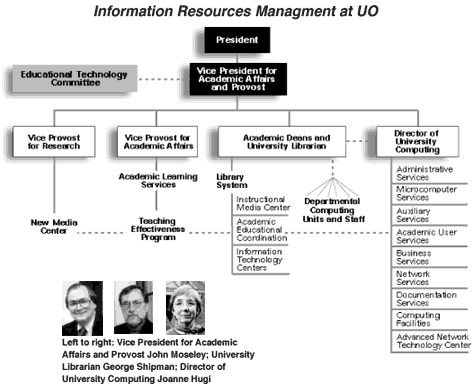
Vice President for Academic Affairs and Provost John Moseley charged a committee made up of faculty and technologists with articulating an educational technology vision for the University, to help support a proposal for such a student fee. The Educational Technology Committee's vision statement consisted of seven principles to guide the development of educational technology at UO, principles that emphasized enhancement, not replacement, of human interaction; assurance of equitable access; the importance of training; facilitation of a range of educational modalities and methodologies; production of technology-based courseware; assessment of the contribution of educational technology to a quality education; and allocation of human resources to support and accommodate change.
The proposed $50-per-term student technology fee was approved, thanks to the support of UO students (who declined to join a statewide student lobby to oppose any new fees). President David Frohnmayer believes funding from the fee has made a tremendous difference at UO: "It gave us the capital to fund a huge number of service delivery innovations for our students. If we had had to rely on a legislative appropriation, we probably would have had to wait until the year 2001. But we felt it was very important to provide student network access as quickly as possible; the student assessment enabled us to make the investment. That seed capital has taken us a very long way and has provided an essential planning tool for the future."
The Educational Technology Committee has since evolved into an ongoing advisory group which helps to set directions for technology at UO. The committee now includes representatives from the deans and Library, as well as faculty and staff of University Computing. Subcommittees in various functional areas explore issues and make recommendations related to those areas.
According to Joanne Hugi, director of University Computing, the Educational Technology Committee is an excellent vehicle for facilitating communication and developing strategies. "When we sit together and address the mission of integrating technology into the curriculum, the deans are responsible for figuring out how to bring the faculty along, while the Library and University Computing are much more involved in how to support them in that effort. It's a very effective process."
Given the entrepreneurial campus culture, Hugi says planning for information technology is more "just in time" than formal and long-range. "We don't have a plan for where we will be five years from now. I just don't think we could predict that far out." The University is required as a member of OSSHE to submit a plan for all major projects or acquisitions every two years. The most recent information resources plan emphasized the University's objectives of aggressively pursuing the delivery of student information using Web-based tools, implementing the client/server architecture of a set of purchased integrated administrative systems, and upgrading the network backbone from 10Mbs to 100 Mbs.
While many universities have created a chief information officer position to unify information resources planning and management, Moseley says UO has not needed to do that. "We're fortunate to have excellent library and computing directors who have shown great leadership, who have a vision and understand the future of the networked environment, and who collaborate and work very well together."
University Computing
The mission of University Computing is to stay abreast of current developments in computing and networking technology, acquire and maintain state-of-the-art hardware and software products to meet needs of users, and offer a full range of educational computer-related support services.
University Computing consists of nine service areas (see organization chart above), a much flatter organization than the previous configuration of three broad areas (applications and user services, network services, and facilities operations). Hugi says this reorganization has provided an opportunity for more functional focus and for more talented professionals to have a say in how the organization moves forward.
University Computing has long recognized the importance of having a dedicated network services unit to provide central coordination of the campuswide network infrastructure. Among the leading-edge projects this unit has implemented is the deployment community-wide of wireless Ricochet modems, in alliance with Metricom, Inc., making UO one of only a handful of universities in the country to offer this service to faculty, staff, and students. In a more recent move, Hugi's organization established a research and development unit, called the Advanced Network Technology Center, for the express purpose of developing leadership in network technologies. ANTC is currently evaluating ATM technology (including the challenge of developing protocols such as RSVP over ATM), Internet integrated services issues, and desktop digital videoconferencing using multicast backbone (MBONE) technology.
Hugi says University Computing recognized the value of decentralizing technology support to colleges and departments early on, especially first-level support. "Faculty need to have someone near at hand to provide technology support. We were happy when departments hired their own computing personnel, especially when often the people they hired had been employed in the central computing organization as undergraduates. These links have been invaluable for effective planning and communication between departments and central computing."
Last year, through a new workshop activity, University Computing and Library staff spent two days working together on common goals and objectives and getting to know each other better. The workshop was very successful in cementing the collaborative relationship between the two organizations.
University Library System
One of the strengths of the UO Library, under the leadership of University Librarian George Shipman, is its commitment to providing quality services and its creativity in designing new programs to meet the University's mission and goals. Several examples of the latter include expanding the Library's instructional program, developing the Orbis union catalog (a collaborative partnership among thirteen academic libraries in Oregon and Washington), restructuring services in the Instructional Media Center, and expanding information technology facilities.
The Library was quick to recognize the need to offer an "Internet curriculum" to teach students, faculty, and staff about Internet services, resources, and publishing opportunities. Last year, the Library received a grant to explore effective methods of teaching information technology to all incoming students during orientation week. This program, called Get Ready, will be launched with the incoming Fall 1997 class.
The Instructional Media Center's space has been expanded to provide, among other facilities, a new TV broadcast studio. The IMC offers teleconference downlinking via dual-feed satellites, and a major emphasis of the center will be delivery of educational services to students at remote sites.
Within the last three years, the Library has built two Information Technology Centers and a third center is under development. These centers are learning laboratories where students and scholars in all disciplines can have access to a wide variety of electronic resources, educational technologies, and information systems.
With funding from the student technology fee, a new function -- Academic Educational Coordination -- has been established within the Library to coordinate support for faculty who wish to incorporate technology into their courses. This important unit oversees the Faculty Consultants Network, a group of faculty leaders in educational technology who volunteer to assist their colleagues in locating resources and using instructional technology. A monthly or bi-monthly network newsletter and an electronic discussion list help to keep faculty informed. This coordinative unit also serves as the Library's link to the University Teaching Effectiveness Program and the New Media Center (described below).
Recently a proposal was submitted to the governor for funding to address the need for curriculum development and faculty support. Over a six-year period the money would be targeted for projects that improve teaching, increase access of courses for students both on and off campus, and increase faculty productivity. While the proposal was not funded in the governor's budget, UO plans to bring it to the state legislature for consideration later this year.
In the meantime, there is much activity already under way to support faculty in technology applications. UO is one of fifty-two institutions worldwide with a designated New Media Center, established in cooperation with Dynamix/Sierra Online. Staff at the center, whose purpose is to work with faculty interested in developing and publishing high-quality, interactive multimedia instructional materials and courseware, has developed a prototype of a new product that will enable faculty to quickly and easily manage and organize a Web site as a focus for a course, without having to learn HTML.
A key program at UO that has existed for many years is the Teaching Effectiveness Program (TEP) in Academic Learning Services, the primary support organization for faculty and graduate teaching assistants interested in improving their instruction. According to Director Georgeanne Cooper, an emphasis on teaching, coupled with increased interest in technology, has revitalized this program in the past two to three years and it has become "as successful as we can handle." A Learn and Earn grant enabled hiring students to make "housecalls" to faculty who have support needs. Cooper says the distinguishing characteristic of TEP activities is their focus on pedagogical concerns, rather than the technology itself. Thus this program is a valuable place for testing new tools, such as those being created in the New Media Center, to ensure that pedagogical considerations are addressed.
Former chair of the Educational Technology Committee Greg Bothun is undoubtedly the University's most active faculty user of the network as a teaching tool. In addition to having developed Java-based modules that allow students in his classes to conduct online experiments,2 he has taken a scholarly interest in investigating the use of high-speed networking for improving the learning environment through the integration of research and education. A grant proposal that he and Provost Moseley submitted to the NSF was awarded funding earlier this year to continue research in this area. This continued study will draw on several projects already under way as a result of earlier activities, among them NERO and the Lane Education Network. NERO is a nationally recognized network developed in partnership with Oregon State University with funding from NASA, to deliver high-speed connectivity to engineering schools at five Oregon higher education institutions. UO developed the Lane Education Network (LEN) with initial funding from the National Telecommunications Infrastructure Administration. LEN provides high-speed fiber-optic network connectivity to a consortium of fourteen educational, industry, local government, and community groups, including all the local K-12 public school districts. UO science faculty recently worked closely with K-12 science teachers to develop curriculum Web pages that enable students to interact with real data.
The major production applications at UO include SCT's Banner systems for student information, financial aid, and finance, as well as Duck Call, an integrated touch-tone registration system. The Banner human resources module is being implemented with a client/server architecture, and UO plans eventually to have a fully integrated database of all major administrative systems with a graphic user interface.
When the student system modules were implemented in 1991-92, the project management team represented a real partnership between the student services and computing offices. It was truly a collaborative effort in which the way students were served was evaluated very closely and many changes were made in conjunction with the Banner installation. The group that managed the student systems implementation has become the ongoing Banner Coordinating Group, which meets regularly to address administrative systems issues and policies.
The recently completed Banner Web application allows students to directly access much of their information, for example, to look at their schedule, change addresses, get grades, change passwords, obtain a bill, and so forth. According to Registrar Herb Chereck, this application has "significantly changed how we do business; foot traffic is 40 percent less than it used to be."
Associate Vice President for Student Academic Affairs Jim Buch concurs: "We are just beginning to get a feel for the benefits of system integration. We now look at every position that becomes available, to see if we still need it, if it needs to be redefined to assist or complement other kinds of functions, or if we can better use it in a different area."
The systems integration has also meant that a lot of information can now be made available to departments to help students get the answers they need quickly, and to support administrative decision-making.
President Frohnmayer speaks often of the value of information technology to the University of Oregon, especially the network connections that link the local government, school districts, and businesses. In Frohnmayer's view, "This makes the University a 'citizen of the community' and encourages communication and learning throughout all relevant communities. The University of Oregon is tied securely to the future, both locally and nationally. I could not be more pleased at the remarkable advances we have made."
 This is a very entrepreneurial campus. People are encouraged to experiment and, I hope, are rewarded for experimentation that results in progress. We don't have a command-and-control administration. We have the kind of atmosphere that encourages innovation and working together in small collaborative groups, and that can end up with big results.
Without the brain power of our technology staff and others, we would still be ad-hocking our way to a network system, instead of having built something that is much more integrated. We don't have resources to replace technology at the optimum moment, but then the tough part is to know when the optimum moment is. That is why it's important to have really smart people in your organization who can decide when to pull the plug.
I think we have leveraged the money we have spent on technology -- federal grants, private grants, student fees -- very effectively, and I think that is very important. We have received a lot of value for the dollars invested. I am very proud of our people for that.
People are our most important resource. They have to be open-minded, flexible, daring, and, yet, still conservative. They have to serve up bite-sized morsels before they serve up the whole meal.
I've seen so many very expensive technology investments "go bad" at other universities; it is really a great joy to see something done so well on a shoestring budget. We are proud of our university being recognized for its excellence. A lot of that has to do with our "organic-growth" rather than "control" approach.
2This work was described in an article by Bothun in the Winter 1996 CAUSE/EFFECT (http://www.cause.org/ir/library/html/cem/cem96/cem9648.html).
This article is based on a visit to the University of Oregon by editor Julia Rudy. CAUSE/EFFECT's Campus Profile department regularly focuses on the information resources environment -- information, technology, and services -- of a CAUSE member institution, to promote a better understanding of how information resources are organized, managed, planned for, and used in colleges and universities of various sizes and types.
![[Comments]](/ir/library/html/cem/comments.gif)
![[Search]](/ir/library/html/cem/search.gif)
![[Home]](/ir/library/html/cem/home.gif)