Copyright 1998 CAUSE. From CAUSE/EFFECT Volume 21, Number 1, 1998, pp. 28-31. Permission to copy or disseminate all or part of this material is granted provided that the copies are not made or distributed for commercial advantage, the CAUSE copyright and its date appear, and notice is given that copying is by permission of CAUSE, the association for managing and using information resources in higher education. To disseminate otherwise, or to republish, requires written permission. For further information, contact Jim Roche at CAUSE, 4840 Pearl East Circle, Suite 302E, Boulder, CO 80301 USA; 303-939-0308; e-mail: [email protected]

Campus Profile:
Duke UniversityWell known for its contributions in North Carolina's Research Triangle and its strong position in men's basketball, Duke University is located in Durham, North Carolina. The striking 9,350-acre campus includes 7,700 acres of forest, and the 210-foot tower of the Duke Chapel accentuates the predominantly Gothic architecture of the West Campus.
Duke is a private institution with an enrollment of more than 11,500. The university was established in 1924 by expanding Trinity College, which traces its roots back to 1838.
The internationally known Duke University Medical Center, currently under reorganization, incorporates one of twenty-one federally funded comprehensive cancer centers, an eye center, and a federally supported general clinical research unit. Duke's library holdings are the eighth largest among private universities in the United States, boasting more than 4.5 million books.
Executive Support
Information technology is a priority at Duke, and a commitment to implementing innovative systems and taking advantage of new research starts at the top with President Nannerl Keohane. She applauds the Duke community, explaining that the most valuable resource for information technology at Duke is the supportive atmosphere "created by faculty, students, administrators, alumni, trustees alike. We're all hooked on information technology and determined to do things even better."
Keohane notes that Duke carefully measures its investments in the information technology arena. She explains, "We are not rich enough to be on the cutting edge of technology in all areas, and we also know that it's a risky place to be. We'll take the risks in some high-tech areas, but we choose our bets carefully."
Still, Duke has been aggressive enough in the field to earn widespread media attention, including recent pieces in Network World and PC Week, as well as award recognition for its networking infrastructure and help desk.
Duke's Office of Information Technology was established in 1994, pulling six information technology units under one umbrella. At the same time Betty Le Compagnon arrived to fill a new position, vice provost for information technology and chief information officer. Le Compagnon's tenure at Duke has been characterized by communication, personal relationships, and collaboration, both within OIT and with other organizations.
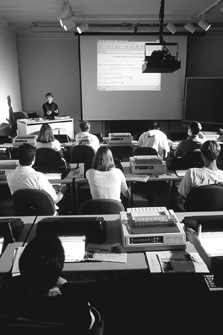
There are over fifty multimedia classrooms available, with more in the planning stages. Seating capacity ranges from twenty to fifty students. In the classroom pictured above, students sit at individual multimedia workstations that can be controlled by the instructor from a teaching console in the front of the room. This allows the instructor to provide help on an individual basis or share a particular screen with the entire class. Also available is a remote broadcast system connected to the Media Center in Lilly Library that makes use of the campus network to bring media images into the classroom on demand.
Advising the CIO
Much of the planning and decision-making for information technology at Duke is spearheaded by one group, the Information Technology Advisory Council (ITAC). The council, which includes representatives from all corners of the institution, advises Le Compagnon. ITAC was established in 1995 and comprises faculty, undergraduate and graduate students, and staff and administrators, including information technology representatives from different schools, the library, and the Medical Center.
The purpose of ITAC is "to support the academic mission of the University through the appropriate use of information technology." Toward that end, the council advises the vice provost on issues of technology and policies, it develops strategic plans for information technology, and it keeps the community informed about issues and initiatives.
A recent decision reversal illustrated the council's willingness to listen to its members. Students protested a plan to create a Macintosh multimedia center in lieu of replacing Macs in computer labs. While money would be going into Mac computers in either case, students preferred having up-to-date machines available for everyday use. When student representatives presented their position at a council meeting, administrators were persuaded that the original plan was not the best one.
Though ITAC is a conglomerate of people with different views and different needs, Le Compagnon says the efficient handling of the Mac issue is indicative of the council's style. "The council has productive discussions and resolves a number of issues, while including everyone. Even those people who aren't necessarily happy with a decision understand the process," says Le Compagnon. "It allows us to make the decisions we need to make as we go along, and that's key."
Campus Connections
"People, process, and then technology," says Philip Verghis, manager of Customer Services, explaining his philosophy of customer support. When hiring Help Desk staff, Verghis looks for customer service skills over technical expertise. Once on board, staff can quickly gain technical knowledge, while people skills are more difficult to pick up.
At the same time, Verghis wants to tackle the majority of inquiries at the first point of contact. "The philosophy is that the frontline customer support should have all the toys that every group has and more," he says. This enables the staff to quickly access the system that is problematic. Verghis' principle is paying off: In September of 1996, 60 percent of the inquiries were solved with the first call; a year later that figure rose to 90 percent.
And customers aren't going be satisfied if the Help Desk isn't, so Verghis is careful to reward employees with social events as well as involve them in the decision-making process. "Assign projects to whomever they affect most," he says. In fact, two students completed 90 percent of the work to streamline last fall's Students With Access to Technology project, or SWAT, a project to get students connected as they arrive on campus.
Duke's residence hall rooms are wired for direct Internet access to DukeNet. Through SWAT '97, three-quarters of the student population, including all freshmen, were connected to the campus network before school started. The rest were connected within the first week of classes. In its third year, SWAT's pricetag was lowered; the project cost less than half of what it did the previous year.
The idea was also not to overload or increase the size of the staff, says Ginny Cake, director of Customer Support, who is proud of Duke's success in self-help. "We want to maintain the size of our staff, even though the inquiries are increasing. We want to help people help themselves." With this process, students who do need real-time help get quality response right away.
Cake explains that self-help starts with published hardware and software guidelines. An easy-to-understand Internet Survival Kit, complete with a guide and diskette or CD, is distributed to students, and the Help Desk runs self-help Web pages. More than 27,000 documents addressing common issues exist on the Web site, and more documents are added as inquiries filter through the Help Desk. During the September crunch in 1996, the Help Desk received 17,500 direct (primarily e-mail or phone) inquiries and 7,200 hits to the Help Desk Web site, totaling 24,700 hits. Although the total number of inquiries more than doubled to 53,200 during September of 1997, the number of direct inquiries rose only to 18,200, while Web inquiries rose dramatically to 35,000.
The success of the Help Desk is credited to DUNK, the Duke University Network Knowledge Base. A reengineering project, DUNK placed Duke as runner-up for the Help Desk Institute's 1998 Team Excellence Award -- a position previously unattained by a university.
A collaboration between OIT and Medical Center Information Systems (MCIS), DUNK was a multi-year project that transformed the Help Desk -- a paper and pencil operation -- into a state-of-the-art support structure. In mid-1997, the Fuqua School of Business and the Law School information technology groups joined Project DUNK. Start-up costs for DUNK were evenly split between OIT and MCIS.
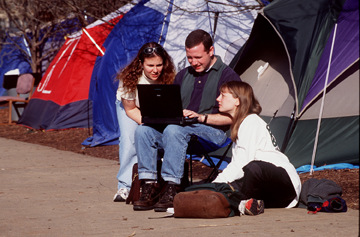
The Help Desk recently helped to keep a pilot project running smoothly at Krzyzewskiville -- a village of tents where students camp out for up to six weeks to get men's basketball tickets. The village, which this year had 1,300 residents, is named after Duke's head basketball coach, Mike Krzyzewski.
Bob Currier, director of Data Communications, convinced Akom, a manufacturer of wireless Internet connections, to use Krzyzewskiville as a test site for their new equipment. A central transmitter and Ethernet-card-like devices permit laptops to access Duke's award-winning campus backbone.
Watching the excitement of students during the Wireless Project at Krzyzewskiville was gratifying to Currier. "It's easy to forget why we're here. When you only see the technology, you tend to disassociate yourself from the person," he said.
Following the successful run of the Krzyzewskiville project, the wireless technology has been installed in the Bryan Center, Duke's student union building, where students with specially equipped laptops can now check e-mail from any of the study rooms or while sipping coffee in the cafe. Other locations being considered for wireless networks are the Perkins Library and the Fuqua School of Business.
Currier is also in charge of DukeNet, which won an honorable mention in CAUSE's Awards for Excellence in Campus Networking in 1997 and was a co-winner in the 1997 Network World User Excellence Award competition. The network, conceptualized in 1989, now boasts more than 20,000 individual registered hosts.
For academic and administrative buildings, Duke is three years into a $20 million, four-year plan to install Category 5 wiring for voice and data and RG-6 coax for video services. An earlier project to provide Ethernet connections and cable TV to student residence halls was completed in 1994.
In March, 1,300 students camped out -- some for up to six weeks -- to get tickets to Duke�s men�s basketball games. This year residents of the tent village Krzyzewskiville, named for head coach Mike Krzyzewski, were able to access the campus backbone through a pilot project testing wireless Internet connections. Building Alliances
Two key partnerships at Duke are those that OIT holds with the Medical Center and the library. Le Compagnon stresses that it wouldn't work to keep the organizations isolated, saying, "For everything now, you have to collaborate with everyone else on campus -- the technology is forcing you to." But she also believes that the organizational structure is not important: "When you think of collaboration, you always try to think of structures. I think collaboration comes from a feeling that you try to give to your staff, that we try to do by example. You build the right relationship with the person in the organization, and it permeates in all directions."
University Librarian David Ferriero, who sits on ITAC, has worked with Le Compagnon and OIT on projects such as building an electronic reserves system. He agreed with Le Compagnon, saying, "I think there's a growing realization that we need each other, and there's a tendency now for libraries and computer centers to work together," regardless of reporting or organizational structures.
But noting that some people or schools still prefer to work as separate entities, Le Compagnon added, "More than anything else, I think the role of the chief information officer and of the librarian today has to be that of facilitator and negotiator."
A similar spirit exists between OIT and Medical Center Information Systems, where walls existed not so long ago.
Landen Bain, CIO for the Medical Center, said that he and Le Compagnon have worked to collapse the barriers between their departments and work under a different principle. "What we have arranged is a general willingness to collaborate and do things together, unless there's a clear reason not to," he said, explaining that factors such as patient confidentiality make partnerships in some areas inappropriate. But projects like DUNK work well. "The closer something is to an infrastructure level, the easier it is for us to collaborate, and the farther out it is at the application level, the more distinct it is." Most of the work in classroom enhancement isn't crossfunctional, for example, but there are real advantages to working together to negotiate with common vendors.
A year ago, OIT and Medical Center Information Systems combined their printing operations, saving $35,000. The printing load of MCIS was transferred to OIT Computing Operations' high-speed, network-attached printers. Le Compagnon said that it was the first major collaboration where one unit had to rely on the other, and it was managed successfully.
Both administrators noted the importance of communicating to their staffs and maintaining a balance between the two organizations. Said Le Compagnon, "At our level, we don't have to make it happen, so we can say, 'Gee, it would make perfect sense to combine our two machine rooms and make it one virtual machine room,' but we don't have to then figure out how to do it." So when it comes to planning a project, staff are urged to get involved from both sides.
Bain added that while he and Le Compagnon talk often, the staffs don't mix as frequently. To encourage positive relationships, the groups now hold a joint annual holiday party. Bain stressed the party's impact: "I think that was an incredibly important, symbolic step -- people started to think in the collective 'we.'"
Cake noted that as Duke implements new technologies, the university is changing its style. "I think the old adage at Duke was that the information technology department should decide how things should be done, and how the technology should be used, and we're trying to change that focus to say, 'You tell us what you want to achieve, and we'll come in and give you the tools and techniques to get things done.'"
Two current projects are university-wide. A new financial system is being implemented, and so is Student Information Services and Systems, a project that will replace antiquated and redundant systems and services. SISS will synchronize efforts throughout the schools and allow the community access for tasks such as online registration.
Beyond Duke
The University has recently worked to coordinate community outreach, and OIT was among the first organizations to extend a hand. A number of Durham neighborhoods have been identified to receive contributions from Duke, and OIT is working with schools and community centers to assess their computer needs and to generate corporate support. OIT is donating computers and office furniture, as well as helping with training teachers in information technologies.
On a national level, Duke is a charter member of Internet2, the initiative to create the next generation of the Internet. Ferriero and Le Compagnon both serve on the advisory board for the North Carolina GigaNet Initiative, a regional network interconnecting Duke, North Carolina State University, the University of North Carolina at Chapel Hill, and the Micro Electronics Center of North Carolina (MCNC) in Research Triangle Park.
The Triangle is at the forefront in the Internet2 project, and through North Carolina GigaNet, researchers will have access to high-speed network resources like the vBNS (very high-speed backbone network system) and the Energy Sciences Network (Esnet), which together will form one of the first implementations of Internet2. A related project, Peer Central, will keep local traffic from traveling to remote locations unnecessarily.
Impact
President Keohane notices technology's impact throughout the university: in the relationships among students, through electronic conversations about ideas; with faculty members, in sharing course information and holding "virtual office hours"; and among administrators, in being able to exchange ideas and information rapidly and effectively.
Says Keohane, "Most of the impact has been positive; our forebears would have been open-mouthed at the ease with which we communicate and transfer complex information. But we also need to turn off the computer more often and get out for face-to-face exchanges over coffee."
Looking forward, Le Compagnon also wants to maintain a focus on people and a continued exploration of collaboration and cooperation. She says, "It is important to remember that the answer is not simply more technology. As the use of technology becomes more widespread, we must focus on 'human issues.'"
CAUSE/EFFECT�s Campus Profile department regularly focuses on the information resources environment -- information, technology, and services -- of a CAUSE member institution, to promote a better understanding of how information resources are organized, managed, planned for, and used in colleges and universities of various sizes and types. This article is based on a visit to Duke University by CAUSE Writer/Reporter Shannon Burgert.
![[Comments]](/ir/library/html/cem/comments.gif)
![[Search]](/ir/library/html/cem/search.gif)
![[Home]](/ir/library/html/cem/home.gif)