

This article was published in CAUSE/EFFECT journal, Volume 21 Number 3 1998. The copyright is shared by EDUCAUSE and the author. See http://www.educause.edu/copyright for additional copyright information.
Enterprise Network Management: Solutions Are Needed!
by James S. CrossEnterprise Network Management--end- to-end management of networks, sys- tems, desktops, and applications--is a hot topic as we approach the 21st century. Heightened interest in this topic is being fueled by the proliferation of "netcentric" computing, the double-digit growth rate of advanced intelligent network services, the unabated growth of the Internet, and the convergence of the Public Switched Telephone (PST) network and networks based on the Internet Protocol (IP). These developments, coupled with the advent of powerful new desktop computers and Internetworking technologies, have ushered in a new era in network management.
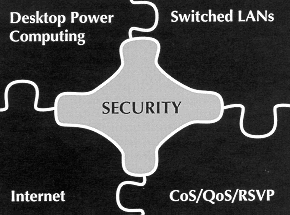
Although the idea of voice, data, and video integration is not new, several developments have renewed interest in using a common transport and an enterprise network management approach. Perhaps the biggest are the core elements of the netcentric computing puzzle illustrated in Figure 1: continued growth in desktop computing power, expansion of the Internet, and the trend toward the replacement of the traditional shared-media, frame-based local area networks (traditional Ethernet and token-ring) with switch-based, frame-cell local area networks (ATM and fast Ethernet). Industry has also embraced the universal serial bus, a new physical interface for connection of telephones to PCs.
Figure 1: Netcentric computing puzzle
The growth of the Internet has also brought enhancements in wide area network (WAN) and local area network (LAN) infrastructure technologies such as improved latency, class-of-service (CoS), quality-of-service (QoS), and non-blocking connections that enable LANs to support voice communications. According to a survey conducted by Beyond Computing, the Internet and associated technologies such as client/server, network computing, data warehousing, and data mining will have the most impact on businesses and organizations in 1998.1 Finally, from a management perspective, SNMP (Simple Network Management Protocol) has become the management protocol of choice for data-oriented LAN products and voice PBX systems.
As more and more vendors climb aboard the voice-over-IP and IP telephony bandwagon, next-generation IP switches, routers, and call processor servers (PBX) will enable network managers to integrate and manage voice and video traffic on their IP networks. A survey of the literature indicates: (a) all of the major players from the telecommunications and data communications industries have announced initiatives for the burgeoning voice-over-IP market; and (b) spending on LAN backbone connections will continue its exponential growth well into the next century.2
The next-generation network will be built around software-controlled switches, virtual routers and hubs, servers, and a policy/performance-based network management system that allows dynamic reconfiguration, to meet the needs of delay-sensitive voice, bandwidth-hungry multimedia, and virtual-reality applications. According to a report by Business Communications Inc., expansion of the Internet, increased automation, and a telecommuting workforce will continue to boost the growth in the computer telephony marketplace by well over 30 percent for the next five years.3
A taxonomy of challenges and tools
Little happens on campus that does not involve the network--from the simplest phone call to mobile computing to biotech research to electronic commerce to the most complicated digital operation. Many challenges network managers face emanate from the substantial increase in traffic in recent years on wide area networks, caused by a proliferation of network-based applications. In the distributed model, you could expect that about 80 percent of LAN traffic would remain on the LAN segment. As more users adopt the centralized server model, only about 20 percent of LAN traffic will remain on the local segment. Traffic to and from file and print servers is also of particular interest because it can have a profound impact on network traffic patterns, often accounting for more than 50 percent of all traffic.
In mission-critical networks, performance is always important, but uptime, reliability, and bandwidth management are paramount. The following represents a taxonomy of areas of growing concern to campus network managers, particularly from the perspective of availability (or lack thereof) of tools to facilitate an enterprise network management approach.
Circuit management
In circuit management, we need a whole new generation of frame/cell performance and service-level management tools to deliver the performance and availability that mission-critical applications demand. The tools must consist of both network access probes and centralized trending and analysis management software that work together to provide customers and service providers with a circuit-to-socket view of how the network is performing against committed service-levels. According to research statistics published by Datamonitor, the worldwide market for ATM and frame relay switches will triple between 1996 and 2001, growing from $1.5 to over $5.2 billion.4Object and agent management
For successful object technology management, it will be imperative for system and network managers to have the tools to control and manage the downloading and testing of executable object code in a neutral environment as the use of Java and ActiveX continues to proliferate. Although the benefits have been highly touted, many believe allowing object technology code to move across a network and be executed on a user�s desktop, without direct intervention or monitoring, poses serious security risks and exposures. The challenge for network managers is to assemble a cadre of tools to minimize the risk and maximize the benefits.Directory services management
In the directory services area, network managers must have the tools to integrate disparate directories and better manage user access, security, and accounts across a rapidly expanding networking arena. The magnitude of the directory management challenge is indicated by the number of different directories being used by organizations. According to a survey conducted by Forrester Research, Inc., the following range of installed directories were indicated when fifty large companies were asked what types of directories they used: e-mail, NT Domain, Netware NDS, mainframe, netware binderies, DNS, UNIX, and a host of other homegrown applications.5 The Lightweight Directory Access Protocol (LDAP) is one evolving standardized solution that lets users integrate and gain access to information locked in proprietary databases. Although LDAP implementation is still relatively immature, it will go a long way toward easing some of the challenges involved in directory management.Quality-of-service management
In the quality-of-service area, the advent of powerful new multimedia desktop systems and applications has ushered in a new era in network management. Every week, some company announces the latest "must-have" application that pushes the limits of network performance. With growing demands for these "gee whiz" technologies, network managers are faced with a precarious balancing act of providing the bandwidth-hungry, high-performance network features and resources that users demand, without sacrificing QoS. According to a recent survey by International Network Services, over 40 percent of users are currently dissatisfied with the overall quality of network performance management. That same survey found that no single tool dominated this area, with a plethora of products cited by respondents, including Network General, HP Openview, Ciscoworks, Bay Optivity, Cabletron Spectrum, SunNet Manager, IBM Netview, and a host of homegrown applications.6Cost accounting and management
As the cost of workstation ownership and network management continues to escalate, users are more and more required to balance technology needs with business objectives. Priorities now include applying business metrics to technology investments and demonstrating the value of network initiatives. Nowhere are these considerations more crucial than in planning, implementing, and integrating new technologies and applications within the enterprise network. According to a study conducted by the Gartner Group, the cost of workstation ownership per year ranges from just over $2,000 for a thin client workstation to well over $14,000 for a "custom fat" workstation.7
Security management
In the security area, the system must provide the capabilities to support a broad range of security techniques incorporating single sign-on and authentication. Protecting your network starts with door locks--locks that control and filter access to servers, applications, and databases. A number of packages are available to support network security planning and auditing, e.g., AuditTrack, BlindView, LT Auditor, and Kane Security Analyst. According to a Beyond Computing survey, the top five security techniques being used in netcentric computing environments are passwords, fire walls, encryption, authentication, and biometric technology.8 A comprehensive set of integrated security tools are necessary for end-to-end management of jobs and business processes.Traffic management
In the traffic management area, quality-of-service and class-of-service management are evolving to be the defining features of the next- generation network. The goal is to adapt the high-speed technology of satellite, microwave, and fiber to a wide array of applications and service types to ease net congestion and guarantee packet delivery. Three activities worth noting are the working group reports and specifications for the Subnet Bandwidth Manager (SBM), Integrated Service over Specific Link Layer (ISSLL), and High Performance Routing (HPR). High-performance routing combines the best features of advanced peer-to-peer networking, frame relay, IP, and System Network Architecture. It draws upon the non-disruptive rerouting capabilities in IP as well as congestion control and class of service to provide improved network performance and utilization of bandwidth.Software management
Software management for most campuses will continue to be characterized by a plethora of packages, applications, protocols, operating systems, and desktop systems. According to a study conducted by IDC, UNIX is still the predominant Internet server operating system with Windows NT gaining momentum.9 Netware, Mac OS, and IBM OS/2 are also still active players that have to be considered.Remote access management
Cheap and loaded with functionality, a new generation of remote-access platforms has evolved in the marketplace. The growing number of organizations establishing or planning to establish high-quality remote LAN connections has driven vendors to roll out a new generation of scalable products with significant increases in functionality and the number of users that can be supported. According to Dataquest, remote-access routers account for over 35 percent of the $4-billion router marketplace.10There are two differentiating features of the new generation of remote access server (RAS) products: first is a technology called adaptive switching that allows the aggregation of digital and analog circuits; and second is the ability to minimize dial-up cost by breaking the connection when the remote user is not actively sending and receiving data, and automatically reconnecting when the line is needed. The net effect of this new generation of RAS technology is less hardware/software, more efficient RAS management, tighter security, fewer circuits, reduced costs, and a simpler migration path from today�s predominantly analog dial service to tomorrow�s principally digital service.
Although there is a wide array of new products and services, determining which to buy to meet the security needs of your campus remote and mobile computing users can be difficult and confusing. There are high-capacity enterprise central site switches (e.g., Bay Networks Bay 8000 series); there are SOHO (Small Office Home Office) mid-range/low-end servers that support a specific LAN environment and a limited number of dial up sessions (e.g., Cisco 765/766 line of routers); and finally there are software-based products (e.g., Microsoft�s Remote Access Services running under Windows NT Server).
Conclusion
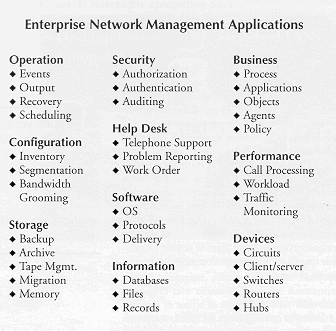
Success in managing the many faces and challenges of enterprise network management cannot be met with yesterday�s tools. We need a broad range of tools and capabilities to manage and control netcentric computing in a number of areas (see sidebar): security, information resources, help desks, configuration, software, storage, device monitoring, traffic congestion, business, and performance.
We need solutions that address:
- the new application demands of desktop conferencing, video on demand, IP telephony, voice on the net, and IP multi-casting and associated traffic profiles;
- infrastructure and the diversity of devices and application profiles;
- prioritization, evolution of service, and policy management; and
- the unique features of LAN and WAN operating environments and the mapping of CoS and QoS issues across these domains.
We must be proactive in working with our vendors and software suppliers to develop the tools and solutions we need to solve our enterprise network management challenges.
For further reading:
Duffy, Jim. "Routers� Role Changes As Both Switches, VLANs Come Into Play." Network World, 3 June 1996, 22.
Foreberg, Rick. "Wending Through The Quality-of-Service Maze." Network World, 10 November 1997, 49.
Krautkremer, Todd. "Circuit Management." Communications News, November 1997, 16.
Lawton, Stephen. "QoS Opens LANs To New Apps." LANTIMES, 10 November 1997, 26.
Radermacher, T., and P. Kocks. "Executable Content: Controlling the Potential Revolution." Sys Admin, November 1997, 61.
Staff Editor. "Political Maneuvers." Computerworld, 2 May 1994, 91.
Stenson, Tom. "Building a Next-Generation Corporate Network." Network World, 26 May 1997, 45.
Endnotes
1 Nick Wreden, "Business Boosting Technologies," Beyond Computing, November/December, 1997, 27.
2 Staff, "Trends," Communications News, May 1997, 6; and James Cross, "Radius: An Evolving Industry Standard," The ACUTA Journal, Spring 1998, 36.
3 Staff, "Trends," 6.
4 Staff, "Trends," Communications News, November 1997, 8.
5 R. Raynovich, "NT Directory Dilemma Split Users," LANTIMES, 27 October 1997, 13.
6 Marc Songini, "Net Management Tools Fail To Satisfy Users," Network World, 10 October 1997), 27.
7 Reported in "Java," Sun Microsystems, LFC 3.2HE290-0, October 1997, 4.
8 Wreden, 27.
9 Christine Burns, "Novell�s Web Server Strategy Thrown for Loop," Network World, 3 November 1997, 1.
10 Cross, 36; and Jim Duffey, "Remote Access Gear Piles Up," Network World, 20 May 1996, 12.
James S. Cross ([email protected]) is vice provost, Information Technologies, at Michigan Technological University.
