Understanding Higher Education Budgeting and Purchasing: A Guide for Trusted Partnerships

Higher education institutions operate within budget structures that differ significantly from those of commercial enterprises. Understanding these cycles and constraints is essential for vendors seeking to build productive, long-term partnerships with colleges and universities. Timing, funding sources, and institutional planning rhythms all shape when and how purchasing decisions are made.
Key Takeaways of the Guide
- Align outreach to institutional budget cycles. Most institutions plan budgets starting in January for a July 1 fiscal year. Align your outreach accordingly.
- Confirm funding early. The person interested in your product may not control the budget. Ask about funding sources and approval workflows early.
- Design pricing for enrollment variability. Enrollment-driven budget variability is real. Build pricing flexibility into your models.
- Do not rely on sales-driven urgency. High-pressure sales tactics are ineffective and damaging to vendor reputation in higher education.
- Make your timelines transparent. Clearly communicate pricing windows, renewals, and constraints so institutions can plan and advocate internally. Communicating your own timelines transparently helps institutional partners plan and advocate internally.
The Fiscal Year and Its Implications
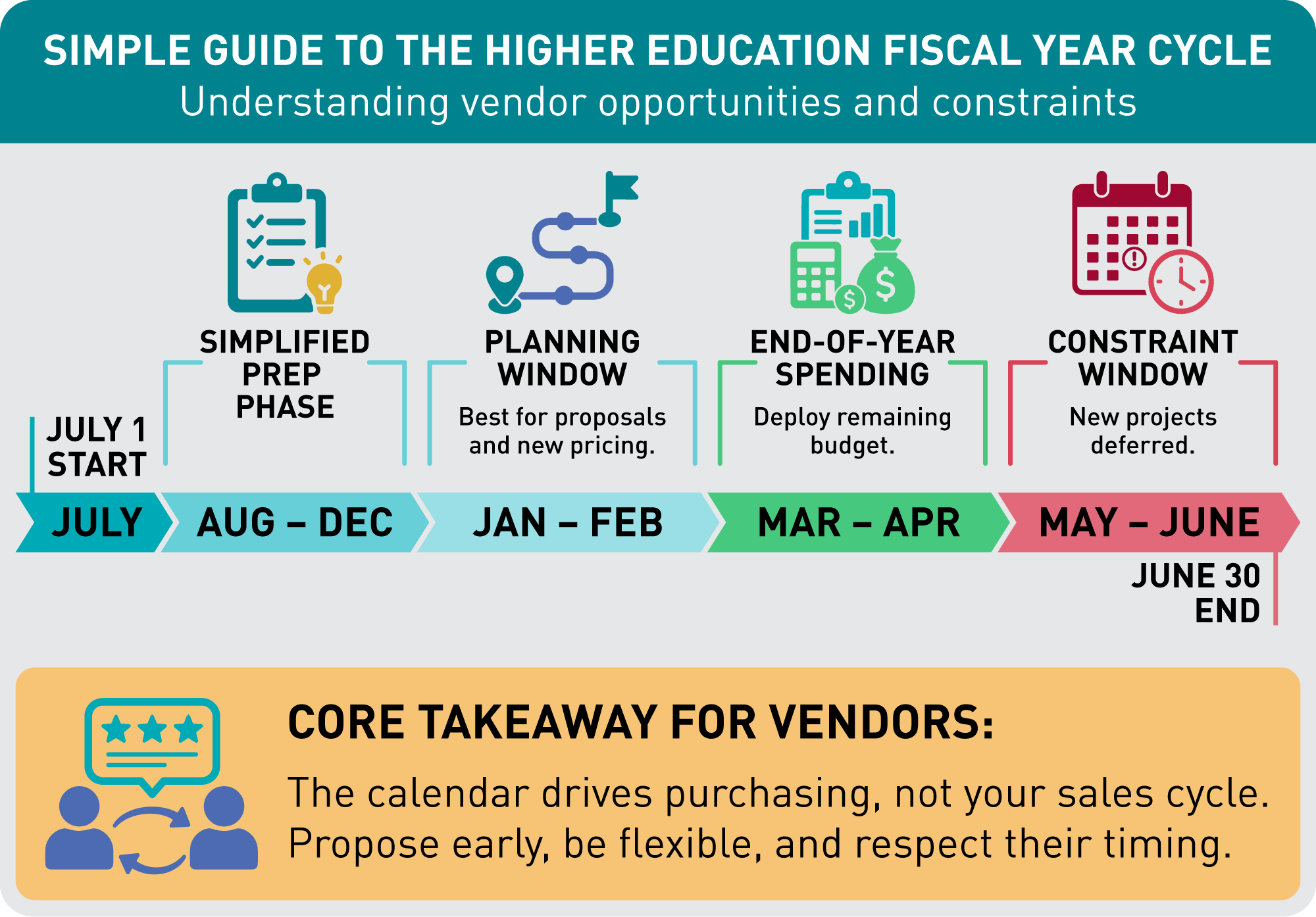
Most public higher education institutions operate on a fiscal year beginning July 1 and ending June 30, though some institutions and state systems follow different calendars. Budget planning for the upcoming fiscal year typically begins in January, when departments submit proposals and spending priorities for leadership review. Budgets may be in flux and are liable to change from late spring into early summer. Spending against those budgets begins in July.
In states that operate on biennial (two-year) budgets, institutions plan within a longer funding horizon but still manage spending and priorities on an annual basis. While the overall budget may be set for two years, allocations and institutional priorities can shift between years with that cycle. Institutions in these states retain flexibility in how funds are allocated but must still encumber funds within the appropriate fiscal period, which means that purchasing decisions cannot simply be deferred indefinitely, even within a two-year window.
For vendors this means that institutional purchasing timelines are driven by the institution's own financial calendar, not by a vendor's sales cycle or quarter-end targets. Approaching a conversation with urgency that reflects internal sales pressure rather than the institution's readiness is likely to create friction rather than accelerate a decision. Understanding when an institution is in active budget planning (typically January through spring), when budgets are being finalized and may still shift (late spring into early summer), and when new spending can begin (July) allows vendors to time outreach and proposals in ways that align with institutional capacity and decision-making. Sharing your own timeline expectations early—and asking about the institution's encumbrance deadlines and fiscal-year constraints—supports the kind of transparent communication that characterizes strong vendor–institution partnerships.
This cycle creates natural windows of opportunity and constraint for vendors. Institutions are most receptive to new proposals and pricing discussions during the planning window, roughly January through April. End-of-year spending activity can begin as early as spring, as departments look to deploy the remaining budget before the fiscal year closes. Once budgets are finalized, discretionary spending decreases and new purchases must either fit within approved allocations or wait until the next cycle. Approaching an institution in May or June with a new vendor-initiated initiative that was not anticipated in the planning process will almost always result in a delayed decision.
Unplanned purchases do occasionally occur outside the typical planning window. Enrollment changes, unexpected departures from a current vendor, one-time funding windfalls, or reallocation of unused budget can create ad hoc purchasing opportunities later in the fiscal year. These are institution-driven circumstances, not openings created by vendor outreach, and recognizing the difference matters. When an institution reaches out outside the normal planning window, it is worth understanding what is driving that conversation before assuming a standard sales process applies. It is important to remember that one-time funding is just that: funding available for a single year, not for a recurring contract.
End-of-year spending patterns vary by institution. Some departments may have remaining funds that must be spent before the fiscal year closes, creating a narrow window for smaller, already-budgeted purchases. However, this should not be mistaken for flexibility on large or unplanned expenditures. Even when sufficient budget exists for a purchase, the approval process required to move a purchase forward may extend past the fiscal-year close. Approvals over the summer can be particularly problematic, as key decision-makers, budget officers, and technical reviewers may have reduced availability due to vacations, institutional transitions, or reduced staffing. A purchase that appears straightforward in May can stall simply because the right people are not available to sign off in time.
For vendors, this means that end-of-year conversations are most productive when they involve purchases that are already in motion. If an institution signals end-of-year budget availability, the most useful question to ask is not "can we close this now?" but rather "do you have the approvals in place to move this forward before your fiscal year closes?"
Fund Types and Restrictions
Not all institutional dollars are alike. Higher education budgets typically draw from multiple fund sources, each with its own rules and restrictions. Operating funds cover day-to-day expenses and are allocated annually. Capital funds are designated for major purchases or infrastructure and often require separate approval processes and timelines. Grant-funded purchases follow federal or state guidelines that may impose additional compliance requirements, procurement rules, and audit expectations. Endowment or gift funds may carry donor restrictions on how they can be used.
For vendors, this means that the person expressing interest in a product may not control the budget that would fund the purchase. The administrative unit with the need and the unit with the funding may be entirely separate. Asking early about funding source, budget authority, and any restrictions on those funds helps prevent misalignment later in the process.
Enrollment-Driven Budget Variability
Higher education budgets are closely tied to enrollment. Tuition revenue is typically the largest single revenue source for most institutions, and enrollment fluctuations directly affect available resources. Institutions experiencing enrollment declines face tightening budgets, deferred purchases, and increased scrutiny on new expenditures. Conversely, growing institutions may have more flexibility but also more competing priorities for those resources.
This enrollment sensitivity has direct implications for pricing models. FTE-based licensing that locks an institution into a count established during a period of higher enrollment becomes a financial burden when enrollment declines. Vendors that build flexibility into their pricing to account for enrollment variability demonstrate an understanding of institutional reality that builds trust and positions them as long-term partners rather than transactional suppliers.
When and How to Engage
Timing matters. Vendors that align their outreach with institutional budget cycles are significantly more likely to be included in planning conversations. A well-timed introduction in late fall or early winter, before the January planning cycle, allows institutional leaders to consider a product or service as part of their upcoming budget. Vendors that appear in March with a product the institution was unaware of face an uphill battle for current-year funding and will almost always find that any serious conversation gets pushed to the next fiscal year's planning cycle. This is not a reflection of interest or fit; it is simply a function of how institutional budgets work. A product that arrives too late to be budgeted cannot be purchased regardless of its merit.
The practical implication is that vendor patience is not just a courtesy but a strategic necessity. When outreach lands outside the planning window, the most effective response is to treat that conversation as an investment in the next cycle rather than an attempt to force a current-year decision. Leaving a clear, concise record of the product's value proposition with the right institutional contacts and committing to follow up in the fall is far more likely to result in a funded purchase than pressure to act on an unbudgeted item. Institutions that say "come back next year" are not dismissing a vendor; they are describing their process.
Sharing your own timelines transparently also helps. If you have fiscal-year pricing windows, promotional periods, or contract renewal deadlines, communicating those clearly allows institutional partners to plan accordingly. Avoid creating artificial urgency through end-of-quarter pressure tactics, which erode trust and are particularly ineffective in higher education where procurement processes have fixed timelines that cannot be compressed to meet a vendor's sales cycle.
Vendor Pricing Models and Licensing Strategies
This section provides practical guidance for navigating institutional procurement processes, building productive relationships, and positioning your offering effectively.
Key Takeaways About Vendor Pricing and Licensing
- Build true-up/true-down and usage level provisions into FTE-based contracts to account for enrollment variability. Explore options for flexible pricing models with institutions to identify mutual best options.
- Honor consortium pricing consistently. Undercutting or exceeding agreed-upon rates damages trust with the entire community.
- Use stepped, predictable price increases rather than sudden, large adjustments.
- Opening with an inflated price you intend to reduce quickly signals a lack of institutional understanding.
- Vendor reputation in higher education is community driven. Pricing transparency is a long-term competitive advantage.
- Value-adds such as training, conference access, and customer advisory roles matter, especially to smaller institutions.
Pricing predictability is one of the most consequential dimensions of a vendor–institution relationship. Higher education institutions operate under budget constraints, enrollment variability, and governance structures that make certain pricing approaches unworkable and others deeply valued. Rigid approaches, including specific packaged bundles of services or solutions, may not be the best fit or provide the best value to every institution; providing flexibility for clients to build the most valuable bundle for their institution is important. Vendors that understand these dynamics and structure their pricing accordingly position themselves as trusted partners rather than interchangeable suppliers.
Common Pricing Models and Their Impact
Higher education institutions encounter a range of pricing models including per-user or per-FTE licensing, site licensing, tiered pricing, subscription models, and consumption-based pricing. Each model carries different implications depending on institution size, enrollment trends, and organizational structure.
Before entering pricing conversations with institutions, vendors should be prepared to clearly communicate whether they offer education-specific pricing, discounts, or nonprofit rates. Institutions will ask, and having a transparent, consistent answer ready signals the kind of partnership orientation that higher education buyers respond to.
FTE-Based Pricing
FTE-based licensing is common but introduces significant friction for an institution when enrollment fluctuates. An institution that signs a multiyear contract at a specific FTE count and then experiences enrollment decline is effectively paying for capacity it no longer uses. Similarly, institutions may learn after adopting a solution that a much smaller percentage of their overall FTE is using it than anticipated. Institutions increasingly seek true-down clauses that allow periodic adjustment of license counts to reflect actual enrollment or usage. Some vendors accommodate midterm adjustments, while others only allow changes at renewal. Vendors that offer true-down provisions and usage-level agreements signal flexibility and partnership; those that do not may find themselves in adversarial renewal conversations.
In practice, the most workable models combine annual true-down windows at renewal with a defined midterm adjustment trigger, such as an enrollment decline exceeding a set percentage threshold. Renewal-only adjustments are acceptable when paired with realistic initial FTE counts; midterm adjustments are particularly valued by institutions in volatile enrollment environments. Documenting the adjustment mechanism explicitly in the contract, including the counting methodology, the measurement date, and any floor or cap, prevents disputes later.
Inconsistent FTE counting methodologies across vendors add administrative complexity, particularly for under-resourced institutions. Establishing a transparent, documented counting methodology and communicating it clearly at the outset of the relationship reduces confusion and builds trust.
Consumption-based and one-off pricing introduce different planning challenges. Consumption models can be difficult for institutions to budget for reliably because usage is hard to predict in advance. For example, a product that looks affordable at low usage may generate unexpected invoices that fall outside approved allocations. One-off or project-based purchases are easier to budget but may trigger formal procurement processes depending on dollar thresholds, adding time and complexity.
Multiyear contracts offer institutions price predictability, which budget offices value highly, but they require vendors to build in fair adjustment mechanisms, including true-downs and stepped pricing increases, to remain workable across the full term of the contract. A multiyear contract with locked FTE counts and uncapped annual escalators is likely to become a source of tension rather than stability.
In all pricing models, the budget cycle has direct implications: pricing conversations initiated outside the planning window, or invoices structured in ways that don’t align with institutional fiscal years, create avoidable friction. Vendors that understand how their pricing model maps onto the institution’s budget calendar and communicate that proactively are easier to do business with.
Tiered and Consortium Pricing
Consortium and cooperative purchasing agreements are valuable channels for reaching multiple institutions through a single procurement process. However, these agreements function only when vendors comply with the agreed pricing consistently. Departing from the consortial rate, whether above or below, is not merely a relationship issue; it is a compliance concern for both the institution and the consortium. Institutional leaders who discover inconsistent pricing may be obligated to flag the discrepancy, and consortia that identify noncompliant vendors risk the integrity of agreements that other members depend on.
Equally important is the question of pre-sales commitments. When a vendor provides a quote that references a consortial agreement, that quote carries weight: offer and acceptance principles mean that the institution is relying on that pricing to move through its own procurement and approval process. If the final contract or invoice departs from what was quoted, the institution faces internal complications including potential re-approval requirements that erode confidence in both the vendor and the agreement itself. Vendors that align their proposals precisely with the terms of the consortial agreement, and that hold to those terms through close, signal that they understand how institutional procurement actually works.
Individually renegotiating outside the agreed rate with specific institutions undermines the collective value of the agreement and damages the vendor’s reputation with both the consortium and its members.
For multi-institution agreements, consider incentive-based pricing tiers that reward adoption volume rather than requiring all-or-nothing commitments. Price drops at defined adoption milestones are more workable than demanding universal participation upfront.
Price Escalation, Predictability, and Total Cost of Ownership
Rapid, unexpected price increases are among the most frequently cited frustrations in vendor–institution relationships. Institutions that invested in a product during an early or competitive-pricing phase and then faced increases of 20 percent or more after the vendor achieved market position describe this pattern as a fundamental breach of partnership. Private-equity acquisitions that trigger immediate price restructuring amplify this concern.
Institutions plan budgets annually and typically project costs over multiyear horizons. Stepped, predictable pricing increases spread across the contract term are far more manageable than sudden, large adjustments. A phased on-ramp approach, where pricing moves toward a target over multiple years rather than in a single jump, demonstrates respect for institutional planning processes and makes budget justification significantly easier for your institutional champion.
Helping institutions understand the total cost of ownership (TCO) of a solution strengthens the case for investment and reduces the risk of sticker shock later. TCO includes not only licensing or subscription fees but also implementation costs, staff time for onboarding and training, ongoing support requirements, integration work, and the cost of eventual renewal or transition. Vendors that surface these figures proactively rather than leaving institutions to discover them mid-contract make it easier for budget owners to plan accurately and for institutional champions to defend the purchase internally. A realistic TCO framing, presented early, is a sign of a trustworthy partner.
The level of detail institutions expect varies by asset type. Hardware TCO conversations should account for the full useful life of the asset (typically three to five years) including maintenance, refresh, and disposal costs. Software and platform agreements often carry longer horizons and should include a projected cost trajectory for at least the initial contract term, with a general indication of expected renewal pricing. Institutions do not expect vendors to guarantee figures years in advance, but they do expect an honest picture of the anticipated cost arc at the outset of the relationship.
Opening a pricing conversation with an inflated figure that you intend to reduce quickly signals a lack of institutional understanding. Starting at a realistic, defensible number and being prepared to show how that number reflects the full value and cost picture over the contract term builds credibility from the first interaction.
Transparency and Reputation
Higher education is a community-driven sector. Institutional leaders talk to their peers, and vendor reputation travels quickly through professional networks, conferences, and community groups. Pricing transparency—consistency across institutions, honesty about what is included, and straightforward communication about changes—is one of the strongest drivers of long-term vendor success in this market.
Confidentiality clauses in contracts that prevent institutions from sharing negotiated rates compound pricing opacity and can create resentment when institutions discover that peers received different terms. Consider whether such clauses serve your long-term interests in a relationship-driven market.
Non-disclosure agreements (NDAs) and confidentiality requirements that gate access to basic product documentation including accessibility compliance records, security assessments, or integration specifications create a particular point of friction. Institutions need this information to fulfill their own compliance obligations, and requiring an NDA to obtain that information signals misaligned priorities. A workable model separates negotiated pricing confidentiality, which has legitimate vendor rationale, from product and compliance documentation, which should be accessible without restriction.
Reputation in higher education is also shaped by visible participation in the community. Institutions notice which vendors show up, not just to sell but to engage. This means sponsoring and attending events at the state, regional, and national level; participating in affiliate organizations such as EDUCAUSE, NACUBO, and their regional equivalents; and contributing meaningfully to the professional conversations those communities care about. Vendor-sponsored events and co-presentations with institutional partners signal investment in the sector beyond the transaction. Vendors that are known in the community before a procurement process begins enter that process with a significant credibility advantage over those that appear only when there is a deal to close.
Engagement should extend beyond the sales team. When institutional staff encounter vendor representatives at a conference, in a working group, or through a community of practice and those representatives are knowledgeable, collegial, and present for reasons other than pipeline development, this builds the kind of ambient trust that makes difficult contract conversations easier and renewals more straightforward.
Value Beyond Price
Pricing does not exist in isolation. Institutions evaluate total value, including implementation support, training, ongoing customer success engagement, and partnership opportunities. Vendors that offer meaningful value-adds such as professional development resources, conference access, customer advisory participation, or co-marketing opportunities differentiate themselves, particularly with smaller institutions for which such gestures carry additional weight. These investments signal a strategic rather than transactional orientation.
Institutions are often asked what it takes to move from vendor to partner. The short answer is consistency over time: showing up in the community, honoring commitments, pricing transparently, and treating renewal conversations with the same care as the initial sale. Formal partnership programs, where they exist, typically involve joint participation in advisory groups, co-development of case studies or thought leadership, and dedicated customer success resources. If your organization has a defined partnership pathway, make it visible and easy to navigate. Institutions that feel like valued partners are significantly more likely to expand their relationship and serve as peer references.
Higher Ed Pricing Models and Licensing Strategies
Technology pricing negotiations are among the most consequential financial decisions institutions make, yet many institutional stakeholders enter these conversations without a clear framework for evaluating pricing models, identifying negotiation power, or anticipating common vendor tactics. This section provides practical guidance for higher education IT leaders, procurement professionals, and functional stakeholders who participate in purchasing decisions. Successful procurement processes rely heavily on strong internal communication, coordination, and partnerships among academic, administrative, and procurement organizations.
Key Takeaways About Institutional Pricing and Licensing
- Negotiate true-up/true-down clauses in FTE-based contracts or usage-level agreements to protect against enrollment or adoption variability.
- Require explicit annual escalation terms in multiyear agreements.
- Evaluate TCO, including implementation, training, integration, and exit costs.
- Share your budget cycle proactively with vendors to set timing expectations.
- Build peer networks for informal intelligence on vendor pricing and behavior.
- Recognize early-warning signs of transactional vendor behavior and negotiate protective terms accordingly.
- Engage IT, finance, legal, and procurement early; cross-functional alignment prevents last-minute complications.
Understanding Common Pricing Models and Encumbrance
Vendors are sales organizations, using a variety of pricing structures, each with distinct implications for institutional budgets. Understanding these models and their trade-offs is the first step toward more effective negotiation. Equally important is knowing who within your institution has delegated authority to commit funds at different dollar thresholds and ensuring that vendor conversations are happening with, or coordinated through, the people who can actually move a purchase forward. Encumbering funds at the right point in the process—and understanding your institution's specific thresholds for informal versus formal procurement—prevents delays and protects both parties from late-stage surprises.
FTE-Based Licensing
A per-FTE or per-user licensing structure ties costs to enrollment or headcount. This model can work well for institutions with stable or growing enrollment, but it creates financial risk during periods of decline. An institution locked into a multiyear contract at a fixed FTE count continues paying for unused capacity if enrollment drops. When evaluating FTE-based proposals, negotiate for true-down clauses that allow periodic adjustment of license counts to reflect actual usage; note that negotiating a true-down clause may lead to a true-up and true-down clause. Some vendors permit midterm adjustments while others restrict changes to renewal points. Understanding this distinction before signing is essential.
Pay attention to how the vendor defines and counts FTEs. Inconsistent counting methodologies across vendors create administrative burden and can result in paying for populations that were not intended to be covered. Request a clear, documented counting methodology and verify that it aligns with how your institution reports FTE internally.
Consortium and Cooperative Pricing
Purchasing through cooperatives and consortia can yield meaningful savings and reduced administrative effort. The value of a cooperative agreement extends beyond pricing: It represents time savings in procurement, streamlined contracting, and the assurance that foundational due diligence (including security, accessibility, and legal review) has already been conducted on behalf of members. Institutions that treat cooperative agreements as living resources, drawing on them across the term of the agreement rather than as a one-time convenience, realize the greatest benefit.
Where possible, maintain and publish an internal list of vetted cooperative agreements that your institution has reviewed and approved for use. This reduces redundant evaluation work across departments and signals to both vendors and internal stakeholders which channels are preferred and trusted.
However, not all cooperative agreements deliver equivalent value. Evaluate whether the consortium pricing truly represents a discount over what your institution could negotiate independently, whether the terms are flexible enough to accommodate your specific requirements, and whether the vendor has a history of honoring consortium rates consistently rather than offering side deals to individual institutions, undermining the agreement.
Site Licensing and Tiered Models
Site licenses provide unlimited access for a fixed fee, which simplifies budgeting but may not represent the best value if actual usage is substantially below the institution-wide threshold. Tiered models that adjust pricing based on volume or adoption level can provide a better fit. When evaluating tiers, examine where your institution falls relative to tier boundaries and whether projected growth or contraction would move you into a different tier during the contract period.
Negotiation Strategies
Effective negotiation begins before a price is on the table. Institutions are best positioned when they understand their own budget constraints, procurement thresholds, implementation needs, and long-term cost exposure before entering vendor conversations. The strategies below are intended to help institutional stakeholders negotiate from a place of clarity, align internal partners early, and secure terms that support both immediate purchasing needs and sustainable vendor relationships.
Establish Price Escalation Expectations
Rapid, unexpected price increases are one of the most common sources of vendor–institution friction. Before signing a multiyear agreement, negotiate explicit terms for annual escalation. Stepped increases that are communicated in advance and written into the contract are far easier to absorb than sudden adjustments at renewal. If a vendor resists committing to a predictable escalation structure, that resistance is itself useful information about how the relationship may evolve.
Share Your Budget Timeline
Institutions can improve vendor relationships and pricing outcomes by proactively sharing information about the budget cycle. Communicating your fiscal year, planning windows, and budget lockdown periods helps vendors time their proposals appropriately and reduces the friction caused by misaligned expectations. This transparency also sets a reasonable expectation that pricing discussions will follow institutional timelines, not vendor sales cycles.
Evaluate Total Cost of Ownership
The sticker price of a license is rarely the full cost. Implementation, training, integration, ongoing support, and eventual migration costs all factor into TCO. Request that vendors provide a comprehensive cost breakdown that accounts for all phases of the relationship, including what happens if you need to leave the platform. Ask specifically whether product enhancements and new features are included in the base agreement or priced separately, and request visibility into the vendor's product roadmap: Understanding the anticipated development trajectory helps institutions plan and avoids being surprised by functionality that was expected but later repositioned as a premium add-on. Institutions that negotiate exit provisions and data portability terms upfront avoid costly surprises when a contract ends.
Leverage Institutional Knowledge
Peers at other institutions are among your best resources for understanding fair pricing. While confidentiality clauses may limit direct rate sharing, informal conversations about vendor behavior, pricing patterns, and negotiation experiences are common at professional conferences, through consortial relationships, and within community groups. Building these peer relationships strengthens your negotiating position over time.
Vendor Management After the Purchase
The work of managing a vendor relationship does not end at contract signing. Institutions benefit from building a structured approach to ongoing vendor management that includes periodic reviews (ideally at year one, year two, and each renewal point) to assess whether the product is delivering the value that justified the investment, whether usage has changed in ways that affect pricing, and whether the vendor's roadmap still aligns with institutional needs.
These reviews should involve the same cross-functional stakeholders—including IT, finance, the functional owner, and where relevant, legal—who were engaged during procurement. Vendors that proactively schedule check-ins, share roadmap updates, and surface renewal considerations well in advance of contract expiration make this process easier and signal a strategic rather than transactional orientation. Institutions should treat vendor management as an ongoing institutional responsibility, not an afterthought.
Recognizing Problematic Pricing Patterns
Several pricing patterns consistently signal that a vendor is oriented toward short-term revenue rather than long-term partnership. Opening with an inflated figure that drops quickly on pushback suggests the initial price was not grounded in actual value. The inverse pattern is equally common: an artificially low introductory price designed to win the bid, followed by significant increases at the first or subsequent renewals once the institution is dependent on the platform. Both approaches reflect the same underlying problem: pricing that is not anchored to actual value or sustainable cost structure.
Steep price increases after the vendor has achieved market position or following a private equity acquisition indicate that initial pricing was a market-entry strategy rather than a sustainable model. Transitioning from partnership-oriented engagement during the sales and early implementation phase to transactional, renewal-focused interactions afterward is a related pattern. Institutions should treat a pattern of escalating pre-renewal pricing pressure, particularly when it arrives without advance notice or accompanying value justification, as a signal worth discussing explicitly with the vendor and documenting for future procurement decisions.
Recognizing these patterns early allows institutions to negotiate protective terms or pursue alternatives before they are locked in.
Building Trusted Partnerships with Institutions: Recommendations for Vendors
The difference between a vendor and a partner in higher education comes down to behavior over time. Institutions remember how vendors act when the contract is not up for renewal, how they respond when things go wrong, and whether the relationship deepens or narrows after the initial sale. This section identifies the behaviors and patterns that build or erode trust, drawn from the direct experience of higher education leaders.
Key Takeaways About Building Trust with Institutions
- Stay engaged between sales cycles. Activities such as roadmap updates, community participation, and implementation check-ins signal a strategic rather than transactional relationship.
- Start pricing conversations with honest, defensible figures that reflect actual value. Ensure continuity between sales, implementation, and support teams.
- Value-adds such as training and advisory roles matter, especially to smaller institutions.
- The partnership-to-transaction drift pattern is widely recognized and deeply damaging to vendor reputation.
- Retain full responsibility for AI-generated content in proposals. Accuracy and specificity remain your obligation.
Behaviors That Build Trust
Trust is built through what vendors do before, during, and after a sale. While pricing and products matter, institutions consistently identify transparency, consistency, responsiveness, and a genuine understanding of higher education as the behaviors that distinguish trusted partners from transactional suppliers.
Non-Transactional Engagement
When initiating a new relationship, lead with authenticity and genuine intent. Opt for approaches to initial communication that represent how you would want to be treated if positions were reversed: Lead with honesty and clarity and be respectful of your contact's time.
Vendors that only reach out when a renewal is approaching send a clear signal about the nature of the relationship. Proactive outreach such as quarterly checkpoints that are not tied to a sales event demonstrate strategic commitment. These interactions should be substantive, including discussing how the institution's evolving needs intersect with your capabilities, connecting institutional staff with relevant peers at other institutions, or proactively sharing product roadmap updates and transparent disclosure of significant product changes, such as the integration of AI into new releases. For example, a vendor that surfaces a relevant peer institution unprompted, without a sales agenda, builds more goodwill than a dozen renewal calls. A designated post-sales contact, whether a formal customer success manager or simply a consistent point of accountability for implementation health and ongoing support, is a concrete indicator of partnership commitment. This does not require a large program; even small vendors can demonstrate this through consistent, proactive follow-through after the contract is signed.
Honest Pricing from the Start
Opening a pricing conversation with an inflated figure that quickly drops on pushback is one of the most frequently cited vendor behaviors that damages credibility. Institutions read this as either a lack of understanding of the higher education market or a deliberate attempt to extract maximum revenue. Starting at a realistic, defensible figure and being transparent about what drives your pricing builds credibility from the first interaction.
Creative Flexibility
Higher education institutions face constraints that commercial enterprises do not, including enrollment variability, public accountability, complex governance structures, and mission-driven priorities that may not align with standard commercial terms. Vendors that demonstrate a willingness to accommodate these realities through flexible contract structures, phased implementations, or customized licensing terms distinguish themselves. This flexibility does not mean accepting unfavorable terms; it means approaching the negotiation as a problem to solve together rather than a zero-sum exchange.
For example, when an institution raises concerns about signing a three-year FTE-based contract during a period of enrollment uncertainty, a vendor oriented toward partnership might propose a true-down provision allowing license count adjustment at each annual renewal, paired with a modest price stability guarantee in exchange for the multiyear commitment. Neither party gets everything they want, but both get something they value. That kind of structured compromise, which is concrete, documented, and fair, is what creative flexibility looks like in practice.
Meaningful Value-Adds
Training opportunities, conference registration, internship programs, customer advisory participation, and co-marketing opportunities are tangible expressions of partnership. For smaller institutions with limited professional development budgets, these gestures carry disproportionate weight and signal that the vendor views the relationship as strategic rather than purely transactional.
Encouraging the Right Stakeholders
Vendors can play a constructive role in ensuring that the right institutional voices are part of the conversation, not to complicate the process but because a purchase that has not been vetted by IT, legal, and relevant functional partners is more likely to stall, fail implementation, or generate conflict after signing. If early conversations are happening only with a single champion, it is reasonable and appropriate to ask whether IT has been consulted on technical fit and compatibility with the institution's existing environment, and whether legal and procurement are aware of the timeline.
This matters for vendors as much as institutions. A solution that is selected without IT involvement may face integration obstacles that were entirely avoidable. A contract signed without legal review may require renegotiation. A purchase that bypasses the institution's strategic technology planning process may not survive a leadership transition. Vendors that proactively encourage broader stakeholder involvement rather than working around it to accelerate a close signal that they are invested in a successful outcome, not just a signed contract.
Behaviors That Erode Trust
Trust is often eroded gradually rather than through a single incident. The behaviors below signal misalignment between a vendor's stated commitment and its actions, creating doubt about whether the relationship is truly structured for long-term partnership.
Partnership-to-Transaction Drift
One of the most damaging patterns in vendor-institution relationships is the transition from collaborative engagement during the sales and early implementation phase to transactional, revenue-focused interaction afterward. Institutions that co-authored white papers, participated in case studies, co-presented at conferences, or served as reference customers during the partnership phase feel betrayed when a vendor subsequently doubles costs or reduces support. This pattern is a leading indicator that the vendor's initial engagement was a customer acquisition strategy rather than a genuine partnership commitment.
Organizational Disconnection
When the people who sold the solution have no connection to those implementing or supporting it, the relationship suffers. Institutions don't want to invest time building trust with a sales team only to discover that the implementation team has different expectations, timelines, or capabilities. A common version of this is when the sales team promises a six-week implementation, but then the implementation team's first call reveals a six-month backlog. Ensuring continuity between sales, implementation, and ongoing support teams signals organizational maturity and respect for the relationship.
Ignoring Institutional Context
Higher education is not a monolithic market. An institution with 1,000 FTEs operates fundamentally differently from one with 100,000. Public institutions face procurement and transparency requirements that private institutions do not. Community colleges, research universities, and liberal arts colleges have different budget structures, governance models, and technology needs. Vendors that apply a one-size-fits-all approach to engagement, pricing, or implementation signal that they have not invested the effort to understand their customers. This extends to the details: Citing a peer reference that is a fundamentally different institution type, or presenting a solution without acknowledging an institution's highly decentralized structure, signals that the vendor has not done its homework.
The inverse problem is equally real. Vendors that offer a completely bespoke arrangement to every institution (such as 30 different pricing models for 30 customers) create confusion, undermine consistency, and can make the relationship feel improvised rather than principled. The goal is contextual awareness within a coherent framework: a consistent approach that is genuinely adapted to institutional type and size, not reinvented from scratch for every deal.
Navigating AI in the Sales Process
The increasing use of AI tools to generate RFP responses raises legitimate concerns within the higher education community. The core issue is credibility. Institutions evaluate proposals not only for what they say but for what they reveal about the vendor's understanding of the specific opportunity, the institution's context, and the vendor's capacity to deliver. A proposal that reads as generic, regardless of how it was produced, raises an immediate question: If the vendor could not invest the effort to respond authentically, can they be trusted to deliver? A response that describes an institution as a "large research university" when it is a mid-sized community college signals that no one has read the RFP.
AI-generated proposals risk being inaccurate, generic, or disconnected from the specific institutional context described in the solicitation. Institutional staff evaluating proposals can often identify AI-generated content, and its presence may reduce confidence in the vendor's commitment to the specific opportunity. The differentiating question is not whether AI was used but whether the proposal demonstrates genuine solution alignment, specific institutional understanding, and a credible picture of what post-sale support and implementation will actually look like. Those elements require human judgment and relationship knowledge that AI cannot substitute.
Regardless of how content is produced, the vendor retains full responsibility for its accuracy, specificity, and honesty. If used, AI should support your response process, not replace the human judgment and relationship knowledge that institutions value. Institutions are not just evaluating your product; they are evaluating whether your sales team and implementation team can deliver what the proposal promises. An authentic proposal, even an imperfect one, is more persuasive than a polished response that feels disconnected from the people who will actually do the work.
Building Trusted Partnerships with Vendors: Recommendations for Institutions
Institutions often focus on evaluating vendor behavior without reflecting on how their own practices shape the quality of vendor relationships. Productive partnerships require accountability on both sides. This section identifies institutional behaviors that strengthen or weaken vendor partnerships and offers practical strategies for building relationships that serve institutional interests over the long term.
Key Takeaways About Building Trust with Vendors
- Communicate decision pathways, timelines, and potential obstacles proactively and honestly to vendors.
- Share information about the budget cycle to help vendors align their engagement with your planning process.
- Address vendor performance concerns directly and early rather than allowing them to compound. Prioritize this for high-value contracts, and build formal business reviews into the contract lifecycle from the start.
- Consider implementing a vendor code of conduct during onboarding to set partnership expectations from the start.
- Reflect on your own negotiation and procurement practices. Partnership quality is shaped by both sides.
- Articulate a multiyear technology vision, even without full multiyear funding, to give vendors the context they need to propose terms that work for both parties.
Institutional Behaviors That Build Partnerships
Strong vendor partnerships are shaped by institutional behaviors as much as vendor actions. Institutions that communicate transparently, engage stakeholders early, and provide vendors with appropriate context create the conditions for more productive relationships, smoother procurement processes, and better long-term outcomes.
Transparency About Decision Pathways
Vendors consistently cite institutional opacity as one of their greatest frustrations. When a vendor invests significant time responding to an RFP, conducting demonstrations, and engaging stakeholders, only to have the decision reversed or delayed without explanation, the experience damages the relationship and discourages future investment. Communicating decision timelines, stakeholder involvement, and potential obstacles proactively helps vendors plan their own resources and signals respect for the partnership.
This transparency extends to procurement outcomes. When an institution confirms an award and the vendor commits resources based on that confirmation, reversing the decision without clear communication creates both financial harm and reputational risk for the institution. Institutions should ensure that internal decision-making processes are sufficiently mature before signaling commitment externally.
Proactive Budget Communication
Sharing information about the budget cycle with vendors, including fiscal-year timing, planning windows, and lockdown periods, sets realistic expectations for both parties. When vendors understand that an institution's budget planning occurs in January for a July fiscal-year start, they can time proposals appropriately and avoid creating pressure during periods when the institution cannot act. This proactive communication also positions the institution as a knowledgeable, professional partner that vendors want to prioritize.
Early and Honest Engagement
Bringing vendors into conversations early enough for their input to be meaningful, rather than only at the point of contract execution, produces better outcomes. When IT or functional teams conduct extensive evaluation and negotiation before involving procurement or other stakeholders, the resulting friction often delays the process and frustrates both sides. On the other hand, involving vendors in exploratory conversations about institutional needs, even before a formal procurement process begins, can surface options and creative solutions that a purely transactional process would miss.
Honesty in this context means being transparent with vendors about where a decision actually stands. If a product is unlikely to move forward regardless of pricing, say so. If a competing solution is strongly preferred internally, vendors deserve to know they are not in a genuine evaluation. If financial resources have not been secured, acknowledge that early rather than allowing a vendor to invest significant time in a process that cannot close. Institutions that communicate candidly (even when the news is unwelcome) build a reputation as straightforward partners. Those that allow vendor effort to continue under false pretenses damage trust in ways that outlast the individual transaction.
Transparency also includes helping vendors understand what to expect from the institution as the process proceeds. At many institutions, having a complex mix of stakeholders, project sponsors, and collaborative decision-making processes requires consideration of multiple perspectives and can take a significant amount of time. Vendors can better plan their own engagement with the institution in the pre-proposal, proposal, and pre-award stage if they know what to anticipate.
This also means ensuring that the right internal stakeholders are part of the conversation before it advances. IT is frequently excluded from early discussions, leaving compatibility with the existing technology environment unexamined until late in the process. Strategic institutional goals are sometimes unknown to the person initiating a solution search. Inviting IT, legal, and relevant functional partners into conversation early, before vendor conversations are substantive, prevents misalignment that is far more costly to resolve after a commitment has been made.
Institutional Behaviors That Weaken Partnerships
Partnership challenges are not always the result of vendor behavior. Institutions can unintentionally create friction when communication is delayed, planning horizons are too short, or assumptions are made about vendor knowledge and capabilities. Recognizing these patterns helps institutions build stronger, more productive relationships over time.
Conflict Avoidance
Institutions sometimes avoid difficult conversations with vendors about performance issues, scope concerns, or unmet expectations. This avoidance allows problems to compound until they become contractual disputes rather than partnership conversations. Establishing regular performance review touchpoints and addressing concerns directly and early preserves the relationship and gives the vendor an opportunity to course-correct. Defining all facets of potential partnership termination at the start of the relationship provides a framework for difficult conversations around performance later.
A prerequisite for this is clarity about who owns the vendor relationship on the institutional side. Ownership often defaults to procurement by virtue of their role in the contract process, but procurement is rarely the best long-term relationship owner. The appropriate owner is typically the functional or operational leader who depends most directly on the product or service, supported by IT when there are technical dependencies. That person should be named explicitly, ideally in the contract or onboarding documentation, and should be the primary point of contact for performance conversations, escalations, and renewal decisions. Without a named owner, accountability diffuses and problems go unaddressed until they reach a crisis point.
Budget Cycle Tunnel Vision
Focusing exclusively on current-year budget needs at the expense of multiyear planning limits institutional negotiating power and makes long-term vendor partnerships more difficult. Vendors that are asked to provide pricing for one year at a time cannot offer the same terms they would provide for a longer commitment. Institutions that can articulate a multiyear vision for a technology investment, even if specific funding is not yet secured for all years, are better positioned to negotiate favorable terms.
Both parties benefit from a longer view. Institutions should ask vendors to provide multiyear pricing projections even when the commitment is annual; this gives budget owners the forward visibility they need for planning purposes without requiring encumbrance beyond the current fiscal year. In return, vendors gain a clearer picture of the relationship's trajectory and can structure terms accordingly. Framing this as a mutual planning conversation rather than a negotiating tactic reinforces the co-stewardship orientation that distinguishes a genuine partnership from a series of one-year transactions.
Assuming Vendor Expertise About Higher Education
Not all vendors understand how higher education operates. Institutions that assume vendors already know about governance structures, accreditation requirements, FERPA obligations, or budget constraints may find that misalignment emerges at the contract stage. Taking the time to educate vendors about institutional context early in the relationship is an investment that pays dividends throughout the partnership.
Establishing a Vendor Code of Conduct
One practical mechanism for setting partnership expectations is a vendor code of conduct, incorporated during vendor onboarding rather than buried in contract appendices. A well-designed code of conduct establishes shared expectations around transparency, context awareness, shared risk, and long-term alignment. It communicates the institution's values and partnership standards from the outset, providing a reference point for both parties when challenges arise.
The code of conduct sits above the transactional layer, above the Scope of Work, the Master Service Agreement, and the contract terms. Whereas those documents govern what will be delivered and under what conditions, the code of conduct establishes how the relationship will operate. It is the starting point for a partnership, not a compliance instrument. A code of conduct might address expectations such as honest and consistent pricing practices, timely and transparent communication about product changes or organizational shifts, appropriate institutional contacts and communication paths, commitment to accessibility and data privacy standards, willingness to engage in regular non-renewal-driven relationship management, and accountability for the accuracy of all sales and proposal content regardless of how it was produced. The code should be practical and concise, written as a collaborative framework rather than a compliance checklist.
Timing and tone matter. The code is most effective when introduced before a formal procurement process begins, shared with vendors the institution hopes will respond to a solicitation, or early in an onboarding conversation with a new partner. Used this way, it signals institutional values and invites vendors into a relationship framed around mutual accountability rather than contractual obligation. It should be flexible and conversational enough that vendors receive it as an expression of how the institution wants to work, not as an edict they are being asked to sign.
Reflecting on Your Own Practices
Institutions benefit from periodically examining their own negotiation behaviors. Are you engaging procurement early enough? Are you coming to the table with a clear business case or presenting vendors with a predetermined solution and expecting procurement to execute? Are you being transparent about timelines and decision processes? Are you honoring commitments once made? Are you being fair? Beyond technical compliance, are you genuinely equitable in how you engage vendor partners that are investing time and resources in the relationship?
Equally important is whether the institution is working cross-functionally before vendor conversations begin. Socializing a proposed solution across IT, finance, academic leadership, and relevant business units early (before a solicitation goes out or a vendor is brought to the table) surfaces competing priorities, prevents late-stage surprises, and signals to vendors that the institution is entering the conversation with organizational alignment rather than internal ambiguity. It is never too early to begin that internal conversation.
The quality of vendor relationships is shaped by institutional behavior as much as vendor behavior, and the most productive partnerships are those in which both parties hold themselves accountable.
A Vendor Code of Conduct for Higher Education Partnerships: Framework for Institutions
A vendor code of conduct is a practical tool for establishing shared expectations between institutions and technology partners from the outset of a relationship. Rather than relying on contract language alone to govern the partnership, a code of conduct communicates institutional values, sets behavioral norms, and provides a reference point when challenges arise. This section offers a framework that institutions can adapt to their own context and incorporate into their vendor onboarding process.
Key Takeaways About Vendor Conduct
- A code of conduct addresses relational and behavioral dimensions that contracts do not cover.
- Frame it as a mutual commitment with expectations for both vendor and institutional behavior.
- Introduce it during onboarding, not as a contract-compliance document.
- Adapt the four core principles (transparency, context awareness, shared risk, long-term alignment) to your institutional context.
- Use it as a living reference point in quarterly reviews and performance conversations.
Purpose and Positioning
The code of conduct is intended to complement, not replace, formal contract terms. It addresses the relational and behavioral dimensions of the partnership that contracts typically do not cover. It should be introduced during vendor onboarding as a collaborative framework, not as a compliance document. The tone should communicate partnership expectations rather than regulatory requirements. Institutions that frame the code as a mutual commitment, with expectations for both vendor and institutional behavior, are more likely to achieve buy-in from vendor partners.
Before the Partnership Begins: Vendor Registration and Eligibility
Before a productive vendor-institution relationship can take shape, vendors must ensure they are eligible and registered to do business with the institution. Public institutions in particular have formal requirements for vendor registration, and failure to address these early can delay or derail an otherwise well-positioned procurement.
At a minimum, vendors should:
- Confirm they are not listed on any federal, state, or institutional debarment or exclusion lists. Institutions are required to verify this, and an excluded vendor cannot receive public funds regardless of how compelling the product.
- Complete vendor registration through the institution's procurement portal. Most institutions publish registration requirements and instructions on their procurement website.
- Ensure compliance with any state-specific business registration, tax, or insurance requirements that apply to the institution's jurisdiction.
- For institutions that receive federal funding (which includes most public and many private colleges and universities), verify that your organization is registered and in good standing in SAM.gov (System for Award Management).
Addressing registration and eligibility before entering substantive procurement conversations signals professionalism and saves both parties from discovering a blocking issue late in the process.
Core Principles
The following four principles provide a foundation for the code of conduct. Each principle includes expectations for both the vendor and the institution, reflecting the mutual nature of a productive partnership.
| Principle | Vendor Expectation | Institutional Commitment |
|---|---|---|
| Transparency |
Provide honest, consistent pricing. Communicate product changes, organizational shifts, and roadmap updates proactively. Ensure accuracy of all proposal and sales content. |
Communicate decision pathways, timelines, budget constraints, and potential obstacles. Provide timely feedback on vendor performance. |
| Context Awareness |
Invest time understanding institutional type, size, governance, budget structure, and mission. Tailor engagement, pricing, and implementation to institutional context. |
Educate vendors about institutional processes, constraints, and stakeholder structures. Share budget-cycle timing and planning windows. |
| Shared Risk |
Build flexibility into contract structures to accommodate enrollment variability, changing needs, and unforeseen circumstances. Offer true-down provisions and stepped pricing. |
Commit to multiyear planning where possible. Engage procurement early. Honor commitments once communicated. Share risk assessments openly. |
| Long-Term Alignment |
Maintain consistent engagement beyond the sales cycle. Invest in customer success, training, and advisory relationships. Ensure continuity across sales, implementation, and support staff. |
Treat vendor relationships as strategic assets. Conduct regular performance reviews outside the renewal cycle. Provide opportunities for vendors to demonstrate value. |
Implementation Guidance
A code of conduct is only valuable if it is actively used and tailored to institutional context. The guidance below outlines when to introduce the framework, how to adapt it to local priorities, and how to keep it relevant throughout the life of the vendor relationship.
When to Introduce
The code of conduct is most effective when introduced during the onboarding process for new vendor relationships or at the start of a contract renewal cycle for existing ones. Presenting it at the point of contract negotiation risks positioning it as an additional compliance burden. Introducing it during a relationship-building conversation frames it as a statement of institutional values and partnership expectations.
How to Adapt
This framework is intentionally broad. Institutions should adapt it to reflect their specific values, governance context, and partnership priorities. A public research university might emphasize transparency and data governance. A community college might prioritize pricing flexibility and contextual awareness of enrollment variability. A private institution might focus on long-term strategic alignment. The principles remain consistent; the emphasis and specific expectations should be tailored.
How to Use It Continually
The code of conduct should serve as a living reference point, not a document that is shared once and filed away. Referencing it during quarterly vendor reviews, performance conversations, and renewal discussions reinforces its relevance and gives both parties a shared vocabulary for discussing partnership quality. When challenges arise, the code provides a constructive framework for raising concerns without escalating to adversarial contract disputes.
Sample Language
Institutions adapting this framework might find the following introductory language useful as a starting point:
[Institution name] values technology partnerships built on mutual transparency, contextual understanding, shared risk, and long-term alignment. We expect our vendor partners to engage with us as collaborators in our mission, and we commit to the same standard in return. This code of conduct outlines the behaviors and expectations that define a productive partnership at our institution.
Contributors
We are grateful for the contributions of our working group contributors!
- Allan Chen, Vice President for Institute Technology and Chief Technology Officer, California Institute of the Arts
- Shannon Dunn, Vice President, Vantage Technology Consulting Group
- Joanna Grama, Senior Principal, Partner, Vantage Technology Consulting Group
- Eric Hoffman, Vice President, Management Consulting, Moran Technology Consulting
- Rosa Lara, Chief Information Officer, Pennsylvania State System of Higher Education, Office of the Chancellor
- Gary Moser, Vice Chancellor of IT and CIO, Kern Community College District
- Katie Fife Schuster, Program Manager, Partnership and Corporate Engagement, EDUCAUSE
- Nathan Sorensen, Senior Director of Government Contracts, Midwestern Higher Education Compact (MHEC)
This resource was created as a result of the collaborations and conversations that occurred during the 2025 EDUCAUSE Annual Partner Summit. Each fall, the EDUCAUSE Annual Partner Summit convenes leaders from higher education, associations, and corporate partners to work together toward solutions to some of higher education’s big challenges.
For more information about the Partner Summits and links to other resources that were developed from those events, visit the Partner Summit Resources page.
See the other resources from the 2025 EDUCAUSE Annual Partner Summit:
-
Designing Curriculum Partnerships for the AI Era: A Co-Creation Guide
-
The Integrated Institution: A Guide to Interoperability for Student Success
-
Aligning Procurement Strategies: A Guide for Vendors and Higher Education Professionals
© 2026 EDUCAUSE. The content of this work is licensed under a Creative Commons BY-NC-ND 4.0 International License.