Aligning Procurement Strategies: A Guide for Vendors and Higher Education Professionals

Whether you work at an institution of higher education or for a company that serves the higher education market, understanding how procurement functions in colleges and universities can be vital in making efficient use of resources and in ensuring positive outcomes when products and services need to be acquired and implemented. Vendors and service providers unfamiliar with the culture and contingencies of higher education procurement risk applying practices and expectations that don’t suit the context of higher education and can undermine relationships. Meanwhile, IT professionals, academic leaders, business partners, and other institutional staff need to understand not only the policies and procedures particular to their institution but also applicable regulations that govern procurement.
This guide provides a broad overview of the factors about higher education that need to be understood and respected, along with advice and context for specific dimensions of procurement decisions. It includes an overview of procurement, sections tailored to campus users and vendors, and a discussion of cooperative and consortial purchasing arrangements.
Key Takeaways of the Guide
- Procurement in higher education is not one but many processes that contribute to a larger whole.
- Meaningful collaboration between IT, procurement, and business owners early in the process leads to a smoother outcome.
- A clear business case outperforms a preselected solution in the long run.
- Cooperative and consortial agreements can meaningfully shorten the path to a contract.
- Meaningful partnerships are built on transparency and mutual respect for timeliness.
- Proactive compliance and documentation from vendors builds trust faster than reactive responses.
How Procurement Works in Higher Education
This section provides a foundational overview of how purchasing decisions are made, who is involved, and what to expect from the process.
Key Takeaways About Procurement in Higher Education
- Procurement varies significantly across institution types, sizes, and structures. Public and private institutions operate under fundamentally different regulatory frameworks.
- Many stakeholders are involved in purchasing decisions; the person who identifies a need is rarely the person who signs the contract.
- Federal funding introduces additional compliance requirements (Uniform Guidance, Federal Acquisition Regulation [FAR]), regardless of whether the institution is public or private.
- Procurement offices are partners in the process, not obstacles. Early engagement leads to better outcomes.
- Institutional procurement websites are the best starting point for understanding a specific institution’s requirements.
Why Understanding Procurement Matters
Procurement in higher education is not a single, uniform process. It varies significantly by institution type, size, organizational structure, and funding source. For vendors and partners entering this space, understanding these variations is essential to building productive relationships and avoiding costly missteps. For institutional staff outside procurement offices, a working knowledge of how purchasing operates can prevent delays, improve collaboration, and lead to better outcomes for the campus community. A well-executed procurement process will pay off handsomely in cost savings, risk mitigation, and contract terms that protect the institution for years.
With nearly 6,000 postsecondary institutions in the United States (according to the National Center for Education Statistics), higher education institutions collectively represent one of the largest purchasing sectors in the nation. The scale of institutional spending creates both opportunity and complexity, spanning technology, facilities, research infrastructure, and student services, among other areas. Navigating this landscape requires familiarity with the structures, timelines, and decision-making pathways that govern how institutions acquire goods and services while meeting compliance requirements and managing institutional risk.
Institutional Variation: One Size Does Not Fit All
The procurement landscape in higher education is shaped by several institutional characteristics that affect how purchasing decisions are made, how long the process takes, and who has authority to commit resources.
Public versus Private Institutions
Public and private institutions share a commitment to ethical, efficient procurement, but their operational realities differ sharply. Public institutions operate within a statutory procurement environment, subject to state procurement codes, public contract laws, administrative rules, and federal oversight. They must comply with competitive bidding requirements, conflict-of-interest rules, public-disclosure mandates, and approval thresholds established by state law. Noncompliance can lead to legal penalties, contract cancellations, or loss of federal funding.
Private institutions are not subject to most public procurement statutes. Instead, they operate under institutional policies, board governance, and conditions tied to federal funding. This gives private institutions significantly greater flexibility in vendor selection, negotiation, and process design. Although competitive bidding at private institutions is guided by internal policy rather than state mandate, many private universities voluntarily align their practices with federal procurement standards to ensure consistency, audit readiness, and grant eligibility.
The differences between public and private procurement rules shape everything from purchasing timelines to contract negotiation strategies to technology adoption. Knowing whether an institution is public or private is often the single most important factor in anticipating how a procurement process will unfold.
Institution Size
Smaller institutions tend to have fewer decision-makers and shorter chains of approval but may also have smaller budgets and fewer procurement staff. Larger institutions typically involve broader ranges of decision-maker titles, more committee-based approaches, and longer timelines, but larger institutions also tend to have more formalized processes that can be easier to navigate once understood.
Organizational Structure
Organizational structure significantly affects how purchasing authority is distributed. A central purchasing group is often the only entity that can formally obligate institutional funds, typically through a purchase order. However, some systems operate with both central and decentralized purchasing functions, and others use third-party procurement services. Public institutions typically maintain a central procurement office with statutory authority for issuing solicitations, ensuring procurement compliance, and managing formal contracts. Private institutions may have central procurement services but with greater agility and flexibility in how thresholds and processes are applied. Many smaller private institutions have no procurement staff and rely on others within the business operation to set, follow, and enforce institutional regulations.
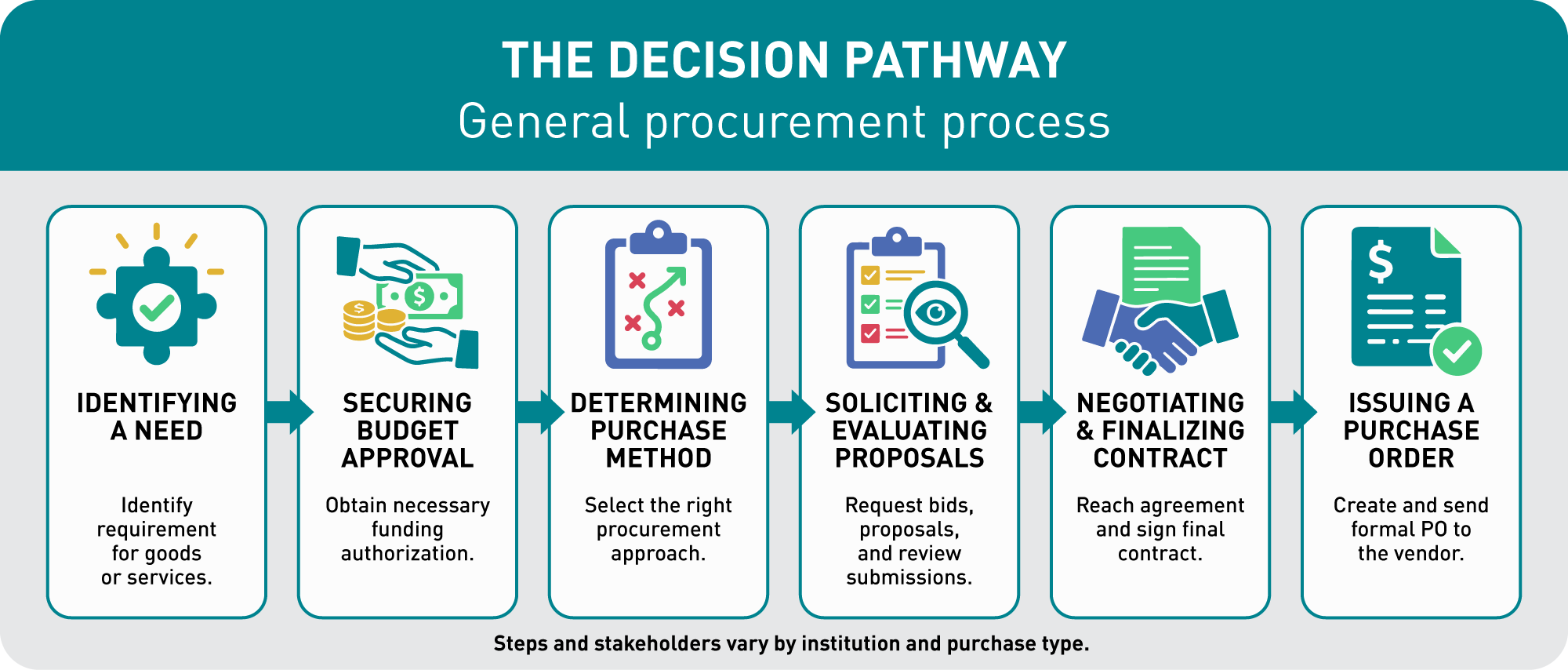
The Decision Pathway
Every procurement action follows a decision pathway, though the specific steps and stakeholders vary by institution and purchase type. At a high level, the process typically moves through the following stages: identifying a need, securing budget approval, determining the appropriate purchasing method, soliciting and evaluating proposals, negotiating and finalizing the contract, and issuing a purchase order (see figure 1).
Who Is Involved
A single purchase can involve many decision-makers, and the set of restrictions that apply to a purchase can vary depending on the dollar amount and organizational setup. In some cases, faculty and staff are allowed to use purchasing cards for small purchases. Departments and colleges might centralize purchasing at their level. Enterprise IT might require approval before technology purchases proceed. Grant recipients might work directly with the purchasing office under separate federal guidelines.
For large purchases, functional stakeholders (sometimes “business stakeholder”) who identify needs might be in IT, or they could be in academic affairs, student affairs, marketing, finance, housing, research, athletics, or other units. Beyond the functional stakeholder, purchases must typically pass through several approvals:
- Finance and budget authorization
- Information security review
- Accessibility compliance
- Risk management assessment
- Legal or contract review
Understanding which of these review layers apply and in what order is essential. It is common for IT to conduct significant background research on solutions before involving the procurement office or staff, which can create misalignment. Bringing procurement into the process early, even in an advisory capacity, can prevent delays later.
Formal Solicitation Processes
Every institution has a purchasing threshold above which a formal solicitation is triggered. These thresholds vary widely, with typical thresholds anywhere between $10,000 and $50,000. When a formal solicitation process is triggered, the type of solicitation depends on how well the institution has defined its requirements and the complexity of the procurement. Public institutions are more likely to require formal competitive bidding at lower thresholds, while private institutions may have more discretion in when formal processes are invoked.
Standard Terms, Conditions, and Negotiation
Institutional contracts typically include standard terms and conditions covering areas such as order of precedence, indemnification, limitation of liability, governing law, shipping terms, information security and privacy addenda, data-protection provisions, AI-related clauses, export control, accessibility, and relevant policy or regulatory items. Public institutions tend to review contract language in greater detail and might need to meet state-specific requirements. Private institutions, while still emphasizing best practices and ethical conduct, may have more room to negotiate and adapt contract terms.
Common negotiation points include venue (which jurisdiction’s laws govern disputes), limitation of liability, indemnification provisions, digital accessibility compliance, and the inclusion of FERPA or other data-privacy protections. Vendors should be aware that many institutions maintain standard terms on their procurement websites and expect vendors to familiarize themselves with those terms before engaging in negotiations.
Funding Sources and Implications
The source of funding for a purchase affects which rules apply. Money from federal sources, such as federal grant awards, carries different requirements from institutional funds, including compliance with the Uniform Guidance (2 Code of Federal Regulations [CFR] Part 200) for grant-funded purchases and the Federal Acquisition Regulations (FAR) for federal contracts. Both emphasize competition, cost and price analysis, supplier inclusion, and documentation. These requirements apply to both public and private institutions when federal funds are involved. Vendors should always ask whether a purchase involves federal funding, as this can change the timeline, documentation requirements, and allowable terms.
Higher Education Procurement Priorities
Procurement decisions in higher education are generally guided by the following priorities:
- Affordable: Stretch available operational funds as far as possible.
- Accountable: Maintain institutional autonomy and fiscal control.
- Effective: Ensure the quality of goods and services meets institutional needs.
- Efficient: Provide easy access to purchasing resources and achieve results quickly.
- Environmental: Provides a sustainable solution for the institution and its community.
These priorities shape how institutions evaluate proposals, structure contracts, and assess vendor relationships over time. Understanding the priorities can help both institutional staff and vendors frame their requests and responses in terms that resonate with procurement decision-makers.
Where to Start
Most institutional procurement offices publish essential information on their websites, including vendor registration processes, purchasing thresholds for informal and formal bidding, signature authority policies, and standard purchase order terms and conditions. This information is publicly available and provides an important foundation for anyone preparing to engage in a procurement process.
- For vendors, researching these published resources before initial outreach demonstrates preparation and professionalism. Tools such as the Integrated Postsecondary Education Data System (IPEDS) can provide institutional enrollment and financial data, and GuideStar by Candid can offer context on private institutions.
- For institutional staff initiating a purchase, understanding your institution’s thresholds and processes before approaching procurement will streamline the conversation and reduce follow-up questions.
From Idea to Acquisition: Procurement for Campus Teams
When procurement works well, it saves the institution money, reduces risk, and produces contracts that serve the campus community effectively over the life of the agreement. This section offers practical guidance for working effectively with your procurement team and preparing to engage in the purchasing process.
Key Takeaways for Campus Teams
- Engage the procurement office early, as a partner, not a final checkpoint. Procurement should be “along for the ride” of supplier/solution selection for the most efficient process.
- Come to procurement with a challenge and opportunity, not a predetermined solution. A clear business case accelerates the process.
- Consult with your procurement office or internal IT purchasing staff for clarity on compliance rules, funding sources, and bidding thresholds before you begin.
- Prepare for security, accessibility, and risk management reviews as part of the procurement timeline.
- Ask about existing cooperative agreements, which might offer a faster path to contracting.
- At the outset, clarify funding sources, some of which trigger additional requirements.
Before You Begin, Know Your Landscape
Before approaching your procurement office with a request, invest time in understanding the foundational elements that will shape the process. Procurement professionals consistently report that their most productive partnerships are with colleagues who come prepared with a clearly defined business problem and an understanding of the institutional context. This includes knowledge of the market and potential suppliers; a list of three to five suppliers that can address institutional need can accelerate the process.
Understand Your Procurement Compliance Rules
Compliance requirements vary based on whether an institution is public or private and by funding sources. Your compliance office (or the office charged with this function) may take direct responsibility for contract review, or it may serve in a consultative capacity. Before initiating a procurement request, clarify which compliance rules apply to your specific purchase.
Institutional compliance requirements extend beyond procurement rules, encompassing security, privacy, data governance, and accessibility standards. Public institutions must satisfy federal regulations such as FERPA for student data, state privacy laws, and Section 508 of the Rehabilitation Act of 1973 or Web Content Accessibility Guidelines (WCAG) standards for accessibility alongside institution-specific policies. Private institutions maintain their own compliance frameworks, though federal requirements apply when handling federal student aid data or grant-funded activities. Responsibility for compliance review may rest with a centralized office such as IT security, or it may be distributed across functional units. Before submitting a request to procurement, identify which compliance reviews your request will trigger so you can build the required timelines into your planning.
Know the Purchasing Vehicles Available to You
Institutions use multiple purchasing vehicles depending on the nature and scale of the purchase. Understanding what is available can save significant time and effort:
- P-cards might be appropriate for small-dollar purchases within defined limits.
- An existing contract with a vendor might enable you to easily extend or add to the existing agreement.
- Existing cooperative or consortium agreements might allow your institution to access competitively bid, pre-negotiated contracts without initiating a full solicitation. Many colleges and universities explicitly authorize cooperative use when it’s in the institution’s best interest; check whether your institution maintains a list of approved cooperatives.
- Formal solicitation processes (such as requests for information, requests for proposals, and similar processes) are triggered by purchases that exceed institutional thresholds.
- Grant-funded purchases might follow separate procurement pathways with additional federal compliance requirements under the Uniform Guidance or FAR.
Identify the Decision-Makers
Procurement committees often make recommendations, but a senior leader typically has final decision authority. At public institutions, board or state approval may be required for large contracts. Know which stakeholders must be part of the decision-making process and who has signature authority for the dollar amount in question. Also consider whether a data-security and privacy review, accessibility assessment, legal review, or risk management evaluation will be required; these reviews can add considerable time to a timeline if they are not anticipated early.
Just as importantly, understand what procurement resources are available to you. Some IT departments have dedicated contracting staff who serve as a single point of contact for technology leaders and liaise between IT and the procurement office; if this role exists at your institution, start there. Some institutions maintain specialized IT procurement teams, while others rely on generalist procurement staff. Even in a generalist model, an agent might be available who is familiar with a particular vendor or technology category and can help you navigate the process more efficiently.
It is worth distinguishing between purchasing authority and contract signature authority because these are often held by different people. Purchasing authority refers to the person who can initiate and approve a purchase request; at some institutions, deans or department heads may approve purchases up to a defined dollar amount. Contract signature authority refers to the person who can legally bind the institution by executing a contract. Understanding where your purchase falls relative to these roles will help you identify who needs to be involved and at what stage. An important rule for campus requestors: do not sign vendor agreements, contracts, terms of service, or other binding documents yourself. At most institutions, only the procurement office or specifically designated officials have the authority to execute purchasing contracts on behalf of the institution. Even if a vendor presents a document as routine or time-sensitive, signing without proper authorization can create legal and financial liability for the institution and may invalidate the agreement entirely. When in doubt, route it through procurement.
Questions to Ask Before Engaging Procurement
Procurement teams frequently receive requests with limited context, which necessitates follow-up questions and delays. You are not expected to have answers to all of the following questions before reaching out, but thinking through them early will help you anticipate what procurement will need and avoid the most common sources of delay. The further you can get on your own or with your IT partner, the smoother the process will be.
Need and Approach
- What business or academic problem are we trying to solve? Can you articulate the need without naming a specific product?
- What are we currently doing to address this need? Is there an existing vendor in place that is being replaced? What is working and what is not? Are there opportunities to increase efficiency by replacing multiple individual contracts with an enterprise solution?
- Who are the beneficiaries of this contract? Which stakeholder group(s) do they represent (e.g., students, faculty, staff)?
- Has someone on both the technical and business or functional side reviewed and agreed on the proposed approach? Have you identified both technical and functional owners for the process and the solution?
Funding and Budget
- Is funding available for this fiscal year, or will it need to be budgeted for the next cycle?
- Which fund is paying, and who controls that budget?
Compliance and Data Considerations
- What type of data will be used with this system? Does it involve student data, research data, or other sensitive or regulated categories? Are there accessibility considerations for the interface of the solution?
- Does this purchase involve federal funding that would trigger Uniform Guidance or FAR requirements?
Procurement Pathways and Requirements
- Is there an existing cooperative or consortium agreement that could cover this purchase?
- Is there a current contract with your institution that could provide the solution?
- What is the institutional bidding threshold and does this purchase exceed it?
- Are there participation requirements for small, minority-owned, or disadvantaged businesses? Does your institution have any local-business preferences that need to be taken into account?
Partnering Effectively with Your Procurement Team
The procurement department is sometimes perceived as a frustration rather than a partner. This perception often stems from late engagement: IT or functional teams sometimes conduct extensive vendor research and even begin negotiations before bringing procurement into the conversation, and when procurement is only informed at the point of contract execution, friction is almost inevitable.
Use the following to build a productive partnership:
- Engage procurement staff during your research phase, even if they will not attend every meeting. Ask them to describe the process and what happens at each stage.
- Come with the business problem and stakeholder buy-in, not just the solution. If you have identified a preferred solution, be prepared to explain why and be open to the possibility that procurement may identify alternatives or point to existing agreements that address the need.
- Translate technical needs into the language that the business (and procurement) understands. Procurement specialists may not be familiar with IT terminology.
- Remember that procurement is an active partner managing competing priorities.
- It is up to you to make sure your process is moving forward in the timeframe you need it to.
- Work proactively with procurement and clarify what tasks procurement owns and will manage in the process.
- Partnership means that you and procurement are both involved and that you must remain an active participant.
- Pay attention to the process and be aware of timelines.
- Clarify who is making the legal and/or risk decision and who is making the business decision. These may be different people.
Framing the Business Case
One of the most common pitfalls in institutional purchasing is approaching procurement with a solution rather than a problem. This matters because, when grounded in a clear business case, the evaluation and competitive process consistently produces better pricing, stronger contract terms, and more defensible outcomes than a preselected solution. A well-constructed business case articulates the need, identifies the stakeholders affected, describes the current state and its limitations, and establishes the criteria by which any solution should be evaluated. This framing gives procurement the context it needs to move efficiently and helps ensure that the evaluation process is grounded in institutional priorities rather than product preference. A strong business case also protects you: If a purchase is later questioned by auditors, leadership, or a board, a documented rationale demonstrates that the decision was deliberate and defensible.
A well-framed business case should address the following:
- The business or academic need driving the request, articulated in terms that connect to institutional priorities
- The beneficiaries of the solution (e.g., students, faculty, staff)
- The current state (what processes or tools are in place today, and where they fall short)
- The desired future state, including functional requirements and integration needs
- For sole-source justification, whether the proposed solution has undergone reviews for risk management, security, privacy, and accessibility (if not, procurement can facilitate these for you or provide instructions on how to get started)
- The expected total cost of ownership, including implementation, training, ongoing licensing, and any integration costs
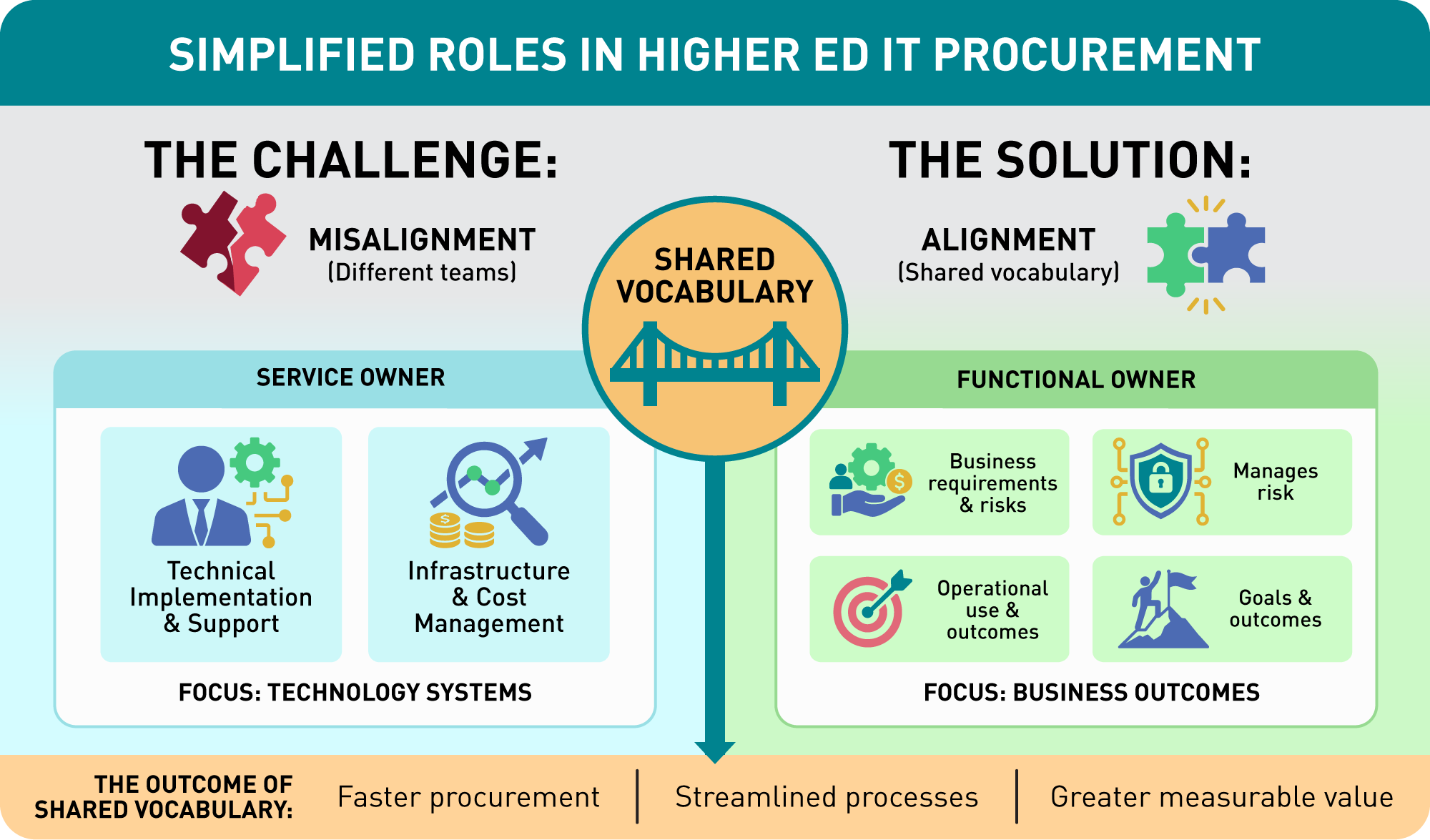
Establishing a shared vocabulary can also improve alignment. Some institutions find it helpful to distinguish between the service owner (the technology team responsible for API costs, integration, and technical support) and the functional owner (the business unit responsible for defining requirements, managing risk, and overseeing day-to-day use).
Sole-Source Justification
When a specific product is the only viable option, the business case becomes even more critical. Sole-source procurement requires formal justification at most institutions, and public institutions in particular must document why competitive bidding was not feasible. Arriving at procurement with a sole-source recommendation but without that documentation triggers additional research, review cycles, and delays. Beyond process implications, sole-source contracts often result in higher costs because the institution has limited negotiating leverage. If you believe a sole-source path is warranted, prepare to explain what makes this supplier uniquely capable, what alternatives were considered and why they were insufficient, and why a competitive process would not serve the institution’s interests. Your procurement partner can help you determine whether the justification meets institutional and regulatory thresholds.
Managing the Timeline
Procurement and contracting processes take time. Data security and systems reviews for risk management can add weeks to the process. Budget cycles, committee review schedules, and legal reviews all introduce their own timing considerations. Public institutions may face longer timelines due to mandatory competitive bidding and state-level approval requirements, whereas private institutions might move more quickly but still require internal reviews and governance approvals.
Follow these steps to manage timelines effectively:
- Start early. If you anticipate a need for the next fiscal year, begin conversations with procurement well before the budget cycle closes.
- Clearly communicate the overall project timeline to set expectations on feedback and deliverables at the beginning of your engagement with procurement.
- Ask procurement to outline the expected timeline and milestones for your specific purchase type and dollar amount.
- Identify potential bottlenecks early, such as security and privacy reviews or accessibility assessments, and initiate those processes in parallel where possible.
- Communicate proactively with vendors about decision pathways and realistic timelines so they can plan accordingly.
Working with Higher Education: A Guide for Vendors
This section provides practical guidance for navigating institutional procurement processes, building productive relationships, and positioning your offering effectively.
Key Takeaways for Vendors
- Research the institution and determine whether it is public or private. This shapes the entire process.
- Ask clients about the decision pathway, stakeholders, timeline, and who needs to be involved.
- Complete the Higher Education Community Vendor Assessment Toolkit (HECVAT) or similar documentation proactively and prepare your accessibility compliance documentation or, at a minimum, be prepared to describe how you handle sensitive data, what security controls are in place, where your accessibility efforts stand today, and what your roadmap looks like for addressing any gaps. Consider participating in programs such as EDUCAUSE Higher Ed Ready that help organizations demonstrate alignment with higher education expectations across areas such as accessibility, security, privacy, and customer engagement.
- Lead with cooperative or consortium agreements when they exist—they can accelerate the process.
- Bring value beyond the product: Training, partnerships, internships, and flexibility build lasting relationships.
- Own every word in your proposal, whether AI-assisted or not. Accuracy and authenticity matter.
Do Your Homework Before You Reach Out
Higher education institutions are complex, mission-driven organizations with procurement processes that differ significantly from commercial or government sectors. Taking time to understand an institution before your first conversation will set you apart from competitors and demonstrate respect for the partnership.
Research the Institution
Start with the institution’s procurement website. Most institutions publish vendor registration requirements, purchasing thresholds, formal and informal bidding requirements, signature authority policies, and standard purchase order terms and conditions. Getting registered as a vendor with the institution is a foundational step. As noted earlier, understanding institutional control (public or private) and the demographics of the institution is a vital step in an effective relationship.
Understand Who Makes Decisions
The business stakeholder who selects a product or service may not be in IT. Academic affairs, student affairs, marketing, finance, housing, research, athletics, and other units all initiate purchases. Beyond the functional stakeholder, purchases typically require approvals from finance, security, accessibility, and risk management. At public institutions, board or state approval may be required for large contracts.
Ask early:
- Who needs to be at the table to move this forward?
- Does the budget office need to be involved?
- Is there a data-security review process?
- Will procurement need to lead the contracting?
- Who is authorized to sign the contract?
Navigating the Procurement Process
Because procurement pathways vary significantly across institutions, vendors who understand decision-making processes, approval requirements, and timelines are better positioned to build trust, avoid delays, and support successful outcomes. Once you understand the institution's structure and stakeholders, the next step is learning how a purchase actually moves from inquiry to signed contract.
Ask About the Decision Pathway
Do not assume you know how a particular institution operates. Ask directly about the decision pathway and what to expect, including timelines. Key questions include the following:
- What is the internal approval process once a competitive response is received?
- How long will the process take from request to purchase order?
- Is there a data security or systems review required for risk management?
- Are you able to move forward directly, or does procurement need to be formally engaged?
- Is this purchase planned for the current fiscal year, and is funding already dedicated?
- Is there an existing cooperative or consortium agreement that could be leveraged?
- Does this purchase involve federal funding that triggers additional compliance requirements?
When submitting questions, determine whether there is a specified path to comply with procurement requirements; some institutions will designate a single point of contact for open opportunities. Many open opportunities such as RFPs, RFIs, and RFQs include a question-submission portal and formal responses from the institution.
Tips for Vendors
Respect Institutional Timelines
Do not approach institutions with hard deadlines tied to your fiscal quarter or year-end. Phrases like “we need a signed contract by Friday to hold this pricing” create stress for everyone involved and rarely accelerate the process.
Institutional procurement operates on its own timeline, often governed by state regulations, board approval schedules, and fiscal year boundaries that cannot be compressed to accommodate a vendor’s internal deadlines.
Many institutions enter a fiscal year close-out period, often a month or more in duration, during which new contracts and purchase orders simply cannot be processed. Build this reality into your planning.
Pressure tactics can damage the relationship with your internal champion, who may be put in the uncomfortable position of lobbying for urgency they cannot justify to their procurement office.
Be Responsive When the Institution Is Ready to Move
When an institution signals that approvals are in place, funding is committed, and the procurement office is waiting for your paperwork, be sure to respond promptly.
Delays on the vendor side can push a purchase past a fiscal year deadline or budget expiration, forcing the institution to restart the process entirely.
The best vendor relationships are built on mutual responsiveness. Understand the institution’s timing needs, align your proposal and pricing commitments to that reality, and match the urgency when staff at the institution are ready to act.
Timelines
Higher education procurement does not operate on the same timelines as commercial sales cycles. Each procurement method serves a different purpose, involves different levels of institutional review, and carries its own typical timeline. Understanding these distinctions will help you set realistic expectations, plan your engagement strategy, and avoid the frustration of misaligned assumptions about how quickly a deal can close.
| Process | Purpose | Typical Timeline |
|---|---|---|
|
Request for Information (RFI) |
Information gathering only; cannot result in an award, but often aids in creating a Request for Proposal (RFP) |
1–3 months |
| Request for Bid / Request for Quote (RFB / RFQ) |
Used for items with precise specifications; lowest-cost vendor typically selected |
2–4 months |
| Request for Proposal (RFP) |
Used when requirements are broad; proposals scored by evaluation committee based on published criteria |
3–12 months |
| Invitation to Negotiate (ITN) |
Invitation to negotiate; allows for flexible discussion of scope and terms |
Varies |
Understanding Cooperative Agreements
Cooperative and consortial agreements are an increasingly significant part of the higher education purchasing landscape. Institutions may realize cost savings alongside substantial administrative time reductions when purchasing through cooperative portfolios. If your organization has an existing agreement through a cooperative, lead with that. An existing, competitively bid, pre-negotiated agreement can significantly accelerate the contracting process.
Be aware that higher education sales teams and government or public sector sales teams within your own organization may not be aligned. Cooperative agreements are often managed on the government side but are available to higher education buyers. Ensuring internal coordination between these teams can open doors that would otherwise remain closed. Public institutions frequently participate in state or regional purchasing consortia, whereas private institutions might use cooperative contracts as optional tools when they offer an advantage.
Compliance, Documentation, and Accessibility
Higher education institutions face significant legal, regulatory, and operational responsibilities related to accessibility, privacy, security, and data stewardship. Vendors who proactively prepare documentation, demonstrate compliance with industry standards, and understand common contractual requirements can reduce procurement delays, build trust, and streamline institutional reviews.
Complete the HECVAT
The HECVAT is a widely used, free, self-disclosure questionnaire that covers security, privacy, and accessibility. Completing the HECVAT proactively, before an institution requests it, demonstrates commitment to transparency and can accelerate the security review process.
Understand Accessibility Requirements
Higher education institutions are required to eliminate barriers in information technology under the Americans with Disabilities Act and Section 508 of the Rehabilitation Act of 1973. The prevailing standard for legal compliance is Web Content Accessibility Guidelines (WCAG) 2.1 Level AA; WCAG 2.2 Level AA represents current best practice and is increasingly adopted by institutions seeking to go beyond minimum requirements. Procurement is a key screening point for accessibility compliance, and noncompliance can block a purchase. Approaching institutions with a clear accessibility posture and evidence of your compliance efforts makes the evaluation process smoother for both parties.
Data Protection Agreements
Most institutions will require a data protection agreement before allowing institutional data to be stored, processed, or transmitted by a third-party vendor. These agreements may take the form of a Data Protection Addendum (DPA), a Data Processing Agreement, or institution-specific data security terms incorporated into the contract. The specific requirements will depend on the type of data involved: student records governed by the Family Educational Rights and Privacy Act (FERPA), health information subject to the Health Insurance Portability and Accountability Act (HIPAA), research data with grant-specific handling requirements, or personally identifiable information covered by state privacy laws. Be prepared to articulate what data your solution will collect, where and how it will be stored, who will have access to it, how it will be protected in transit and at rest, and what happens to institutional data at the end of the contract. Institutions increasingly expect vendors to accept their data protection terms rather than negotiate from the vendor’s standard agreement, so familiarize yourself with common higher education data protection language and be prepared to work within it.
Know the Standard Terms
Institutions maintain standard terms and conditions. Public institutions in particular review contract language closely, with state-specific requirements that may apply. Common negotiation areas include venue, limitation of liability, indemnification, and the inclusion of FERPA protections. Package the terms relevant to the specific transaction rather than sending a comprehensive list that includes inapplicable provisions.
Building the Relationship
Building strong relationships in higher education is about more than delivering a product or service. Successful partnerships are built on trust, shared goals, and long-term engagement. Institutions value vendors who understand their mission, contribute meaningfully to the broader campus community, and approach relationships with authenticity and transparency.
Consider the Value You Provide
Institutions value vendors who bring more than a product. Consider what additional value you can offer:
- Professional development opportunities, conference sponsorships, or training resources
- Internship or experiential learning opportunities for students
- Willingness to serve as a formal partner with deeper engagement beyond the contract
- Flexibility on licensing structures that respect institutional budget constraints
Small and Medium Businesses
If your organization is a small or medium-sized business, some institutions (particularly public ones) have goals or requirements for engaging small, minority-owned, or disadvantaged businesses. Both the Federal Acquisition Regulations, Uniform Guidance, and many state procurement codes include supplier diversity provisions. Ask about relevant requirements and state business development programs that may offer pathways for smaller vendors.
A Note on AI in Proposals
As AI tools become more widely used in proposal development, vendors should exercise caution. AI-generated proposals risk containing inaccurate terms, pricing, or capability claims. Regardless of how content is created, the vendor is responsible for the accuracy and completeness of every statement. Beyond proposals, maintain the humanity in the relationship. Communications and partnerships are built on trust and personal connection.
Leveraging Cooperative and Consortial Purchasing
This section explains the landscape of cooperative and consortial purchasing in higher education, how these structures work, and how both parties can use them effectively to streamline procurement.
Key Takeaways About Cooperative Purchasing
- Cooperative purchasing can save institutions significant time and money.
- Arrangements range from simple contracts of convenience to deeply integrated consortia.
- Properly structured cooperative contracts support compliance with the Uniform Guidance and the Federal Acquisition Regulation.
- Policy clarity at the institutional level is essential to unlocking cooperative value. Establish approved cooperative lists and clear pathways.
- Public institutions may be required to use cooperatives; private institutions use them as optional, strategic tools.
- Vendors should align internal sales teams and proactively engage with cooperative solicitations.
Why Cooperative Purchasing Matters
Cooperative purchasing allows institutions to access competitively bid, pre-negotiated contracts without conducting their own full solicitation process. Colleges and universities face simultaneous pressures: shrinking or volatile revenues, enrollment headwinds, and rising operating costs. Cooperative agreements and group purchasing organizations (GPOs) have become central to institutional procurement strategy because they aggregate demand, deliver pre-competed and compliant contracts, and compress cycle times for complex categories including IT, lab and scientific equipment, facilities, construction, and professional services.
Institutions report financial savings alongside substantial administrative time reductions when shifting spend onto cooperative portfolios. Cooperative purchasing is particularly valuable for small and mid-sized institutions, whose purchasing volume and/or procurement and legal teams are too small to negotiate highly competitive pricing independently.
Cooperative vehicles also help institutions meet compliance requirements under the federal Uniform Guidance and the FAR by leveraging transparent, competitive lead-agency solicitations. Both frameworks emphasize competition, price reasonableness, supplier diversity, and documentation, which are requirements that well-structured cooperatives are designed to support.
Definitions and Operating Models
A group purchasing organization (GPO) aggregates multi-member demand to negotiate pre-competed supplier contracts across broad categories. Members opt in to use these awards. Examples active in higher education include OMNIA Partners, Sourcewell, E&I Cooperative Services, the Coalition for College Cost Savings, and NASPO ValuePoint, as well as other regional and statewide consortia.
An education-focused cooperative can be a member-owned and governed group (E&I Cooperative Services, Equalis, etc.), aligning contracting roadmaps to member needs through governance structures that prioritize academic and research requirements. Alternatively it can be an availability of contract use that was established for a specific institution or system (OMNIA Partners, etc.). Finally, certain system or statewide and regional consortia form contracts for their intended member audience and will allow others to use those contracts outside their member base (Internet2 NET+, MHEC, IUC-PG, VHEPC, NERCOMP, etc.). In practice, all models produce contracts that institutions can adopt; the differences lie in governance, incentives, and category strategy.
GPOs are focused on quantity/volume, whereas education-focused cooperatives emphasize shared institutional needs. These models are not mutually exclusive, however. Some organizations, such as E&I Cooperative Services, operate as both a cooperative and a GPO—leveraging aggregated purchasing power while also maintaining member governance and education-focused contracting priorities.
Selected Cooperative and Consortial Organizations
Cooperative and consortial purchasing opportunities in higher education come in several forms. Understanding these categories will help you identify which agreements may apply to a given institution and how to ask about them:
- Member-owned education cooperatives serve higher education exclusively, offering competitively solicited contracts with pricing and terms tailored to academic institutions. Membership is typically free for institutions, and contracts span a broad range of categories, from technology to facilities.
- Lead-state cooperative models aggregate demand across state governments, their political subdivisions, and eligible entities including public colleges and universities. A single state leads the competitive solicitation, and the resulting master agreement is made available to participating states and institutions.
- Regional and state-level higher education compacts are organized around geographic regions or individual states, negotiating agreements that reflect the shared needs and regulatory environments of institutions within their footprint.
- Mission-aligned consortia are organized around shared institutional characteristics or technical communities rather than geography. These include research university alliances, network and infrastructure communities, and academic affinity groups that negotiate collective agreements with vendors in their area of focus.
- National purchasing alliances serve a broad public-sector market that includes but is not limited to higher education. Contracts are competitively solicited and available to government, education, and nonprofit entities.
- Nonprofit and government-operated organizations are worth distinguishing because their governance structures affect how contracts are managed and how vendor fees are handled. Some cooperatives are nonprofit and member-governed, while others operate as government agencies or public-sector entities.
Professional organizations such as The Institute for Public Procurement (NIGP) and the National Association of Educational Procurement (NAEP) provide additional resources, best practices, and networking opportunities related to cooperative purchasing.
Types of Group Purchasing Arrangements
Group purchasing arrangements exist along a spectrum of complexity, member involvement, and potential savings.
| Type | Description | Complexity | Savings |
|---|---|---|---|
| Contract of Convenience |
Establishes a business relationship; members access a vendor through competitive procurement without conducting the process themselves. Members negotiate most terms and pricing independently. These are often state-based contracts. |
Low |
Minimal |
| Master Contract |
Leverages collective spend to negotiate favorable terms and pricing. Members often participate in the competitive process and sign a participation agreement. |
Medium |
Considerable |
| Consortium |
Members align goals, develop bylaws, and establish governance. Commitment to outcome is established before award. Requires active participation and professional management. |
High |
High |
In addition to these formal structures, cooperative procurement takes two fundamental operational forms. In a joint solicitation, two or more institutions combine their requirements into a single procurement effort, and the resulting contract binds all participating agencies. In piggybacking, an agency obtains permission to use another agency’s existing contract even though it was not part of the original solicitation. Piggybacking is the more common and available form, particularly for smaller institutions, though it may not always yield the most competitive pricing because suppliers cannot predict the total purchasing volume in advance.
Evaluating a Group Purchasing Organization
Not all GPOs are created equal. When evaluating whether to use a particular GPO’s contracts, consider the following dimensions:
Procurement Methods
- Was the contract competitively bid?
- Were GPO members and subject-matter experts involved in the procurement process?
- Was specific spend volume guaranteed during the solicitation?
- What evaluation criteria were used to select vendors?
Contract Quality and Vendor Mix
- Does the GPO specialize in a particular sector (such as higher education, facilities, or healthcare), or is it broadly focused?
- Does the contract include all products and services you require?
- Are performance terms embedded in the contract?
- Will the GPO represent your institution if problems arise with a vendor?
Pricing and Fees
- Was pricing negotiated as part of the solicitation?
- What type of pricing structure is in place (percentage discount, floor and ceiling, tiered volume pricing, unit price)?
- Is pricing fixed or variable, and for how long?
- Is additional volume discounting available? Are any rebates returned to the institution?
- What is the GPO fee, and does the institution or the vendor?
Ease of Participation
- How do you enter or exit the contract?
- What level of commitment is required in terms of spend or contract duration?
- Is the contract paperwork streamlined? Does the GPO maintain documentation needed for institutional legal counsel?
- Will the GPO respond to public information requests?
Governance, Risk, and Compliance
Cooperative contracts provide a ready path to compliance and audit readiness under both the Uniform Guidance and the FAR if properly competed and documented. Lead-agency solicitations satisfy competitive requirements, but institutions retain responsibility for documenting price reasonableness and how cooperative pricing meets their specific needs. Institutions should maintain the participation agreement, lead-agency solicitation and award files, and internal justifications for best-value use.
Many colleges and universities explicitly authorize cooperative use when in the institution’s best interest, often listing approved cooperatives and associated thresholds. Establishing this kind of policy clarity at the campus level is essential to unlocking the full value of cooperative purchasing.
Supplier diversity goals can also be addressed within cooperative frameworks. Institutions can apply local Historically Underutilized Business (HUB), Minority Business Enterprise (MBE), or Women’s Business Enterprise (WBE) goals when awarding under cooperative contracts, or they can select cooperative contracts that embed diversity requirements.
How Institutions Locate Cooperative Opportunities
The most direct step you can take is to ask your procurement office whether an existing cooperative or consortium agreement covers the solution you are pursuing. Procurement professionals typically maintain awareness of which cooperatives, state agreements, and federal contract vehicles are available to your institution. A single conversation early in the process can save weeks of competitive bidding.
Another avenue is to ask the vendor directly. Many vendors participate in cooperative agreements and can tell you whether their product or service is available through an existing agreement or a similar vehicle. Vendors who are active in the higher education market will often know which agreements cover your institution before you do.
How Vendors Can Engage with Cooperatives
For vendors, cooperative agreements represent an opportunity to reach many institutional buyers through a single competitive process. However, working with cooperatives requires different structures from typical one-to-one sales relationships:
- Know which cooperative agreements exist in your product category and whether your organization already holds any.
- Ensure coordination between your higher education and public-sector sales teams. Cooperative agreements are often managed on the government side but are available to higher education buyers.
- Be prepared to create internal structures that support consortial purchasing, including different pricing models and reporting mechanisms. Remember to be prepared for individual billing for each institution off of a master contract.
- Declining to engage with cooperatives may limit your reach. Some institutions will only purchase through pre-established agreements.
- Monitor cooperative solicitation announcements proactively to compete before contracts are awarded to competitors.
Public versus Private Institutions and Cooperatives
Public universities frequently participate in state or regional purchasing consortia to leverage volume pricing, and cooperative use is often embedded in state procurement codes. Private non-profit institutions may use cooperative contracts but typically treat them as optional tools rather than mandatory mechanisms. Private universities often allow cooperative purchasing when it is advantageous, but they are not required by statute to do so. This distinction matters for vendors: At public institutions, cooperative contracts may be strongly preferred or required, while at private institutions, they represent one option among several.
Websites and Resources
The Institute for Public Procurement provides a Dictionary of Procurement Terms that includes definitions for procurement-related terms commonly used in higher education.
The following resources provide additional information and perspectives on procurement in higher education:
- American Association of State Colleges and Universities (AASCU) and National Association of Educational Procurement (NAEP): Public College and University Procurement Survey
- BidFinderEDU: How University Procurement Works
- Brown University: Group Purchasing Agreements
- Concord: How Cooperative Purchasing Networks Are Transforming Higher Education Contract Management
- Dryden Group: How Your Company Can Use Procurement Data: A Guide to Procurement in Higher Education
- E&I Cooperative Services: Group Purchasing Organizations (GPOs) vs Cooperatives: A Complete Guide for Educational Institutions
- E&I Cooperative Services: How Does Higher Education Procurement Work
- E&I Cooperative Services: The Complete Guide to Higher Education Procurement: RFP Processes, Sourcing Strategies, and Contract Management
- eCFR: 2 CFR Part 200 — Uniform Administrative Requirements
- Harvard Business Review: “How E&I Cooperative Services Unlocked Efficiency Through Procurement Transformation”
- Higher Education Publication: Understanding the Procurement Process in Higher Education: A Sales Guide
- K16 Solutions: K16 Solutions and OMNIA Simplify Data Warehouse Procurement for Higher Ed
- NAEPnet.org: National Association of Educational Procurement
- NASPO ValuePoint: Cooperative Contracts
- NIGP: Cooperative Purchasing Programs
- OMNIA Partners: Higher Education Portfolio
- Sourcewell: Higher Education Solutions
- Tradogram: Mastering Procurement in Education
- UMass: Group Purchasing
- University of Houston: Procurement Cooperatives
Contributors
We are grateful for the contributions of our working group members!
- Shannon Dunn, Vice President, Vantage Technology Consulting Group
- Keith Fowlkes, Executive Director and Cofounder, The HESS Consortium
- Donna Ginter, Associate Vice President, Procure-to-Pay, The George Washington University
- Jennifer March-Wackers, Executive Director, IUC Purchasing Group (Inter-University Council of Ohio, hosted at The Ohio State University)
- Emily Perry, Software Supply Chain Manager, University of Arizona
- Katie Fife Schuster, Program Manager, Partnership and Corporate Engagement, EDUCAUSE
- Carrie Shumaker, Vice Chancellor for Information Technology and Chief Strategy Officer, University of Michigan–Dearborn
- Valerie Vogel, Senior Strategic Consultant, Vantage Technology Consulting Group
This resource was created as a result of the collaborations and conversations that occurred during the 2025 EDUCAUSE Annual Partner Summit. Each fall, the EDUCAUSE Annual Partner Summit convenes leaders from higher education, associations, and corporate partners to work together toward solutions to some of higher education’s big challenges.
For more information about the Partner Summits and links to other resources that were developed from those events, visit the Partner Summit Resources page.
See the other resources from the 2025 EDUCAUSE Annual Partner Summit:
-
Designing Curriculum Partnerships for the AI Era: A Co-Creation Guide
-
The Integrated Institution: A Guide to Interoperability for Student Success
-
Understanding Higher Education Budgeting and Purchasing: A Guide for Trusted Partnerships
© 2026 EDUCAUSE. The content of this work is licensed under a Creative Commons BY-NC-ND 4.0 International License.