Designing Curriculum Partnerships for the AI Era: A Co-Creation Guide

Employers want graduates who are ready for the realities of today's workplace. Institutions want to prepare students not just for their first job but for careers that will continue to evolve over time. Curriculum partnerships can help create a bridge to align these priorities, providing opportunities for educators and employers to work together in shaping learning experiences that are both academically meaningful and relevant to the workforce.
This guide explores how institutions and industry partners can build those relationships. It examines the challenges driving the need for deeper collaboration, identifies the stakeholders involved, outlines principles for productive engagement, and provides a practical framework for curriculum co-creation in the AI era. While AI serves as the catalyst for this discussion, the strategies presented here are ultimately about strengthening the connection between learning and work, increasing institutional agility, and preparing students for a future defined by continuous change.
Key Takeaways of the Guide
- AI is widening the gap between traditional curriculum and workforce needs.
- In the age of AI, human skills are becoming more important, not less.
- Industry partnerships must evolve from advisory to co-creative.
- Curriculum agility requires institution-wide collaboration.
- Higher education and industry are on a shared AI learning journey.
- Structured partnership models create relevant, future-ready learning experiences.
The Case for Curriculum Partnerships in the AI Era
As AI accelerates the pace of workplace change, the challenge is no longer whether curriculum should evolve but how quickly and effectively institutions can adapt. Strong curriculum partnerships help bridge the distance between campus and workforce by creating pathways for shared learning, co-creation, and continuous feedback. When designed well, these partnerships enable institutions, faculty, students, and employers to respond together to emerging opportunities and skill needs.
A Widening Gap Between Campus and Workforce
Higher education is navigating a fundamental shift in what it means to prepare students for the workforce. The rapid integration of AI across industries has exposed a growing disconnect between what students learn in degree programs and what employers need from new graduates. This is not simply a matter of adding new courses or updating syllabi. It reflects a deeper structural tension between how institutions have traditionally organized knowledge and how the AI-enabled workplace demands that knowledge be applied. Three interrelated challenges define this gap: capability, speed to curriculum, and partnership maturity.
The Capability Gap
Higher education curricula have traditionally been organized around discrete bodies of knowledge and technical skills. Students learn the foundations of their disciplines, master specific tools and methods, and demonstrate competency through assessments. This model has served institutions and learners well for generations. But the AI-enabled workforce increasingly demands a different kind of preparation: adaptable capabilities such as critical thinking, ethical judgment, communication, and the ability to collaborate with intelligent tools. The shift is not away from disciplinary depth or disciplinary thinking but toward ensuring that depth is paired with transferable, human-centered competencies practiced within real professional contexts.
Without this evolution, institutions risk preparing students for yesterday’s tools rather than tomorrow’s work. The students entering higher education today will graduate into workplaces where managing agentic AI, exercising judgment alongside automated systems, and communicating across human–machine teams are baseline expectations, not specialized skills. These are not domain-specific requirements. They demand less focus on who has which technical background and more focus on critical thinking, analysis, and broad, adaptable skills.
The Speed-to-Curriculum Gap
The pace of technological change and industry need now exceeds the speed at which traditional curriculum design, review, and approval processes operate. At many institutions, a full curriculum revision can take two or more years through conventional governance channels. In that time, the tools, platforms, and workplace practices that prompted the revision may have already evolved again. This mismatch means that even institutions with strong intent to modernize their programs face structural barriers to doing so at the pace the moment demands.
Faculty bear much of this burden. They are asked to integrate emerging technologies into their teaching while navigating governance timelines that were not designed for rapid iteration. Many express genuine interest in incorporating AI into their courses but lack the time, resources, and institutional support to do so confidently. Institutions also face the question of what no longer needs to be learned, including how and when to update curricula when existing learning outcomes may themselves be outdated. Established instructional design processes, aligned objectives and assessments, and course-level outcome mapping provide a foundation for this work, but the pace of change demands that these processes themselves become more agile. Without new models for rapid iteration, shared design, and ongoing industry partnerships, institutions struggle to keep programs current, faculty struggle to stay supported and confident, and students risk graduating into a workforce shaped by tools and practices their coursework did not meaningfully address.
The Partnership Maturity Gap
While industry increasingly seeks graduates who can apply AI responsibly within real workplace contexts, the partnerships between higher education and industry often remain advisory or transactional rather than deeply embedded in curriculum design. Advisory boards meet periodically to share information but rarely participate in the sustained, hands-on work of co-creating courses, designing assessments, or shaping learning outcomes. This limits institutions’ ability to understand evolving skill needs in real time, constrains faculty exposure to current industry practice, and reduces opportunities for students to develop authentic, applied competencies through co-created learning experiences.
A critical assumption also deserves scrutiny: Institutions should not assume that industry partners already know how to best apply AI in their own workforce. Employers are engaged in real-time upskilling alongside higher education. There is an arc of process and maturity that both sides must navigate before curriculum partnerships can produce their full value. Recognizing this shared learning journey is essential for building productive relationships.
Moving from information-sharing to embedded partnership requires intentional structures, including opportunities for industry professionals to spend time in curriculum design processes, mechanisms for translating workforce needs into learning outcomes, and feedback loops that ensure graduates are meeting employer expectations. Community colleges and technical institutions have often led the way in building these relationships through industry advisory boards, specialized accreditation processes, and deep local employer connections, offering models that four-year institutions and research universities can learn from and adapt.
What Success Looks Like
Addressing these gaps requires more than incremental course updates. It calls for a reimagining of how institutions, industry partners, faculty, and students collaborate on the design and delivery of learning experiences. When this collaboration works well, the outcomes are meaningful for every stakeholder.
For Students
- Technical and human skills that transfer across tools and roles
- Practical engagement with AI to accomplish goals, not just acquiring knowledge about specific tools
- Judgment, creativity, and responsible use alongside technical proficiency
- Improved job placement and career readiness
- Integrated, practice-oriented learning experience
For Faculty
- Access to current industry practice and field-specific AI developments
- Support for integrating AI into disciplinary teaching without abandoning existing expertise
- Space to experiment with new pedagogical approaches, including freedom to fail
- Tools, partnerships, and perspectives that keep teaching relevant
For Institutions
- More holistic, responsive curriculum development with process improvements at scale
- Better alignment between program outcomes and workforce needs
- Industry relationships that move from periodic advisory input to genuine co-creation
- Improved job placement outcomes for graduates
For Industry Partners
- Graduates equipped with critical thinking, ethical reasoning, and applied AI capabilities
- Both technical skills and human skills for new employees, including managing agentic AI and ethical use
- Meaningful role in shaping the educational experiences that produce desired outcomes
- Transferable knowledge about effective tool use, not just familiarity with specific platforms
The sections that follow offer practical frameworks and strategies for making this collaboration real, from mapping stakeholders and building engagement strategies to establishing rules of engagement with industry partners, concluding with a recipe for curriculum co-creation.
Stakeholder Map and Engagement Strategy
Designing curriculum partnerships for the AI era is inherently cross-functional work. It touches academic governance, instructional design, industry relations, student services, IT infrastructure, and institutional strategy. No single office or role owns it, and no single perspective is sufficient to guide it. Stakeholder mapping provides a structured way to identify who needs to be involved, what each group cares about, and where shared goals create opportunities for alignment.
Key Takeaways for Stakeholder Mapping
Curriculum partnerships are cross functional by nature.
Stakeholder mapping clarifies who should be involved and why.
An effective approach is to start with a focused core group and then expand engagement intentionally.
Each stakeholder group brings distinct goals, concerns, and contributions.
Centers for teaching and learning and instructional designers can serve as bridges across the work.
Effective engagement balances immediate priorities with the broader ecosystem.
Shared Goals Across Stakeholders
A critical early decision is scope. The list of potential stakeholders is long, since virtually every campus function has some connection to curriculum and workforce preparation. Effective stakeholder mapping resists the temptation to engage everyone at once and instead identifies the most strategic voices for each phase of work. Start with a core cross-cutting group, then expand deliberately as the work matures.
Despite their different roles and vantage points, stakeholders across the curriculum partnership landscape share several foundational goals:
- Student preparation: Ensuring that graduates leave with both the technical and human capabilities the workforce demands, including critical thinking, ethical reasoning, adaptability, and the ability to collaborate with intelligent systems.
- Governance and policy alignment: Establishing shared agreement on how AI tools will and will not be used in teaching and learning, and building governance structures that can evolve as the technology does.
- Institutional agility: Building processes that allow curriculum to respond to industry changes more quickly without abandoning the rigor that gives academic programs their credibility.
Key Stakeholder Groups
Successful curriculum partnerships depend on engaging the right people at the right time. While every institution’s ecosystem is unique, certain stakeholder groups consistently play critical roles in shaping, approving, supporting, and sustaining curriculum change. Each brings distinct priorities, expertise, and concerns to the conversation. Understanding what motivates these groups and how to engage them effectively helps institutions build the trust, alignment, and momentum needed to move from isolated initiatives to sustainable partnership models.
The following profiles outline the primary goals, contributions, and engagement strategies for the stakeholder groups most commonly involved in curriculum partnerships for the AI era. Institutions can use these descriptions as a starting point for stakeholder mapping and engagement planning, adapting them to their own governance structures, culture, and workforce needs.
Institutional Leadership
This group includes provosts, chief academic officers, deans, department chairs, directors of community engagement, and leaders of workforce development divisions. Their role is to provide strategic direction, secure buy-in for new initiatives, and approve curriculum changes. They set the institutional conditions that either enable or constrain the pace and scope of partnership work. Leaders of instructional design, faculty excellence, accessibility, and library services also play essential roles in the processes that make curriculum change sustainable.
- Goals: Strategic alignment of curriculum with institutional mission, approval pathways for new and revised programs, resource allocation, and visibility into how AI integration supports broader institutional priorities.
- Engagement approach: Connect curriculum partnership work directly to institutional mission statements, strategic plans, and accreditation goals so leadership sees this as aligned with existing priorities rather than an additional burden. Some provost offices have found success with innovation grant programs that provide funding for faculty to experiment with new approaches to course design and delivery. These grants incentivize creativity, surface early adopters, and generate visible evidence of what is possible. When paired with teaching and learning center support, institutional research capacity, and a symposium to share results, innovation grants can activate campus in a way that feels invitational rather than mandated. Industry partners can also contribute to fund these efforts.
Faculty and Faculty Governance
Faculty are both the designers and deliverers of curriculum. Their engagement is essential and their concerns are legitimate. These may include academic integrity, the pace of change, the time required to redesign courses, and the tension between disciplinary depth and emerging skill demands. Faculty governance bodies, including curriculum committees, faculty senate, and department-level governance, control the formal approval pathways for curriculum change. Engaging these groups early and substantively is critical.
- Goals: Support for staying current with AI developments in their fields, time and resources for course redesign, protection for experimentation and iteration, and clarity on how AI integration connects to tenure, promotion, and professional development.
- Engagement approach: Provide dedicated time and resources for faculty to explore AI tools before asking them to integrate those tools into courses. Research consistently shows that hands-on experience builds both competence and confidence. Establish communities of practice where faculty across disciplines can share how they are using AI, learn from each other, and normalize the iterative nature of course redesign. These communities defuse fear, surface practical strategies, and create peer networks that sustain engagement over time. Build in explicit permission to experiment and fail—faculty who feel their careers are at risk if an AI integration does not work as planned will not take creative risks. Institutions should create a culture of grace around experimentation, ensuring that tenure and promotion processes account for innovation efforts. Emphasize that the core skill is not the technology itself; when faculty understand that the curriculum goal is critical thinking, ethical analysis, and adaptability, AI integration becomes an extension of their expertise rather than a replacement for it. Help faculty see connections between their disciplines and workforce preparation, whether direct (e.g., applied AI in engineering or health sciences) or indirect (e.g., the critical thinking and communication skills that every employer seeks). Professional schools often have faculty with natural industry connections, but humanities and traditional disciplines can also illustrate relevance through durable skills.
- Navigating governance: Faculty governance bodies serve essential quality-assurance functions, but their timelines were not designed for the pace AI demands. Engage governance committees early in the conversation (not just at the approval stage) and help them understand the urgency behind more frequent curriculum updates. Practical approaches include piloting new courses as electives before seeking formal program changes and advocating for expanded flexibility in how much of a syllabus can be revised without triggering a full review. Some institutions have found that running a course as an elective for one or two semesters allows them to gather student assessment data and feedback while building the evidence base needed for smoother governance approval and in some cases accelerating the review and approval process.
IT and Information Security
IT teams manage the technical infrastructure that underpins any AI integration in curriculum, from learning management systems and student information systems to security and data privacy. When curriculum partnerships introduce new technologies, IT needs to be part of the conversation from the start, not brought in after decisions have been made.
- Goals: Early involvement in technology strategy, clear requirements for new platforms, alignment between curriculum technology needs and enterprise architecture, and manageable support burdens.
- Engagement approach: Bring IT and information security into curriculum partnership conversations at the point of tool exploration, not after a vendor or platform has been selected. Early involvement allows IT to flag security, privacy, and integration concerns before they become blockers and gives them time to plan support infrastructure alongside the curriculum design process rather than in reaction to it. When new AI tools are under consideration, frame the conversation around enterprise architecture and data governance from the start. For instance, what student data will the tool access, how does it integrate with existing systems, and what are the ongoing support implications? Establishing a liaison relationship between teaching and learning centers and IT can help translate between pedagogical goals and technical requirements, ensuring that neither side is working in isolation. For faculty and curriculum leaders, IT partnership is most effective when it is positioned as an enabler rather than a gatekeeper.
Students
Students are the primary beneficiaries of curriculum partnerships, and their perspectives should inform the design process directly. Student government, advisory groups, and recent graduates all offer valuable input. Students bring insight into how they are already using AI (often in creative and sophisticated ways) and what they need to feel prepared for the workforce.
- Goals: Preparation for AI-integrated workplaces, understanding of ethical AI use and data privacy, a voice in how AI is incorporated into their learning experiences, and reassurance about how AI-driven workforce changes will affect their career trajectories.
- Engagement approach: Students are not just recipients of curriculum change; they should be valuable partners in designing it. Engagement can take multiple forms: co-creating AI use policies for courses, providing feedback on proposed learning experiences, participating in advisory groups, or contributing to course design through capstone or practicum projects. For graduate students in education programs, curriculum partnership work itself can become a meaningful learning experience; for example, a student might develop a capstone project shepherded by a faculty PI with industry partners involved in content development and funding. It is also important to consider the diversity of student experiences. Traditional-age students, returning adult learners, concurrent enrollment students from K–12, and community college transfer students all bring different backgrounds, needs, and expectations. Community college students looking to upskill with a specific credential have different motivations from those of traditional-age students seeking a full degree. Personalizing engagement approaches and anticipating different prerequisites strengthens the design process.
Career Services and Corporate Partnerships
Career advisors and corporate liaison roles serve as a bridge between campus and industry. They have direct relationships with employers and visibility into hiring trends, skill expectations, and workforce evolution.
- Goals: Stronger alignment between curriculum and hiring needs, deeper industry engagement beyond career fairs, and mechanisms for incorporating employer feedback into academic planning.
Industry and Corporate Partners
Industry partners bring real-world context to curriculum design: what skills they actually need, how AI is changing their operations, and what they look for in new hires. This group includes employers across all industries (not just technology partners), local unions, chambers of commerce, and business alliances.
- Goals: A pipeline of graduates with relevant applied skills, meaningful participation in shaping educational programs, and alignment between institutional credentials and workforce needs.
Government and Regulatory Bodies
State legislatures, governing boards, accreditation bodies, departments of education and commerce, and K–12 systems all influence the environment in which curriculum change happens. Chief relations officers and institutional policy teams play an increasingly important role in advocating for streamlined processes.
- Goals: Compliance and quality assurance, workforce alignment at the state and federal level, licensure requirements, and policy frameworks that support innovation.
- Engagement approach: Accreditation bodies are both gatekeepers for curriculum change and potential allies. Engaging them proactively, including sharing what the institution is doing and why, helps build mutual understanding and may contribute to evolving standards. Specialized accreditation in fields such as engineering, health sciences, and business often includes industry alignment as a core requirement and may offer useful models. State regulatory processes shape the timeline for curriculum change; some institutions have advocated for modest increases in the percentage of a syllabus that can be revised without triggering a formal review to make programs more responsive to markets. Building awareness among legislators about the need for more agile curriculum development is an important advocacy priority.
Associations and Organizations
Organizations such as EDUCAUSE, APLU, CIC, Internet2, AAC&U, state technology councils, the NEA, as well as research partners such as Deloitte, EAB, and Gartner, provide convening power, research, and frameworks that institutions can draw on. These organizations amplify successful models, connect institutions with peers, and create shared resources.
- Goals: Facilitating cross-institutional learning, providing evidence-based frameworks, amplifying successful models, and supporting member institutions through periods of significant change.
The Broader Community
The boundaries of campus often extend well into the surrounding community. Community colleges are deeply embedded in their local ecosystems, but all institutions exist within a web of relationships that influence curriculum decisions. Prospective students, adjunct faculty, parents, and community organizations all have a stake in how institutions prepare graduates. K–12 school districts are particularly relevant given concurrent enrollment—half of some community college populations are concurrent-enrollment students. Parents have growing concerns about how AI will affect their children’s education and career prospects. Local employers may be informal partners who have never been formally engaged.
Addressing digital access and the digital divide is essential. AI-integrated curriculum assumes equitable access to technology and connectivity that is not currently available to all students or communities. Engagement strategies should account for these disparities and work to ensure that AI in curriculum does not deepen existing inequities.
Teaching and Learning Centers and Instructional Designers as Bridges
Teaching and learning centers and instructional design teams are natural bridges for engagement work across all stakeholder groups. They have existing relationships with faculty, expertise in course design, and infrastructure for supporting pedagogical innovation. They can provide direct faculty support through workshops, consultations, and co-designed sessions, and they can play a coordinating role to connect faculty working on similar challenges across departments and surfacing patterns and opportunities that might not be visible from within a single discipline. Asking faculty to rethink their courses in light of AI is a significant demand; teaching and learning centers help make that demand feel supported and achievable.
Effectiveness and Measurement
Offices responsible for institutional effectiveness, assessment, and reporting, which are often rooted in institutional research, should be engaged early so they can help measure what curriculum change looks like in practice. These offices may be small, but they provide essential evidence of impact: student learning outcomes, placement data, employer satisfaction, and longitudinal tracking of how graduates apply their learning. Engaging them from the beginning ensures that measurement is designed alongside the initiative, not retrofitted after the fact.
Prioritizing Engagement
Not every stakeholder group needs to be engaged at the same depth or at the same time. A practical approach is to identify the three to five people or groups that are indispensable for the first phase, such as those who can authorize change, design it, and represent end users, and build outward from there. Large-scale disruptive change can also be more successful when broader engagement is included, so consider a both/and approach: a core leadership group for decision-making, with structured mechanisms for wider input. The stakeholder groups listed in table 1 provide a starting framework; the specific roles and relationships will vary across institutions, systems, and sectors.
Table 1 highlights a practical set of stakeholders that institutions might choose to engage first because of their direct influence on strategy, curriculum design, technology enablement, learner experience, and workforce alignment. These groups often form the core coalition needed to launch and sustain an initial curriculum partnership effort.
| Stakeholder Group | Primary Goal | Engagement “Hook” |
|---|---|---|
| Faculty |
Academic integrity and time |
Communities of practice, “culture of grace” |
| IT and Security |
Manageable support burden |
Early involvement in tech strategy |
| Students |
Workforce readiness |
Co-creators / capstone projects |
| Industry |
Relevant talent pipeline |
Curriculum feedback loops |
| Leadership |
Mission alignment |
Connecting AI to strategic plans/accreditation |
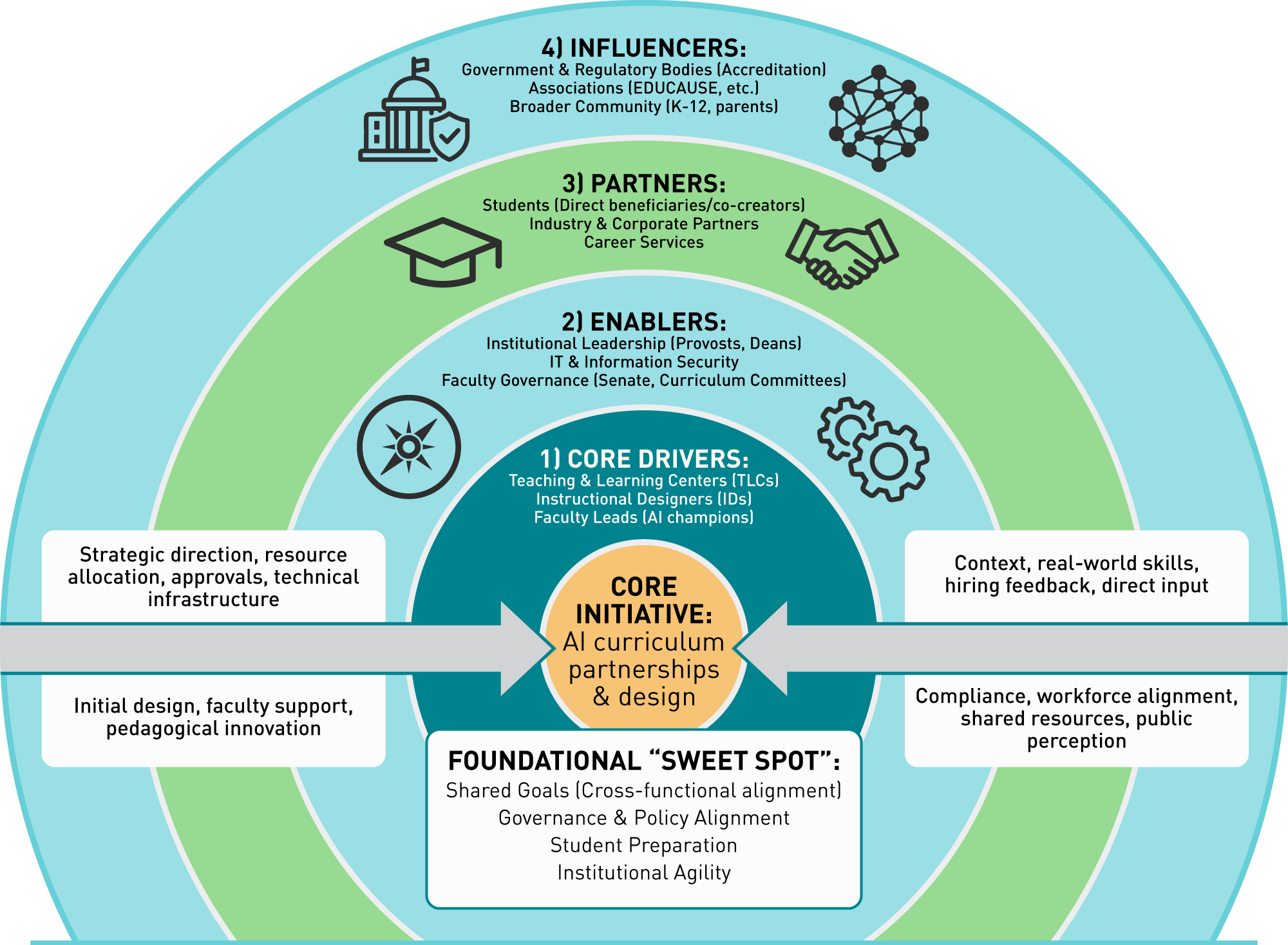
Whereas table 1 focuses on a starting point, curriculum partnerships ultimately exist within a much larger ecosystem. Figure 1 illustrates a broader landscape of stakeholders and relationships that may influence or contribute to curriculum partnerships over time. Institutions can use the figure as a stakeholder-mapping tool to identify potential engagement opportunities and determine which groups should be involved immediately, engaged later, or kept informed throughout the process.
Rules of Engagement with Industry Partners
Effective curriculum partnerships do not happen by accident. They require clear expectations, shared goals, and intentional structures that help institutions and industry partners move beyond occasional interaction toward meaningful collaboration. The principles in this section provide a framework for building productive, sustainable partnerships that can respond to the pace of change in the AI era while respecting the unique priorities, constraints, and expertise of each partner.
Key Takeaways for Rules of Engagement
Establish clear pathways for engagement.
Build shared language and expectations.
Move from advisory input to co-creation.
Focus on transferable capabilities, not specific tools.
Create continuous feedback loops.
Balance agility with governance.
Measure and communicate outcomes.
Moving Beyond Advisory to Embedded Partnership
The traditional model of industry engagement in higher education has often included periodic advisory committee meetings, guest lectures, and events such as career fairs. This model has served important purposes, but it is insufficient for the scale and speed of change that AI demands. If institutions are to keep curricula relevant to an AI-transformed workforce, partnerships with industry must move from transactional and advisory to deeply embedded in the work of curriculum design itself.
This shift requires both sides to understand each other more fully. Industry partners need to understand the culture, governance structures, and pace of higher education, dynamics that are often unique within higher education and vary significantly across institutions. Institutions need to understand that industry needs are evolving in real time and that the skills employers seek, such as critical thinking, ethical reasoning, adaptability, and communication are often the same durable skills that higher education has always valued, now applied in new contexts.
It is also worth recognizing that both sides are on a learning journey. Institutions should not assume that industry partners already know how to best apply AI in their own workforce, and industry should not assume that institutions are simply slow to adapt. Both face real-time upskilling demands. There is an arc of process and maturity before partnerships can produce their full value: Faculty need experience with AI to integrate it into their classes, and industry needs to understand AI application in workplace contexts. Recognizing this shared learning journey is the foundation for authentic collaboration.
Establishing the Way In
One of the most practical steps an institution can take is to create a clear, viable pathway for industry partners to engage with curriculum work. A partner who wants to co-create a course should know exactly what the steps are, what the timeline looks like, and whom to talk to. This might include:
- A web-based intake form where partners can express interest in collaboration, describe their needs, and learn about available partnership models.
- A published set of partnership tiers with expected timelines, commitments, and outcomes, from light-touch input (guest lectures, advisory participation) to deep engagement (co-designed courses, embedded residencies, joint credential development).
- A designated liaison who serves as a single point of contact and can help partners navigate institutional processes.
- An orientation to working with higher education that helps partners understand shared governance, accreditation requirements, the academic calendar, and the cultural norms that shape decision-making. EDUCAUSE’s Higher Ed Guide for the Corporate Community is one resource that supports this, and institutions can contribute by making their own processes transparent and navigable.
The goal is to systematize what has often been ad hoc. When the pathway is clear and allows self-service participation, it lowers the barrier for new partners and signals institutional seriousness about collaboration.
A Shared Framework: Three Tiers of AI Competency
Curriculum partnerships benefit from a shared understanding of what AI in the curriculum actually means. A useful organizing principle identifies three tiers of competency that partnerships should aim to develop:
- AI skill: General AI literacy and fluency such as prompting, responsible use, understanding what AI can and cannot do, and maintaining meaningful human oversight. This is foundational and applies across all disciplines and career paths.
- AI skill in context: Discipline-specific application of AI, with practice in authentic or simulated workplace environments. This is where industry context is most valuable, such as writing code alongside AI in a software engineering course, using AI-assisted diagnostics in a health-sciences lab, applying natural language processing in a journalism program, or leveraging AI in biological research. The range is as broad as the workforce itself, including hospitals, clinics, production companies, broadcasting, manufacturing, and beyond. Industry partners from every sector, not just technology companies, have essential contributions to make here.
- Human skills needed in the age of AI: The durable, transferable capabilities that distinguish human contribution from machine output, including judgment, creativity, leadership, critical thinking, ethical reasoning, and the ability to manage AI-driven workflows. These are the same skills employers have sought for decades, and they are now more important than ever.
This framework helps partners and institutions establish shared expectations and frames the conversation around transferable capabilities rather than specific tools. These transferable capabilities are particularly essential given how rapidly the technology landscape evolves.
Principles for Productive Partnerships
Successful curriculum partnerships are built on more than good intentions. They require shared understanding, mutual trust, clear communication, and structures that support meaningful collaboration over time. The principles outlined here can help institutions and industry partners establish relationships that move beyond transactional engagement toward sustained co-creation and continuous improvement.
Start with Shared Language
Institutions and industry partners often describe the same needs in different terms. Establishing shared vocabulary early prevents misalignment and builds trust. When industry says they want critical thinking and institutions say they cultivate analytical reasoning, both sides should recognize they are describing the same capability. Similarly, discussions about durable skills, soft skills, and transferable competencies often refer to overlapping concepts. Both sides should also resist the assumption that the other already fully understands AI application in their own domain; the shared learning journey is the starting point, not an obstacle.
Design for Depth, Not Just Input
Meaningful partnership goes beyond information sharing at semi-social events. The goal is to move from advisory roles to embedded participation in curriculum design. Consider models such as:
- Embedded residencies for which industry professionals spend extended time (days or weeks, not hours) working alongside faculty and instructional designers on course development.
- Co-facilitated course design workshops in which industry experts and faculty jointly develop learning outcomes, assessments, and case studies.
- Faculty site visits to industry workplaces to observe how AI is changing practice, which helps faculty connect what they teach to how graduates will actually work.
- Structured course shells with a syllabus framework where industry partners contribute content, tools, and real-world scenarios within a structure designed by faculty and instructional designers.
- Joint development of certifications, microcredentials, or stackable credentials that carry weight in both academic and employment contexts.
Build Feedback Loops
Partnerships need mechanisms for ongoing, bidirectional feedback. Are graduates meeting employer expectations? Are the skills being taught translating to workplace performance? Are industry partners updating their own position descriptions and hiring criteria to match the skills and credentials they say they need? Industry advisory committees can evolve from information-sharing venues to active participants in program development.
Feedback should also flow from alumni. Recent graduates are a powerful group to ask what they wish they had known and what they wish they had learned. Their perspective bridges the gap between curriculum design and workforce reality.
Leverage Existing Structures
Many institutions already have structures that can be strengthened rather than replaced. Industry advisory boards, particularly at community and technical colleges, have long served as conduits between campus and workforce and represent a best practice that all institution types can learn from. Professional schools often have faculty with deep industry connections and specialized accreditation processes that already require industry alignment. Programs in continuing education are frequently more agile than traditional degree programs in responding to market needs and may offer faster pathways to curriculum responsiveness. The question of how industry co-developed programs blur the distinction between credit and noncredit, and how continuing education relates to traditional curricula, is itself worth exploring as institutions seek more flexible models.
Consider Accreditation and Governance
Industry partners should understand that curriculum changes must navigate accreditation and governance requirements with real timelines and constraints. Institutions should engage accreditation bodies early to understand how more frequent curriculum updates driven by industry partnerships will be reviewed. At the same time, institutions should advocate internally for governance processes that balance rigor with responsiveness. Faster iteration without triggering a full review process may be feasible for mechanisms such as elective course pilots, modular credentialing, or expanded flexibility in syllabi revision.
The Translation Challenge
At the heart of curriculum partnerships is a translation challenge: Employers describe the skills they need, and institutions must translate those descriptions into learning outcomes, assessments, and curricular structures. This translation is the core of the partnership, and it is where the most creative work happens.
The translation process may be supported by curriculum specialists, by faculty with deep industry connections, or increasingly by AI itself, which can help with alignment checking, rapid prototyping of course materials, or assessing whether stated outcomes match what is actually being taught. If institutions define their outcomes clearly, AI can provide data to assess alignment. The Department of Labor and Department of Education publish guidance on workforce skills and future jobs that can inform this translation work.
However it happens, the translation function is what transforms a conversation about workforce needs into a concrete learning experience. Investing in the people, processes, and tools that make it work is essential.
Make Outcomes Visible
Curriculum partnerships gain traction when their outcomes are visible and measurable. Tracking indicators such as job placement rates, employer satisfaction with graduate readiness, student feedback on applied learning experiences, and time-to-competency for new hires provides evidence that partnership investments are paying off. Stackable microcredentials offer a particularly promising mechanism for demonstrating return on investment, both for students building a portfolio of capabilities and for institutions demonstrating responsiveness to workforce needs.
Communicating outcomes broadly to faculty governance, institutional leadership, prospective industry partners, and the broader higher education community helps sustain momentum and attract new collaborators. Successful partnerships should be shared as case studies and examples that other institutions can learn from and adapt.
A Recipe for Curriculum Co-Creation
The metaphor of a recipe is deliberate: Curriculum co-creation, like cooking, involves assembling the right ingredients, following a process that allows for both structure and improvisation, and producing something that serves the people at the table. This section provides is a practical framework for institutions and their partners to use as a starting point, adapting it to their own contexts, resources, and goals.
Ingredients
Every successful recipe begins with the right ingredients. Curriculum co-creation is no different. While every institution and partnership context will look different, successful collaborations tend to rely on a common set of foundational elements: a clear purpose, engaged stakeholders, relevant expertise, adequate resources, and a culture of trust. Think of these ingredients as the essentials that make meaningful collaboration possible, regardless of the specific curriculum challenge being addressed.
A Clear Problem Statement and Direction
Define the problem you are solving. What skills are your graduates missing? Where is the gap between your current curriculum and workforce needs? What specific outcomes do you want the partnership to produce? A clear direction serves as the recipe title—it tells everyone what you are making and why.
An Organizational Change-Management Strategy
Curriculum co-creation is a change effort, and it benefits from being treated as one. This means having a plan for communication, stakeholder engagement, resistance management, and sustaining momentum over time. Organizational agility is essential because you must be able to adjust the approach as you learn what works.
Stakeholder Engagement
Identify the key individuals and groups whose participation is essential. Prioritize those who can authorize change, design it, and represent end users. Build and maintain relationships with industry partners who bring real-world context and are willing to invest time in co-creation.
Expertise About AI
Identify where AI expertise will come from and assess its quality. Is it healthy and full of nutrients? Is the primary source the IT organization, vendor partners, faculty researchers, or external consultants? Strong knowledge-management practices help ensure that AI expertise is shared broadly rather than concentrated in a single office or individual.
Funding and Resources
Meaningful curriculum change requires investment:
- Budget for faculty learning and course redesign through grants, course relief, and stipends for summer development. Innovation grants from the provost’s office can incentivize creativity and surface faculty who are ready to lead.
- Staff time for instructional designers, curriculum specialists, and change-management support. This may include new roles to support faster course redesign and new proposals, staff to help teach faculty about AI, and staff to help faculty review course and curricular alignment with program requirements.
- Faculty time with explicit institutional support. Faculty should have clarity on how this work contributes to tenure and promotion. They should be given freedom to experiment, and grace when experiments do not produce expected results. The question of who gets to experiment matters; institutions should ensure access is equitable, not limited to those who are already most comfortable with technology.
- Partner contributions: Industry partners can contribute funding, content expertise, access to real-world tools and environments, and staff time for co-design work.
Trust and Intentional Inclusion
The foundational ingredient is trust among faculty, administrators, students, and industry partners. Trust is built through intentional inclusion: the more meaningfully stakeholders are involved in the design process, the more likely they are to support the outcomes. This includes a bias toward action, moving beyond planning into tangible steps that demonstrate commitment and progress.
Instructions
Having the right ingredients is only the beginning. The real value of curriculum co-creation comes when those ingredients are combined through a thoughtful and collaborative process. The steps that follow offer a practical roadmap for turning ideas into action, helping institutions and industry partners move from shared goals to meaningful learning experiences that can be tested, refined, and scaled.
Before You Begin, Conduct a Pantry Inventory
Before acquiring new resources, take stock of what you already have. What existing courses, programs, or faculty expertise are relevant? What industry relationships are already in place? What instructional design capacity exists? What technology platforms are available? Understanding your current resources prevents duplication and helps identify the specific gaps that new partnerships need to fill.
Step 1: Build Support
Before beginning curriculum design work, establish the conditions for success. Secure leadership sponsorship. Align the effort with institutional strategic priorities. Confirm governance pathways and timelines. Build shared language among partners so that when industry says “critical thinking” and faculty say “analytical reasoning,” everyone recognizes they are describing the same capability. Set a direction and establish what you are trying to create together.
Step 2: Convene Key Stakeholders
Bring together the cross-functional group identified in stakeholder mapping. Ensure representation from faculty, instructional design, IT, career services, student voices, and industry partners. Use initial discussions to establish shared goals, surface concerns, and agree on a working process. A container approach can help teams move quickly without getting overwhelmed by the scale of the broader challenge: define a bounded, fast-tracked process for a specific course or credential. Think of it as a meal kit with a defined scope, clear steps, and a specific outcome, rather than trying to redesign the entire menu at once.
Step 3: Design Together
Move from input-gathering to co-creation. Industry partners should not simply describe what they need and leave; they should participate in designing learning outcomes, developing assessments, and shaping the learning experiences that will build the capabilities they seek. Consider models such as embedded residencies, co-facilitated design sprints, or structured course shells where industry partners contribute content within a framework designed by faculty and instructional designers.
Use AI itself as a tool in the design process for activities such as rapid prototyping of course materials, alignment checking between stated outcomes and actual content, or generating draft assessments that faculty can refine. If institutions define their outcomes clearly, AI can help assess alignment and provide data to support continuous improvement.
Step 4: Pilot and Iterate
Launch the co-created curriculum as a pilot, with built-in mechanisms for feedback and revision. Gather data on student learning, student experience, and employer response. Treat the first iteration as a learning opportunity, not a finished product. Share what you learn with the broader campus community to build interest and credibility. Well-designed pilots also test what the governance pathway looks like for eventual formal approval.
Step 5: Share Successes and Scale
Communicate outcomes broadly. Use internal venues such as faculty symposia, governance presentations, and institutional newsletters, as well as external venues including professional conferences, publications, and community networks. Leverage peer institutions and professional associations to scale successful models. What works at one institution may be adaptable by others facing similar challenges.
Yields and Nutrition Information
When the recipe works well, the outcomes include the following:
- A campus culture in which experimentation and innovation are acceptable and encouraged, with faculty and students feeling supported in taking creative risks.
- A productive tension between structure and possibility, with enough rigor to ensure quality and a positive student experience and enough flexibility to respond to change. If higher education tends toward less risk to protect student outcomes, the recipe creates a bounded space for safe experimentation.
- Curriculum that centers transferable human capabilities alongside technical skills, making programs more resilient to rapid technological change.
- Thoughtful attention to privacy, data security, and ethical AI use, with students who understand why these considerations matter and can help others make informed decisions about safe software solutions.
- Modularized content and credentials that can fit into specialized program requirements or span across curricula, including stackable microcredentials that demonstrate specific competencies to employers.
- Evidence of alignment between curriculum and workforce needs, supported by data from institutional effectiveness offices and employer feedback loops.
Pointers and Tips
- Use a convection oven, not a slow cooker: Define a fast-tracked, agile process for developing a new course or revising an existing one. Same quality, less time. If you have found success with a rapid design process, document it and share it so others can replicate it.
- Learn from students: Students are using AI in creative, thoughtful ways for ideation and studying. Their practices and perspectives should inform course design, not just receive it. Let them challenge your assumptions about how AI should be used in the classroom and in their future careers.
- Use professional development strategically: Workshops and faculty learning communities build comfort and confidence. Help faculty adopt a positive mindset about student agency and responsible AI use, with less emphasis on policing and more on partnership.
- Co-create with students: Consider writing syllabi together with students. Involving them in the design of their own learning experiences builds ownership, surfaces insights about how they want to learn, and models the collaborative, human-centered practice that the AI era demands.
- Build on momentum: Each successful pilot, each positive outcome shared, each new partner engaged creates energy for the next step. Do not wait for a comprehensive plan before taking action.
- Look for what is already working: There are probably people on your campus already doing this kind of work without its being centralized or visible. Find them, learn from them, and help connect their efforts to the broader institutional strategy.
How Is This Best Served?
Right away. Curriculum partnerships for the AI era are not a future initiative but a present need. The good news is that this recipe does not expire because its core ingredients (trust, stakeholder engagement, shared design, and iterative improvement) are durable practices that will remain relevant as technologies continue to evolve. Start with what you have. Adjust as you learn. And share what you create so others can build on it.
Contributors
We are grateful for the contributions of our working group contributors!
- Tracey Birdwell, Assistant Director, Center for Instructional Excellence, Purdue University
- Sarah J. Buszka, Director, Applied AI Lab, Waukesha County Technical College
- Shannon Dunn, Vice President, Vantage Technology Consulting Group
- Adrienne Garber, Chief Technology and Innovation Strategist for Higher Education, Dell Technologies
- Jenna Linskens, Director, Center for Instructional Design & Educational Technology, Ithaca College
- Jeff Nesheim, Senior Information Officer/Associate Vice President for Instructional Technologies, Arapahoe Community College
- Kathe Pelletier, Senior Director of Community Programs, EDUCAUSE
- Amie Runk, Strategic Analyst, Vantage Technology Consulting Group
- Katie Fife Schuster, Program Manager, Partnership and Corporate Engagement, EDUCAUSE
- Matt Varin, Field Sales Manager for Higher Education (West Region), CDW
- Karen Vignare, Vice President, Digital Transformation for Student Success, and Executive Director, Personalized Learning Consortium, Association of Public & Land-Grant Universities (APLU)
This resource was created as a result of the collaborations and conversations that occurred during the 2025 EDUCAUSE Annual Partner Summit. Each fall, the EDUCAUSE Annual Partner Summit convenes leaders from higher education, associations, and corporate partners to work together toward solutions to some of higher education’s big challenges.
For more information about the Partner Summits and links to other resources that were developed from those events, visit the Partner Summit Resources page.
See the other resources from the 2025 EDUCAUSE Annual Partner Summit:
-
Aligning Procurement Strategies: A Guide for Vendors and Higher Education Professionals
-
The Integrated Institution: A Guide to Interoperability for Student Success
-
Understanding Higher Education Budgeting and Purchasing: A Guide for Trusted Partnerships
© 2026 EDUCAUSE. The content of this work is licensed under a Creative Commons BY-NC-ND 4.0 International License.