The Integrated Institution: A Guide to Interoperability for Student Success

Connected systems create connected experiences. By improving how data moves across platforms, institutions can better support students, enhance experiences for faculty and staff, make better-informed decisions, and build a stronger foundation for future innovation. This guide offers practical strategies for assessing, prioritizing, and advancing interoperability across the institution.
Key Takeaways of the Guide
- Treat interoperability as a strategic priority, not just a technology initiative.
- Connect systems and data to improve student support, decision-making, and institutional agility.
- Build a foundation for AI, analytics, and future innovation through standards-based data practices.
- Assess your current environment to identify gaps, priorities, and opportunities for improvement.
- Use procurement and vendor partnerships to advance long-term interoperability goals.
- Start small, build momentum, and scale through governance, collaboration, and intentional change management.
Interoperability and Student Success: What It Is, Why It Matters, and What It Makes Possible
Every institutional initiative surrounding student success depends on data that can be acted upon. Yet in most higher education environments, the data needed to understand and support students is scattered across dozens of disconnected systems. Interoperability is the foundational capability that makes student success data usable, portable, and meaningful.
What Does “Interoperability” Mean?
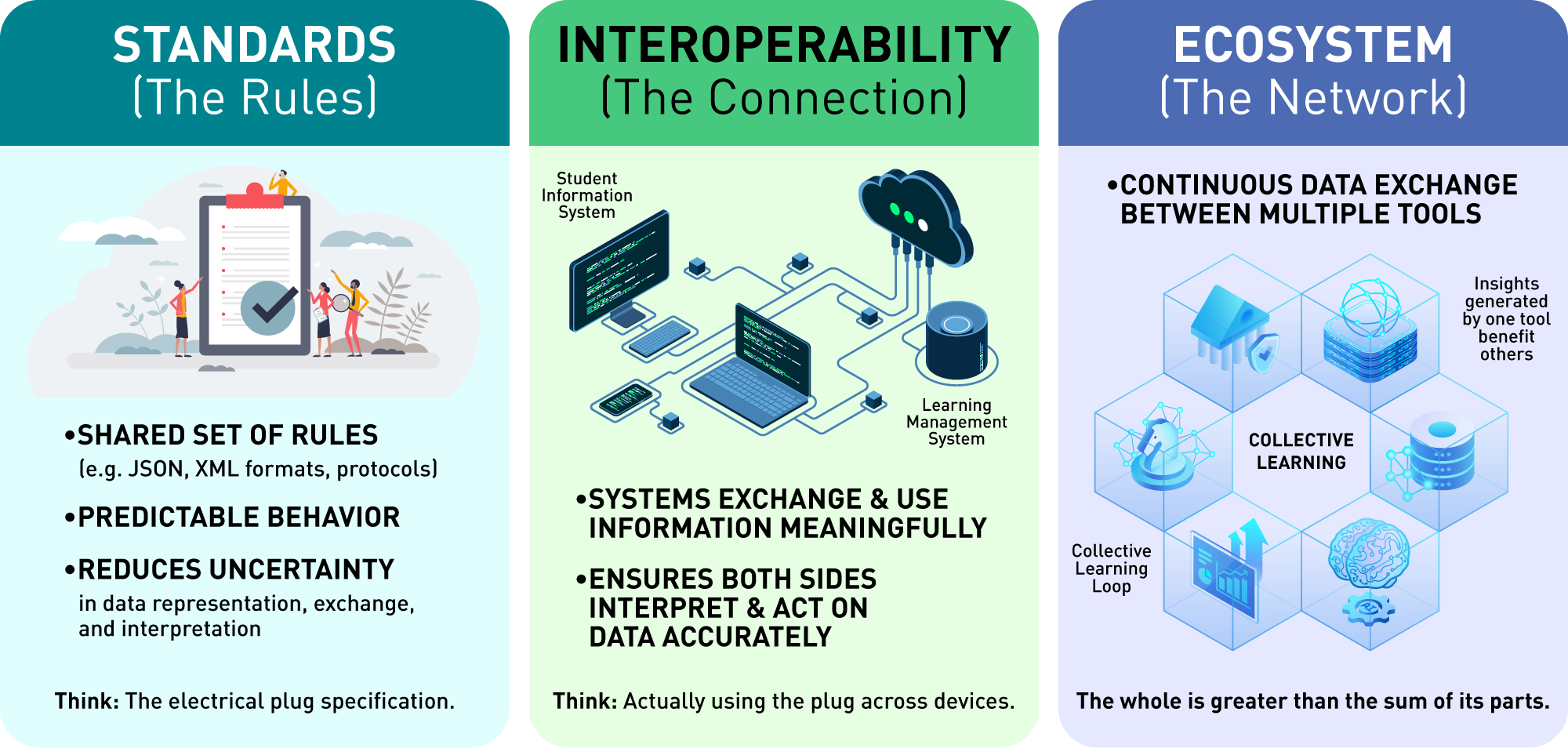
A standard is a shared set of rules that everyone agrees to follow so that various products, systems, or processes behave in predictable ways. In education, standards reduce uncertainty by specifying how data is represented, exchanged, or interpreted across different systems. This common ground allows independent developers to build tools that work together, even if those tools were developed in separately.
💡
To understand standards, think of the electrical plug on a lamp. You do not need to understand electrical engineering to buy a lamp and use it at home. The plug complies with a standard, the outlet complies with a related standard, and they work together because everyone agrees on the same specifications.
Interoperability builds on standards. Whereas a standard defines the shape of the plug, interoperability is the experience of actually using that plug across multiple devices and scenarios; it is about systems that work together. Formally, interoperability is the ability of two or more systems to exchange information and use it meaningfully. That means not just moving data but ensuring that both sides interpret it accurately and can act on it.
An ecosystem goes further still. In a true ecosystem, tools do not just connect to a central platform but continuously exchange data so that insights generated by one tool can be used by others. The result is a collective learning loop in which the whole is greater than the sum of its parts (see figure 1).
Why Does This Matter for Student Success?
Why should institutions care about interoperability? For the same reason consumers care about standard light bulb sockets: They want a return on their investment. An institution that purchases a learning analytics platform should not discover it can only function in isolation. Standards lower barriers, expand options, and allow innovators to compete on quality and experience rather than proprietary lock-in. For both institutions and for students, standards can do more than improve operational efficiency. When students are not supported by the tools and environment to help them be successful, their progress may be stymied, and institutions may face real reputational risk. Investment in interoperable systems helps students persist and graduate, which may pay dividends for years to come.
The Interoperability Spectrum
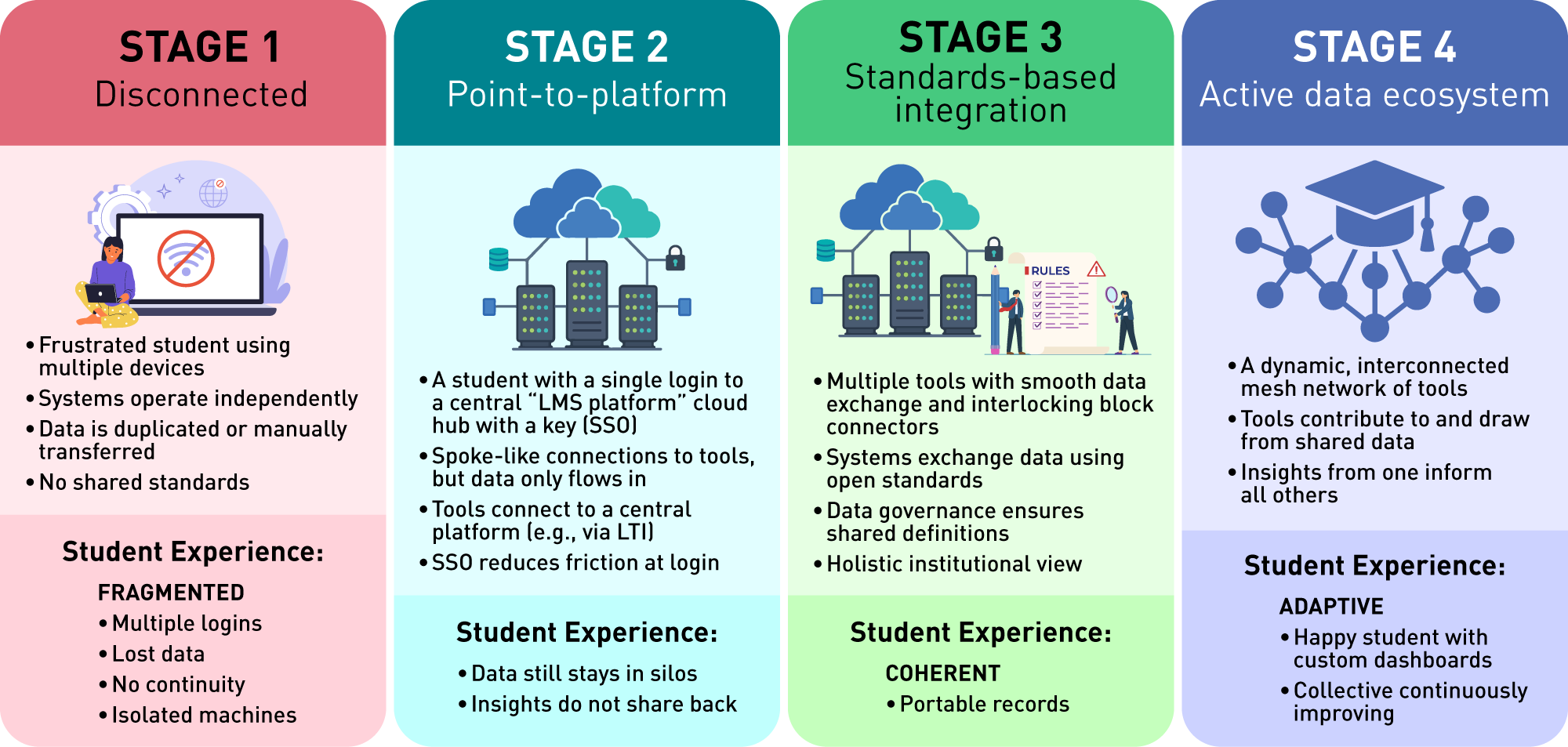
Most institutions sit somewhere on a spectrum for enabling and realizing the benefits of interoperability. Understanding where your institution is on that spectrum is the first step toward improving your position (see figure 2).
- Stage 1 — Disconnected: Systems operate independently. Data is duplicated or manually transferred. No shared standards. The student experience is fragmented, consisting of multiple logins, lost data, and no continuity.
- Stage 2 — Point-to-Platform: Tools connect to a central platform (e.g., LMS via LTI). SSO reduces friction at login. But data still stays in silos; tools receive context but do not share insights back.
- Stage 3 — Standards-Based Integration: Systems exchange data using open standards. Data governance ensures shared definitions. Students experience coherent, portable records and a more holistic institutional view.
- Stage 4 — Active Data Ecosystem: Tools contribute to and draw from shared data. Insights from one tool inform all others. The student experience is personalized, adaptive, and continuously improving.
Who Benefits?
- Students: Portable credentials, a coherent digital experience, and agency over their own data.
- Faculty and Staff: A holistic view of teaching and learning, timely integrated insight, and fewer systems to navigate.
- Institutions: Shared security and privacy standards, AI-ready structured data, and data-informed decision-making.
- IT Organizations: Reduced technical debt, standards-based integrations, and sustainable ecosystems.
Common Challenges
- Institutional Inertia and Resource Constraints: Attitudes based on “we’re doing fine” delay progress, especially when interoperability is seen as an IT-only concern.
- Vendor Adoption of Standards: The marketplace has been slow to consistently require or reward compliance.
- Data Complexity: Data flows and dependencies are often not well understood, even within IT.
- Data Management and Governance: Without shared definitions, consistent data standards, and clear ownership, technical integrations may risk amplifying inconsistencies in data definitions and other data management complexities at scale.
- Student Engagement: Institutions overlook the need to understand what students need from their data and digital experience.
Key Terms at a Glance
- LTI (Learning Tools Interoperability): A standard for connecting tools to learning platforms such as the LMS.
- Edu-API: A 1EdTech standard for structured data exchange across educational systems.
- CEDS (Common Education Data Standards): A framework for consistent data definitions.
- SSO (Single Sign-On): Allowing one login to be used across multiple systems.
- Data Governance: Policies, roles, and processes ensuring data accuracy, security, and appropriate use.
- Technical Debt: The accumulated cost of maintaining custom, non-standard integrations.
Making the Case: Connecting Interoperability to Institutional Priorities
The ability of institutional systems to exchange data and use it meaningfully is not an IT initiative. It is a strategic enabler that directly affects your institution’s ability to achieve its most important goals. When systems cannot share data reliably, every strategic priority becomes harder to achieve, more expensive to pursue, and more fragile to sustain.
Yet interoperability is often invisible until it fails. Leaders do not see “interoperability” on their dashboards; they see unreliable reporting, duplicated student records, slow onboarding of new tools, manual workarounds that introduce errors, and compliance risks that grow silently. These are all symptoms of the same underlying condition.
Interoperability Connects to What You Already Care About
- Student Success and Retention: When advising platforms, early-alert systems, and learning tools share data, advisors get a complete picture of each student. Without interoperability, staff toggle between systems, and students fall through the cracks.
- AI Readiness and Scalability: AI tools require structured, clean, interoperable data to function effectively. Institutions without interoperable systems will struggle to leverage AI in meaningful ways. Interoperable data infrastructure is not a one-time investment but a foundation that scales with emerging technology, protecting the institution’s ability to adapt as the AI landscape continues to evolve. This is an urgent and universal driver, perhaps the most compelling one for institutional action right now.
- Cost Containment: Custom integrations are expensive to build and maintain. Every nonstandard connection adds technical debt. Standards-based interoperability reduces long-term costs and frees IT resources for strategic work.
- Accreditation and Assessment: Clean data flows mean faster, more reliable reporting for accreditation, program review, and institutional effectiveness.
- Data-Informed Decision-Making: Reliable dashboards and analytics depend on data that is consistent, timely, and trustworthy across systems. Without interoperability, reporting requires manual reconciliation and is vulnerable to error.
- Digital Accessibility: Interoperable systems support more equitable, consistent access to institutional services and data across the student experience.
The Cost of Inaction
Lack of interoperability is not merely an inconvenience. Students perceive the absence of interoperable systems through friction in accessing resources, gaps in support, and experiences that fall short of expectations. Lack of interoperability also actively hinders institutional strategy. It means new tools take longer to deploy, student data is fragmented and incomplete, compliance risks grow unmonitored, and the institution cannot move at the speed its strategic ambitions require. Every system acquired without interoperability standards adds to a growing burden of technical debt that future leaders will inherit.
What Leadership Sponsorship Looks Like
Interoperability succeeds when leaders treat it as an institutional priority, not a discretionary IT project. Active sponsorship means the following:
- Connecting interoperability explicitly to strategic plan objectives.
- Reinforcing governance decisions and resolving cross-functional tensions.
- Ensuring procurement processes require standards compliance.
- Communicating the value of interoperability in terms of outcomes, not infrastructure.
- Maintaining focus through inevitable trade-offs and competing priorities.
One Question to Start With
Ask your CIO or IT leadership: “If we needed to combine student data from our top-five systems into a single dashboard tomorrow, how long would it take and how confident would we be in the result?” The answer will be illuminating.
From Infrastructure to Impact: A Change-Management Guide for Interoperability
Interoperability is often described as a technical challenge, one that involves systems, integrations, and APIs. In practice, it is a change-management challenge rooted in people, processes, and shared understanding. Technical solutions implemented without institutional buy-in, clear communication, and stakeholder engagement will fail to deliver their intended value.
Phase Your Approach
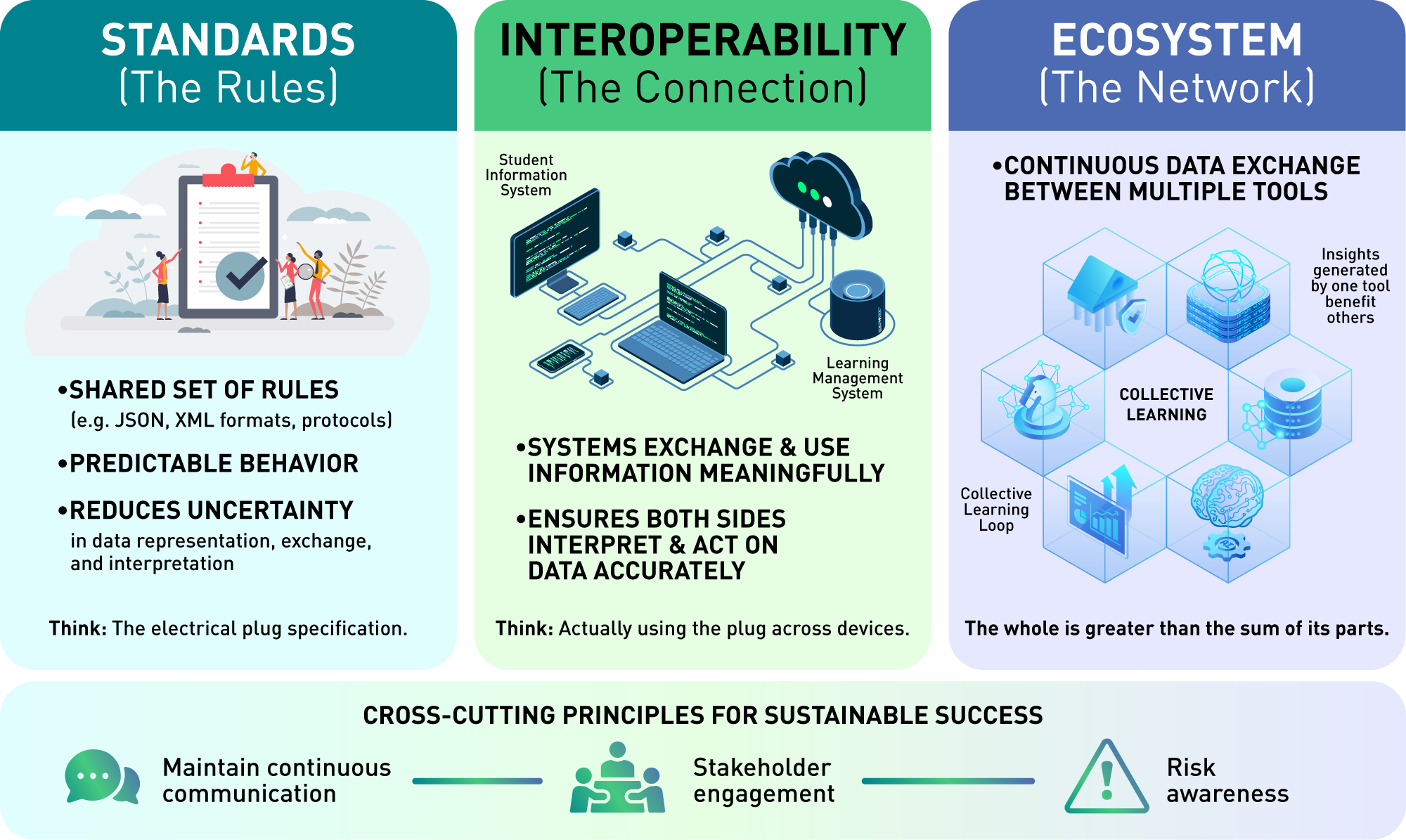
Effective interoperability efforts are intentionally sequenced. Trying to do everything at once leads to change fatigue. Instead, build capacity in phases (see figure 3).
- Phase 1 — Lay the Foundation: Establish shared language. Form a cross-functional team. Define data governance roles. Connect interoperability to strategic priorities. Assess the current environment. Key stakeholders are leadership, IT, and governance.
- Phase 2 — Prove the Value: Launch targeted pilot projects. Measure and communicate wins. Refine governance processes. Engage faculty and students. Embed interoperability in procurement standards. Key stakeholders are all groups, engaged role by role.
- Phase 3 — Scale and Sustain: Tackle complex integrations. Require vendor compliance with standards. Build toward a data ecosystem. Participate in sector-level standards. Sustain leadership sponsorship. Key stakeholders are across the enterprise.
Throughout all phases, maintain continuous communication, stakeholder engagement, and risk awareness.
Establish Shared Language
The term “interoperability” itself can be a barrier. For many audiences it feels abstract or overly technical. Reframe it as “getting our systems to talk to each other in ways that meaningfully support our work.” This shared language is essential for alignment. Stakeholders need to understand that interoperability is about enabling better outcomes, not introducing complexity.
Shared language also means shared definitions. A grade, an enrollment status, or a program attribute may mean different things in different systems or departments. This is where data governance enters naturally. Systems cannot communicate effectively without consistent data translation and a common understanding of meaning. Interoperability enables connectivity; data governance ensures meaning. Standards-based frameworks such as CEDS enable structured data to be exchanged across systems and make AI tools more effective by giving them structured data to work with.
Communicate by Audience
The value proposition of interoperability looks different by role. Tailor your messaging to the audience.
- Faculty: Fewer logins, automatic roster sync, timely insight into student learning
- Advisors: Holistic student view without toggling between platforms
- IT: Reduced technical debt, sustainable integrations, less firefighting
- Leadership: Cleaner data for accreditation, assessment, and resource decisions
- Students: Coherent digital experience, portable credentials, agency over their data
Demonstrate Value Through Pilots
Pilots and proof-of-concept initiatives build credibility by showing that interoperability is practical, not theoretical. A well-designed pilot demonstrates reduced manual effort, improved data accuracy, or an enhanced student experience. Equally important, pilots help validate the effort required by individuals to adopt the change. Communicate outcomes in concrete terms: time saved, errors reduced, satisfaction improved. These results sustain momentum and build the case for broader rollout.
Engage Stakeholders Intentionally
Faculty, IT professionals, institutional research staff, academic leadership, student support teams, and students themselves all experience systems differently. Engage these groups early through advisory councils, design workshops, or structured feedback so that they take an active role in defining what interoperability should achieve. Apply design thinking—listen for the “voice of the customer.” If interoperability efforts are perceived as adding complexity, they will struggle. If they demonstrably improve daily work, they build trust.
Acknowledge the Technical Dimension
While interoperability is fundamentally a people-and-process challenge, the technical component should not be downplayed. Custom APIs and point-to-point integrations are qualitatively different from standards-based interoperability. Standards-based approaches (such as the Edu-API from 1EdTech) provide durable, scalable foundations, while custom integrations create fragile dependencies. Make this case explicitly to stakeholders who believe the institution is already “interoperable enough.”
Manage Risk Awareness
Raise awareness that unvetted tools (even, or maybe especially, free ones) present integration and data risks. Interoperability standards provide a common framework for evaluating what tools can and should connect to institutional systems. This is particularly important in LMS environments where LTI connections can expose institutional data.
Where Are You Positioned? Assessing Institutional Interoperability
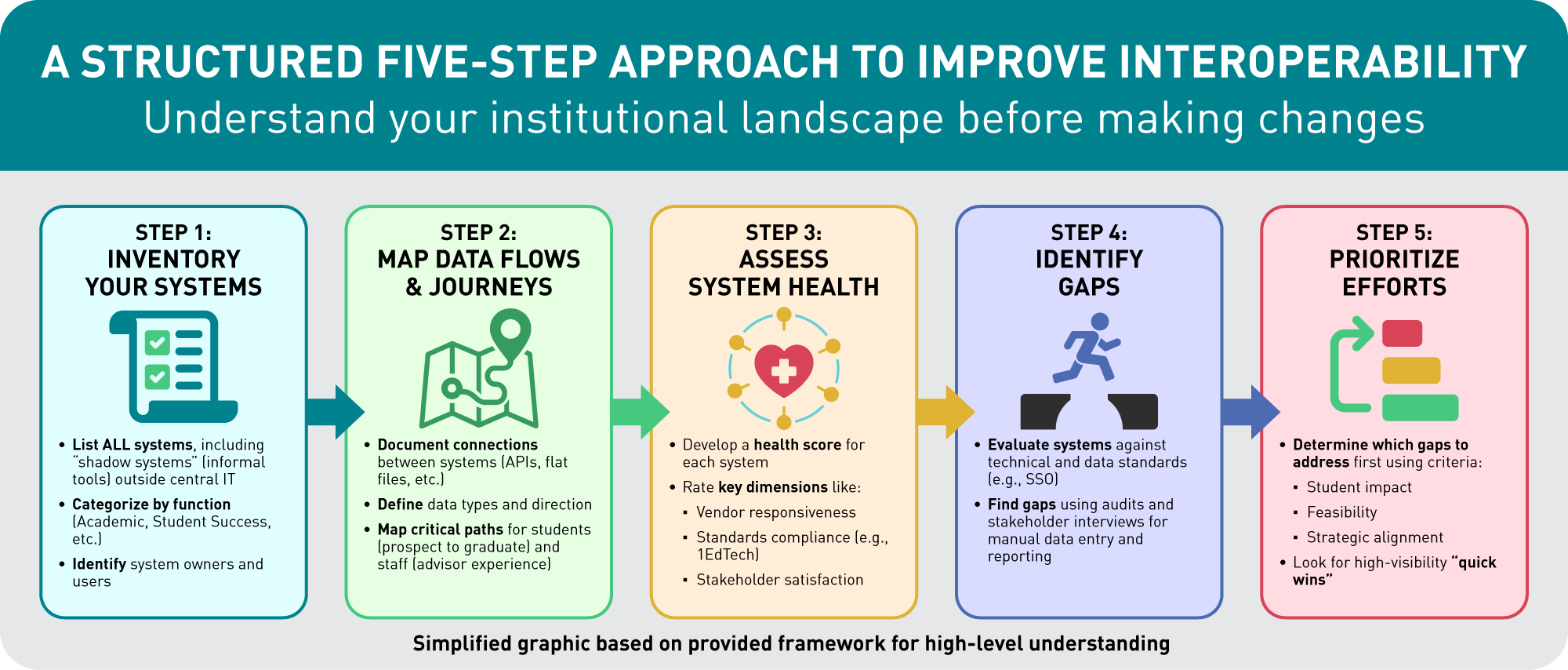
Before improving interoperability, you must understand where your institution is currently positioned. This framework provides a structured five-step approach: inventory systems, map data flows, assess system health, identify gaps, and prioritize.
Step 1: Inventory Your Systems
Conduct a comprehensive inventory that goes beyond what IT formally supports. Many institutions discover shadow systems (tools purchased at the department level, free vendor tools adopted informally, or legacy platforms in partial use) that handle student data outside central IT’s awareness. Supplement surveys with audits of financial records and software licenses.
Categorize systems by function: academic, enrollment, student success, financial, research, advancement, and operations. Mapping overlap across categories reveals redundancy and risk. For each system, identify who owns it, who uses it, and who depends on its data.
Step 2: Map Data Flows and Journeys
Document integrations between systems: what data flows, in what direction, how frequently, and through what mechanism (API, flat file, manual entry, middleware). Note whether integrations are based on standards or custom built. Then map two critical journeys:
- The student journey: How does a student flow through your systems from prospect to graduate? How many systems do they touch? Is there SSO? Where do handoffs create friction or data loss?
- The staff experience: How many systems does an advisor access to see a complete student picture? How many logins and interfaces does a faculty member encounter?
Consolidate findings into a visual map illustrating systems, categories, data flows, and integrations. This makes the invisible visible, especially for nontechnical stakeholders.
Step 3: Assess System Health
Develop a health indicator for each system using dimensions such as the following:
- Vendor relationship: Is the vendor responsive and transparent? Are they oriented toward partnership or a transactional relationship?
- Standards compliance: Is the vendor certified in recognized interoperability standards (e.g., 1EdTech)? What evidence exists regarding privacy, security, accessibility, and AI transparency?
- Stakeholder satisfaction: Use surveys and direct inquiry (interviews, focus groups) to gather feedback.
- Integration complexity: How difficult is the system to connect to others?
- Support effort: How much IT resource does the system consume?
- Strategic fit: How well does the solution align with institutional direction?
- Time since last review: How long has it been since a competitive evaluation or RFP?
Step 4: Identify Gaps
Assess each system against your technical standards.
- Authentication: What methods are supported? Is SSO in place?
- Deployment model: On-premises or cloud? What are the integration implications?
- Source of truth: Is this system authoritative for its data domain, or do shadow systems create competing versions?
- Utilization versus capability: Are you using the integration features the system already offers?
Supplement the technical assessment with stakeholder interviews to identify gaps that do not appear in audits such as manual data re-entry workflows, reports requiring data from multiple systems, and reconciliation done in spreadsheets.
Step 5: Prioritize
Not all gaps are equal. Use a multidimensional framework.
- Student Impact: Which gaps most directly affect the student experience and outcomes?
- Feasibility: What is technically and financially realistic now?
- Strategic Alignment: Which efforts connect to the institutional mission and strategic plan?
- Operational Efficiency: Where would integration most reduce effort, errors, or duplication?
Look deliberately for quick wins: What low-effort, high-visibility improvements can you achieve in a short period of time with low investment or effort? This could include enabling an existing unused integration or automating a manual data transfer. Quick wins build momentum and credibility for larger efforts. Before moving forward, ensure that key stakeholders have reached agreement on priorities, objectives, and requirements. Shared alignment at this stage prevents costly misunderstandings and scope drift later in the process.
From Assessment to Action: Building an Interoperability Roadmap
A completed assessment is only valuable if it leads somewhere. This section translates your interoperability baseline into a concrete, sequenced roadmap, helping you move from identified gaps to coordinated action across planning, procurement, and governance toward a desired future state.
A Unified Interoperability Strategy
Plan: Build the Institutional Roadmap
The foundation of interoperability is knowing where you are and where you are going.
- Assess and Inventory: Use an assessment framework to map data flows, evaluate system health, and identify gaps. This baseline is essential for setting realistic goals.
- Align with Strategy: Embed interoperability goals directly into your institutional and IT strategic plans. If interoperability exists in isolation, it will lack the resources to succeed.
- Prioritize and Sequence: Not all gaps are equal. Weigh student impact against feasibility. Start with quick wins to build momentum, and then move to complex integrations as institutional capacity grows.
Execute: Leverage Standards and Procurement
This is where the roadmap becomes reality. Use the external sector standards as your internal tools for quality control.
- Use Procurement as a Lever: Every new acquisition is an opportunity to reduce technical debt. Require vendor commitment to recognized standards (such as 1EdTech or EDUCAUSE Higher Ed Ready) and demand data portability in every contract.
- Evaluate the Portfolio: For every tool, ask whether the data is interoperable, whether it is structured, and whether it travels with the student. If a vendor is “closed,” recognize that as a long-term cost.
- Participate to Lead: Join sector-level communities (Internet2, InCommon). This isn’t just volunteering but ensures that the standards being built actually solve your specific institutional problems.
- Build in Auditability: Make the ability to audit data flows and compliance a standing requirement. In an ecosystem of third-party tools, visibility is a security necessity.
Communicate: Tailor the Value
Interoperability is a technical solution to a human problem. You must frame the messaging for the audience.
- Leadership: Focus on strategic alignment, ROI, and reducing institutional risk.
- Faculty and Academic Leaders: Focus on reduced administrative friction and better access to insights about student learning.
- IT and Data Governance: Focus on technical architecture, security compliance, and sustainable sequencing.
- Procurement: Focus on clear vendor evaluation criteria and standardized contract language.
Sequence the Work Intentionally
Start with the foundations of governance, shared language, and assessment. Move to quick wins that build momentum and credibility. Then tackle complex integrations with the institutional capacity and stakeholder trust the earlier phases built. Avoid pursuing everything simultaneously; sequencing prevents change fatigue and builds durable capability.
Asking the Right Questions: Vendor Engagement for Interoperability
The questions institutions ask before signing a contract can influence far more than the solution they choose. Those questions can affect how well systems work together, shape data practices, impact implementation success, and influence the strength of the relationship. This section offers practical guidance for evaluating vendors, strengthening procurement decisions, and building long-term partnerships that support your institutional goals.
Start with Your Own Readiness
Before evaluating vendors, clarify your institution’s current and desired future state. To do this, work through the following steps:
- Define the business or academic process you are trying to support.
- Assess what is working and what is not.
- Articulate the gap. This clarity prevents being seduced by features that do not address your actual needs and protects against long-term partnerships that become resource sinks or lock-in traps.
- Make sure to clarify how this engagement ties directly to the institutional mission.
- Ensure that your technical environment can provide support for possible solutions.
- Understand the potential cost impact for this effort across the total cost of ownership, including the true financial commitments as well as resources required for support, updates, and training. This should include any functional owner commitments required for success.
Vendor environments carry their own risks: startups may not last, larger companies get acquired, and features enabled after procurement can fundamentally change your privacy and security posture without triggering a new review. Interoperability standards help mitigate these risks by ensuring data portability.
Address Six Areas in Every Vendor Conversation
Institutions need questions that go beyond technical jargon, questions that almost anyone can understand while surfacing the information needed for informed decisions.
- Data and AI Practices: Where and how is institutional or student data used to train AI models? What evidence can you provide? What controls exist for AI features? Do not accept vague policy statements, demand specifics. (If you have the opportunity to align with a systemwide or consortial data sharing agreement, you may ease the process for peer institutions to participate.)
- Data Sharing and Ownership: Is data shared with third parties? Is student data used for advertising? Who owns the data, where is the data stored, and what are the intellectual property and student data terms? Can you extract data in structured, portable formats?
- Standards Compliance: Is the vendor certified in recognized interoperability standards (e.g., 1EdTech LTI, Edu-API, Caliper)? Where is the evidence? What is the roadmap for adopting emerging standards?
- Privacy, Security, and Accessibility: What certifications does the vendor hold or what standards do they meet (SOC 2, HECVAT, VPAT, WCAG)? How frequently are these evaluations updated? Is the vendor proactive about disclosing changes that affect institutional data? What happens when new features change the security posture?
- Vendor Organization: Is the sales team separate from implementation and delivery? Can you engage with the delivery team to validate that the proposed solution meets your needs? Has the vendor completed the EDUCAUSE Higher Ed Guide for the Corporate Community orientation to working with higher education? What is the company’s long-term stability and ownership structure?
- Integration Capabilities: What does the vendor’s integration architecture look like? Which technical staff should be in the room for this conversation? How does the product align with your institutional ecosystem?
Strengthen Your Procurement Process
The RFP process is the most significant leverage point for advancing interoperability.
- Explicitly Including Interoperability Requirements : Standards adoption, data portability, API capabilities, and roadmap questions should be standard in every RFP.
- Anticipating Implementation Surprises: Build contractual expectations around integration capabilities and timelines.
- Vendor Accountability: Contract terms should include measurable interoperability commitments.
- Sharing Knowledge: Shared question sets, rubrics, and lessons learned across institutions benefit everyone.
To make data-informed decisions about student success, institutions must first make data-informed procurement decisions.
Leverage Community Resources
No institution should navigate vendor evaluation alone. Key resources include the following:
- Peer and other institutions that are using the solution: Ask for their experiences with the solution, including highlights and points of friction,
- 1EdTech TrustEd Apps Directory: Verify integration features and vendor standards compliance.
- 1EdTech TrustedApps Program: Data-driven procurement support
- EDUCAUSE Higher Ed Ready Program: Third-party assessment that recognizes companies demonstrating strong commitment, transparency, and service to higher education
- Higher Education Community Vendor Assessment Toolkit (HECVAT): Security and privacy assessment toolkit
- Internet2 Cloud Scorecards: Cloud service evaluation
- ListEdTech: Edtech market research and comparison (requires payment)
Collaborative procurement brings more voices to the table, increases trust, and creates collective leverage. CIOs consistently want a marketplace where solutions are already vetted, and contributing to community-driven vetting helps build that resource for everyone.
Build Partnerships, Not Just Contracts
Engage stakeholders, including both functional units and IT, from the beginning of vendor conversations, not as approvers at the end. Cross-functional procurement teams reduce duplication and ensure systems serve the broadest institutional needs. Build or join a community of practice around procurement through peer institutions, consortia, or organizations such as EDUCAUSE, 1EdTech, InCommon, and Internet2.
Contributors
We are grateful for the contributions of our working group contributors!
- Kim Arnold, Director, Teaching and Learning Program, EDUCAUSE
- Casey Brown, President, Higher Education User Group (HEUG), and IT Director of Administrative Applications, Embry-Riddle Aeronautical University
- Suzanne Carbonaro, Vice President, Postsecondary Education and Workforce Programs, 1EdTech
- Shannon Dunn, Vice President, Vantage Technology Consulting Group
- Penny Evans-Plants, Chief Information Officer, Berry College
- Susan Featherston, Senior Strategic Consultant, Vantage Technology Consulting Group
- Jodie Penrod, Associate Vice President and Chief Information Officer, Marshall University
- Katie Fife Schuster, Program Manager, Partnership and Corporate Engagement, EDUCAUSE
- Karen Warren, Associate Vice President for Information Technology, Wesleyan University
This resource was created as a result of the collaborations and conversations that occurred during the 2025 EDUCAUSE Annual Partner Summit. Each fall, the EDUCAUSE Annual Partner Summit convenes leaders from higher education, associations, and corporate partners to work together toward solutions to some of higher education’s big challenges.
For more information about the Partner Summits and links to other resources that were developed from those events, visit the Partner Summit Resources page.
See the other resources from the 2025 EDUCAUSE Annual Partner Summit:
-
Designing Curriculum Partnerships for the AI Era: A Co-Creation Guide
-
Understanding Higher Education Budgeting and Purchasing: A Guide for Trusted Partnerships
-
Aligning Procurement Strategies: A Guide for Vendors and Higher Education Professionals
© 2026 EDUCAUSE. The content of this work is licensed under a Creative Commons BY-NC-ND 4.0 International License.