What Students Want from Their Institutions (In Their Own Words)
Students are arguably the single most important group of end users of the technologies that IT units develop, implement, and/or support. In 2017, more than three-quarters of students reported having either good or excellent overall technology experiences. Fewer than 10% of students reported that overall their technology experiences were negative. Even with these generally positive reports, students' open-ended responses reflect specific issues related to their technology experiences, such as challenges with networks, as well as more general desires for increased use of technology.
We categorized students' open-ended responses into themes based on what their institution and instructors could do with technology to enhance their academic success. The most prevalent themes were:
- Institution—providing reliable Wi-Fi across all areas of campus
- Institution—providing technology training and support for students
- Institution—increasing the use of technology in classrooms and on campus
- Faculty—more frequently and consistently using their institution's LMS to post lectures, course content, and grades
Overall Results
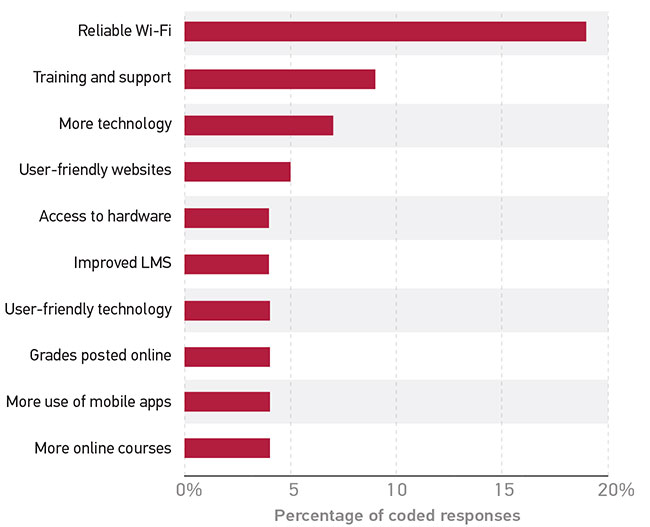
In figure 1 we present students' most frequently reported "one thing" that their institution could do with technology to enhance their academic success.1 Fourteen percent of students didn't answer, reported that they did not know, or indicated that the question was not applicable to them.
Reliable Wi-Fi on Campus: Faster, Stronger Connections That Are Consistent across Campus
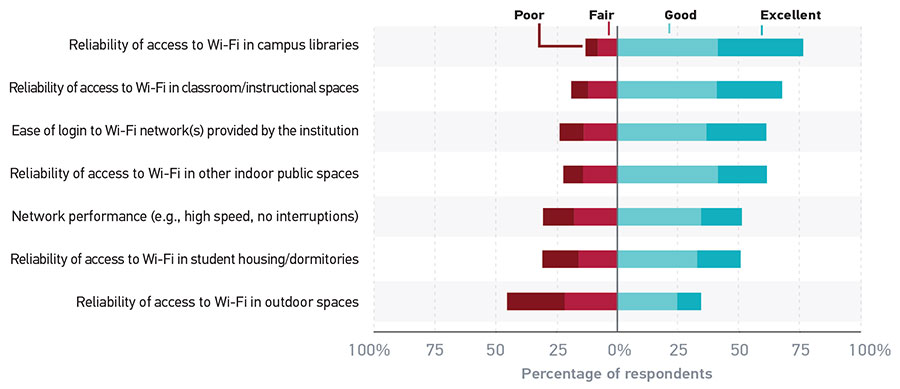
Students' overall experience with technology on their campuses is, in part, a function of their interactions with the wireless infrastructure and campus networks. The good news is that in 2017 a majority of students told us they had good or excellent experiences with their institution's Wi-Fi in campus libraries (76%), classrooms (68%), general indoor public spaces (61%), and dormitories and student housing (51%).2 However, almost half of students reported subpar experiences in outdoor spaces, and nearly one in three students reported fair to poor experiences with dormitory Wi-Fi (32%) and network performance (30%) (see figure 2).
Similarly, students' open-ended responses primarily reflect challenges in institutional Wi-Fi in outdoor spaces and dormitories. These responses suggest that for some institutions, campus technology infrastructure is not providing "ubiquitous and frictionless access" in a BYOE (bring your own everything) campus environment.3 Student responses reflect general concerns about their institution's Wi-Fi as well as concerns specific to access, strength, speed, and connectivity with mobile devices.
Although many students offered general complaints about their institution's Wi-Fi, such as weak signals, they also pointed to specific examples of how Wi-Fi access affects their academic success. Inconsistent Wi-Fi access was reported as impeding the ability to complete coursework:
I highly recommend that the Wi-Fi be upgraded. There have been many instances when I am completing an exam/quiz and it disconnects. There are also times when my laptop/phone doesn't connect at all.
Another student reported that the institution should "improve its atrocious Wi-Fi, whose frequent unreliability impedes online class participation or assignments."
A student reported how difficulties with Wi-Fi were also interconnected with general IT support challenges within the institution:
I'm in a computer lab for three of my classes, and half the computers never work or connect to internet. IT seems apathetic to fixing any of the problems. Improvements to Wi-Fi, computer labs, and Blackboard need to be made because often they are useless.
Students also reported that logging in to their institution's Wi-Fi service and changing Wi-Fi passwords is not user friendly.
Among the specific comments about wanting more reliable Wi-Fi, a little more than half cited specific issues with the respondent's institutional Wi-Fi. These subthemes may offer an explanation for why one institution's network was characterized as "awful," even as a majority of students at other institutions reported good or excellent experiences with their institution's Wi-Fi. The most frequently reported concerns with Wi-Fi centered on its availability across all areas of campus, followed by a desire for stronger and faster connections and ease of login across multiple devices.4
- Wi-Fi should be reliably and consistently available across all areas of campus, including dormitories, campus buildings, and outside.
- Wi-Fi should be stronger and faster.
- Wi-Fi should be easier to sign in to across multiple devices and without multiple logins necessary during the day or month.
- Wi-Fi bandwidth should be able to adequately accommodate periods of high use.
- Wi-Fi costs should be lower, or students should have discounted Wi-Fi off campus.
- Wi-Fi security measures should be improved.
- Wi-Fi usage should have fewer restrictions.
A student shared the challenges of Wi-Fi not being available outside: "Make Wi-Fi more accessible in all areas. Sometimes I lose Wi-Fi walking from one building to the next, and therefore lose the web pages I was on." A few other students commented that specific buildings had poor connections or no signals in parts of the buildings (e.g., basements). Many student responses regarding Wi-Fi reliability suggested improving already existing services along with network speed and strength. A student commented that intermittent access to campus Wi-Fi increased reliance on wireless providers: "My phone constantly has to switch on and off of Wi-Fi due to lack of connection, which uses a lot of my data." Some students reported that login procedures were not user friendly: "When it's time to change the Wi-Fi password (connected to my institution's network), the student shouldn't be shut out of the Wi-Fi until the password is changed."
In 1981, students wanted their MTV. In 2018, students want reliable Wi-Fi. Everywhere. There has been a shift in student perception: the wireless network is seen as the "real network" rather than as a "network of convenience." This shift is likely attributable to "consumerization of enterprise IT."5 Consumerization has increased student expectations that the activities supported by private network connectivity or public spaces (e.g., restaurants, shopping malls) across multiple devices should be similarly supported on their campus. In 2017, 64% of students told us that they live off campus.6 It is likely that when these students come to campus they expect the same level of connectivity that is available in public spaces and in their homes.
Students not only attend classes and conduct their work of being students on campus, but many also work and live on campus. The 36% of students who live on campus expect to have reliable networks available in their dormitories. Students may have decreased distinctions between school, work, leisure, and home domains, which results in expectations of a seamless flow of network connectivity from the campus library to the classroom, outside on campus grounds, and inside coffee shops, nonacademic campus buildings, and dormitories. After studying all night in the library, binge-watching a television series may be as viable an option for stress relief as any other. Students may also rely on their dormitory's network reliability to complete assignments and activities online, including research (which may involve streaming content) or simply registering for courses. Rather than viewing such options as a "frivolous" use of bandwidth, students perceive ubiquitous networks as essential to their lives. Institutional administrators may not relish the fact that students perceive themselves as consumers (of education), but often this is the case, particularly when they are paying technology fees. Engaging in this customer–provider relationship increases expectations among students for reliable and prevalent connectivity.
A few students reported that private routers in dorms decrease the efficiency of Wi-Fi networks in dormitories: "Improve the Wi-Fi. Find people who bring private routers and fine them a large amount because it messes with the Wi-Fi and makes it even worse than it already is." Widespread use of personal routers downgrades the available Wi-Fi. Additional tasks, such as online gaming and accessing wireless printers, also pose challenges for Wi-Fi networks in dormitories. When students report poor Wi-Fi in dorms, it may be the result of a perfect storm of personal routers, wireless printing, online gaming, and networks without the capacity to support all of these network-intensive tasks, let alone online exam-taking.7
Student expectations are all the more important to acknowledge given the increased student ownership of smartphones (97% in 2017) and the percentage of students (78% in 2017) reporting that their phones were at least moderately important to their academic success. These findings reflect that students expect "ubiquitous and frictionless" network experiences across all domains of their lives and across all devices. This also suggests that students are likely using their smartphones across campus—academic and nonacademic buildings, dormitories, libraries, gyms, outdoors, parking lots—and expect to be able to quickly review their LMS, email their instructor, download a syllabus, or register for a course.
Students' assessment of their institution's network performance (e.g., high speed, no interruptions) is significantly and strongly associated with their ratings of Wi-Fi access across campus. Students who assessed network performance as poor or fair also assessed Wi-Fi in the dorms and outside as poor or fair.8 This offers some insight into more general student complaints about network performance. Poor network performance in dormitories or outdoors around campus may be the source of this general dissatisfaction. Student expectations of network performance extend to all areas of their lives on campus, not just to where studying and learning traditionally take place—the library or classroom. This reflects a continuing consumerization of enterprise IT, decreasing distinctions between work and leisure time, and increased student expectation that campus networks will be as reliable as those in their homes, coffee shops, or airports. With the near-universal use of mobile devices on campuses, student expectations will likely only increase in scope. Ensuring this frictionless experience of connectivity across student life domains reflects the view that student success is a result of the entire student experience, not just degree completion rates.9 This student-centered, holistic approach to student success applies technology to the student's experiences inside as well as outside the classroom. That means that expectations of IT are expanding to include technology's contribution to all aspects of students' experiences, in addition to academic success. Students' experiences are not solely understood in terms of the classroom. Rather, the entire amalgam of student characteristics—commuter, dorm resident, registrant, learner, Wi-Fi user—is considered when strategically leveraging IT for student success.
Receiving Institutional Training and Support
A majority of students told us that they agreed or strongly agreed that they were well prepared to use productivity software programs (e.g., MS Office, Google apps, etc.) when they started college. However, many students reported in open-ended responses that they would like to receive institutional training in productivity software programs (such as MS Office) and institution-specific technology.10 Students also requested online support for their technology needs. Student responses appeared to reflect an availability of technology at their institution, but they faced challenges in learning how to effectively use the technology that was provided to them.
Very few students reported needing security training or training in basic skills, such as typing. Students did report, however, that they would like to have training in how to use MS Office programs, such as Excel: "Hold a short and very basic Microsoft Office workshop each semester." A student reported that because he did not know how to utilize MS Office software, completing an assignment was challenging:
Make sure to explain how a certain part of a project works, such as Microsoft Excel. I had a project this semester that revolved around making graphs with Excel, and I didn't know how to use it. It took forever to learn despite the fact that doing the project actually was not that difficult.
Several students suggested that their institution could enhance their academic success by providing online tutoring for their classes or marketing existing services in an effective manner. Some students reported they needed training on analytic software and computer use. For example, a student reported:
I wish it was easier to learn new technology and easy to find out how/where to learn. I've discovered a lot of classes have projects with software like Excel or SAS or LaTeX, but you don't know that til [sic] you actually take the course. It's not info that is available when looking through a catalog, and there is very little titled "A Class on SAS" to make it obvious.
A student who reported being quite familiar with productivity software offered an explanation for why training could assist incoming students:
Offer a course in how to use programs such as Excel and Word. I know how to use everything, but when every class we have [has] to go over how to use Excel and PowerPoint it gets repetitive and I don't see how that is helping me personally. I took a Microsoft course in high school; I do not need to spend hours now essentially taking that course again because people don't know how to make a graph in Excel. A course should be offered or mandatory for those who are not familiar with Microsoft applications.
Slightly fewer than half of students (44%) told us that they agreed or strongly agreed that their institution sufficiently prepared them to use institution-specific technology when they started college. Open-ended responses reflect students' desire to have training and support for navigating their institution's websites and technology infrastructure. These responses suggest an additional challenge beyond solely becoming fluent in productivity software: they point to a challenge in effectively getting critical tasks completed through university websites. A student reported, "The process of learning how to work the online programs is not well taught. Things such as signing up for classes and finding what fees are owed are very hard with the current setup." Students also identified a need for training on how to navigate their course's LMS: "Make learning how to use Blackboard/SIS part of orientation. It took a couple weeks [to learn]."
A student shared the stresses of not being able to effectively navigate registration for courses:
Help freshmen understand how to sign up for classes and how to use Blackboard and SIS. I am a sophomore and it's been almost 2 years since I went through that experience, and I still remember how horrible and stressful it was to not understand what my major was, what classes were available, and how to sign up [for classes]. They made us do it all alone without having ever met our advisor, and they should have allowed us to do it during orientation week.
More Technology Use at Their Institutions
A majority of student respondents also voiced their desire to have increased access to and institutional use of technology in their classrooms and libraries to enhance their learning.11 Only a few students offered specifics on how they wanted to have technology incorporated into their classroom experiences. A student provided an example of how rigid "no technology" classroom policies for students are and how instructors' limited use of innovative technology tools (e.g., use of videos) affected their academic performance:
I think the institution should prohibit professors from having "no technology" policies. I personally can take notes much faster by typing than I can writing by hand. My success depends on that. I also think having more "real life" assignments, such as having students watch TED talks, listen to speakers and podcasts, etc., and then having them recall that is critical to ensuring success not only academically but [also] for students' lives outside of the classroom. I think technology could enhance learning in many ways.
This quote reflects the student's desire to use a laptop in class. However, such use is not widely embraced among faculty. From 2015 to 2017, there was an increase in instructors encouraging or requiring students to use laptops in class, although 20% of students still reported that laptop use was banned or discouraged. One student suggested, "Actively create classes with more technology used as a learning tool." Another student observed:
Instructors should be less technophobic. Embrace the fact that students can use them [laptops] for productive purposes. Just be sure to walk around every once in a while to weed out the ones that are irresponsible with it. Stop telling us we can't take notes on our laptops ... for some of us this is the most efficient way [to take notes].
Although there has been an increase in student reports of classroom policies prohibiting laptops, only a quarter of students reported using laptops to engage in nonclass activities during class. In 2017, students reported that laptops were the device used most for coursework and were also rated as most important among all devices to their academic success. Half of students reported that they use laptops to make other connections with the learning materials, and nearly half reported that they use their laptop to take notes.
Given the near universal use of laptops and students' assessment of their importance, the manner in which laptops are used to take notes may actually hinder a deeper understanding of lecture content.12 For example, if laptops are being used to take verbatim notes (i.e., transcribing instructor lectures) rather than to actively understand content (i.e., noting points for later consideration), this may not contribute as much to student learning. This suggests that although students want to use more technology in the classroom and report that it is crucial to their success, they may also need help effectively using this technology, or they may need to improve their note-taking and study skills. Rather than an either-or approach to mobile device use, strategies that incorporate the use of technology in the classroom should be well thought out and based on empirically informed pedagogy that enhances student engagement and learning.
Students also wanted their institution to better equip their libraries with technology. One student suggested that the institution should use the most current technology: "I would like my institution to invest in the most advanced equipment and resources in order to keep its students in touch with how the world is advancing." A student specifically discussed, for example, how introducing students to recent technology, such as Skype, would be beneficial: "Let us interact with it [technology] more to educate ourselves. Introduce us to new technology and let us test it, as we aren't likely to try it on our own. For example, set up Skype with students abroad in a language or international relations class." Students also suggested more use of learning games, in-class polling, clicker questions, Kahoot!, Makerspace, 3D applications, video-editing classes, and opportunities to engage with robotics.
Notes
-
A total of 970 coded segments of data were derived from 1,100 open-ended student responses. Responses often had co-occurrence of codes and were not limited to single codes. Responses lacking substance (e.g., "not applicable") were removed from the sample. Denominator to calculate percentages is based on total number of substantive coded segments (970) for this open-ended question rather than total responses. Figure 1 presents the top 10 codes within these responses, which represents 51% of all student coded responses (or segments of coded data). For complete frequencies for this coded response, see Appendix A.
↩︎ -
Brooks and Pomerantz, ECAR Study of Undergraduate Students and Information Technology, 2017.
↩︎ -
Eden Dahlstrom and Steve diFilipo, The Consumerization of Technology and the Bring-Your-Own-Everything (BYOE) Era of Higher Education, research report (Boulder, CO: ECAR, March 2013).
↩︎ -
A total of 104 student open-ended responses focused on what the institution could do to improve Wi-Fi. Of these, 62% (n = 64) reported concerns regarding availability of Wi-Fi in dormitories, outside, and in other campus buildings.
↩︎ -
Joseph Moreau, "Managing Campus Wi-Fi Networks: In Favor of Connectivity," EDUCAUSE Review, April 30, 2018.
↩︎ -
Seventy-one percent of students reported living off campus in 2016.
↩︎ -
For an institutional strategy to implement Wi-Fi networks across student housing, the associated successes, and lessons learned, see Steven Belcher, Vicki Smith, and Steven Watkins, "Netflix, Nintendo, and No Down Time: Welcome to Wireless Residence Halls," presentation at the 2017 EDUCAUSE Annual Conference, October 31–November 3, Philadelphia, Pennsylvania.
↩︎ -
This subset of 189 students who reported they needed improved Wi-Fi to enhance their academic success represents a sampling bias, i.e., they feel dissatisfied enough with their institution's Wi-Fi to provide open-ended responses. Twenty-eight percent (28%) of students who rated their institution's Wi-Fi reliability as poor or fair did not provide open-ended responses.
↩︎ -
Susan Grajek and the 2017–2018 EDUCAUSE IT Issues Panel, "Top 10 IT Issues, 2018: The Remaking of Higher Education," EDUCAUSE Review, January 29, 2018.
↩︎ -
There was no significant association between students who requested training and support in open-ended responses and their reporting of how prepared they were by their institution to use institution-specific or general productivity software (e.g., MS Office, Google apps, etc.).
↩︎ -
The majority of these responses did not have depth. Many students simply stated "use more technology" for classroom learning.
↩︎ -
Pam A. Mueller and Daniel M. Oppenheimer, "The Pen Is Mightier Than the Keyboard: Advantages of Longhand over Laptop Note Taking," Psychological Science 25, no. 6 (2014): 1,159–1,168.
↩︎