Technology Use and Environmental Preferences
Key Findings
- The average number of devices connecting to campus Wi-Fi in a given day is two per student, with an overwhelming majority of students reporting connecting two or more devices daily.
- Three-quarters of students who connect to campus Wi-Fi do so with both a smartphone and a laptop, the digital devices of choice for higher education students.
- Students continue to want face-to-face classes more than any other learning environment, with a majority preferring either completely or mostly face-to-face.
- The two most important environmental features of study spaces are that they are quiet and have room to spread out books, papers, and devices.
- No technology is more important to students when studying than Wi-Fi, with access to power outlets a distant second.
- Faculty continue to use technology during class to enhance learning, but less than half of students report being encouraged to use their own technology during class to deepen their learning.
Actions You Can Take
- Establish research-based instructional practices in all teaching modalities, and adjust online course design and teaching practices to fit the modality. Reach out to your campus teaching and learning center for suggestions about improving the design of your courses, and consider adopting general course design standards for online, hybrid, and blended courses..
- Develop an acceptable use policy (AUP) for classroom uses of student devices that is informed by evidence-based practice and students' preferences for device use. Allow students to participate in the design of the AUP to create a digital learning environment in which they feel empowered to use their devices and to regulate their own behavior.
- Assess student access to Wi-Fi and digital devices and work to ensure that every student has access to these critical technologies. Take stock of the availability of laptops and tablets available for students to check out or loan, adjust supplies accordingly, and explore ways to make technology access more affordable.
Peers You Can Connect With

Adult Learning Institute
University of Cincinnati
The University of Cincinnati's Adult Learning Institute is a seven-week online course designed to educate faculty on the theories and principles of andragogy (adult education) and to equip faculty with course design and instructional tools for meeting the unique needs of adult learners. Early faculty feedback shows increased faculty confidence in course design and in using strategies such as alignment maps and active learning.
Learning Sequences
College of Saint Benedict & Saint John's University
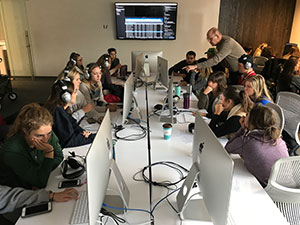
The College of Saint Benedict & Saint John's University's Learning Sequences program is a collaboration between instructors, instructional technology staff, and librarians to engage students in technology-based assignments in support of the students' learning outcomes in the classroom. Whether creating podcasts, creating videos, or building 3D designs, students and faculty alike have enthusiastically embraced these opportunities to combine information literacy, technology, and learning goals.

SDSU Flex
San Diego State University
As a part of its SDSU Flex program, which is designed to equip faculty to teach in virtual environments, SDSU launched a series of three-week Flexible Course Design Summer Institute courses for nearly 900 faculty over the summer of 2020. These summer institutes offered faculty training on social presence and community in online modalities; aligning course learning outcomes, activities, and assessments; designing inclusive and equitable virtual classrooms; and universal design for learning (UDL).
Got Devices. Got Wi-Fi?
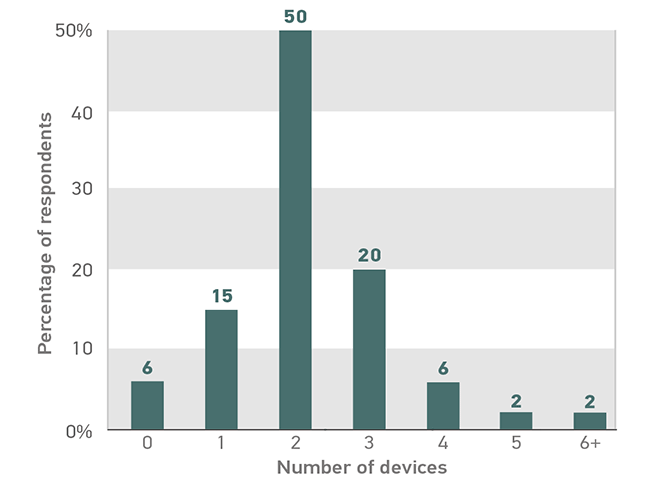
The average number of devices connecting to campus Wi-Fi in a given day is two per student. The typical student reported connecting two devices—typically a smartphone and a laptop—to their campus Wi-Fi daily; four out of five students reported connecting two or more devices daily. Community college (CC) students are more than three times as likely to connect zero or one device to the campus Wi-Fi than non-CC students. Although most higher education institutions provide robust Wi-Fi (76–100% coverage) in many critical locations (e.g., classrooms, computer labs, libraries, residence halls), the emergency move to remote learning in response to the pandemic in spring 2020 exposed areas lacking full coverage (e.g., outdoor spaces, student unions). Institutions responded to the difficulties students were experiencing accessing Wi-Fi by loaning hotspots to students and extending Wi-Fi to outdoor spaces, especially parking lots, so that students could access the Wi-Fi from the safety of their vehicles.1 Whatever mode of instruction and residency institutions adopt for the 2020–21 academic year, extending the range and increasing the number of Wi-Fi access points for students is of paramount importance, regardless of the number of devices students may try to connect to it.
I Want My F2F
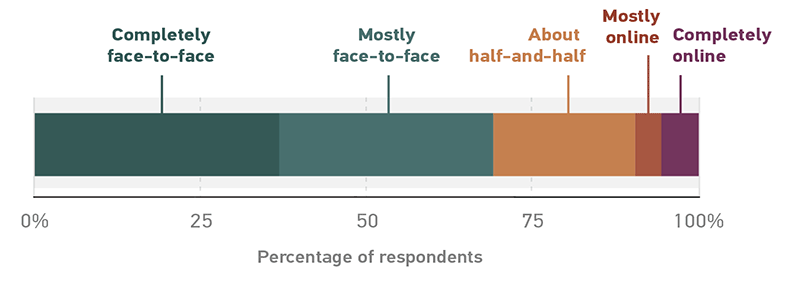
Students continue to want face-to-face classes more than any other learning environment. An overwhelming majority of undergraduate students said they prefer either completely (37%) or mostly (32%) face-to-face learning environments, a pattern we have observed in previous years.2 And although 58% prefer blended learning experiences—as opposed to completely face-to-face or completely online—most of them lean in the direction of more face-to-face components than online ones. As in previous years' research, we observe that women, married students, independent students (with and without dependents), and/or working students are significantly more likely to prefer learning environments that are mostly or completely online than their counterparts.3 These preferences are detached from evidence that online and face-to-face learning outcomes are equivalent and that blended outcomes are superior to fully online or face-to-face.4 The fact that these preferences don't account for research on learning environments is particularly worrisome given that any negative experiences students have had with remote learning during the pandemic may strengthen their preference for face-to-face environments.
Anatomy of a Study Space
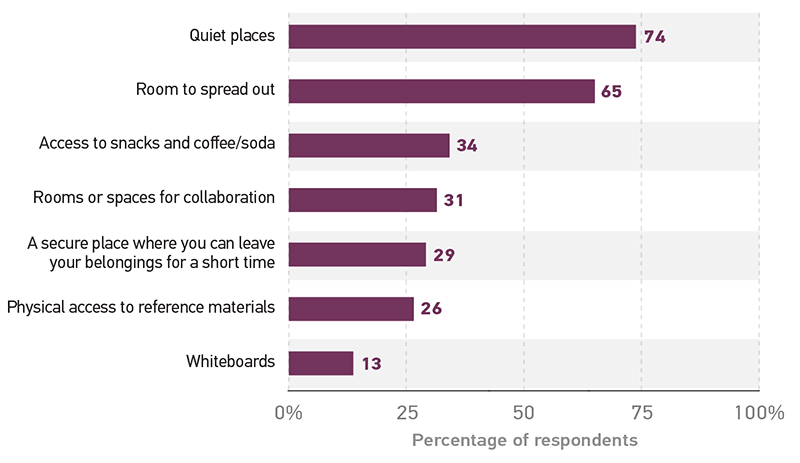
The two most important environmental features of study spaces are that they are quiet and have room for spreading out books, papers, and devices. Nearly half (46%) of students said that both of these things are prerequisites for selecting a place to camp out for a study session, and only 7% of students did not select either of these as one their top-three features. A second tier of environmental features appears to be related to individual preferences or circumstances that supplement the need for quiet and room to spread out. The need for study spaces of one's own can be a challenge that institutions struggle to accommodate under regular circumstances. In the face of an academic year under the conditions of a global pandemic, these challenges will likely prove even more difficult, with limitations on the room and building capacities, restrictions of the flow of foot-traffic, requirements to maintain social distancing, and the provision of sanitized workspaces.
Wi-Fi: A Basic Student Need
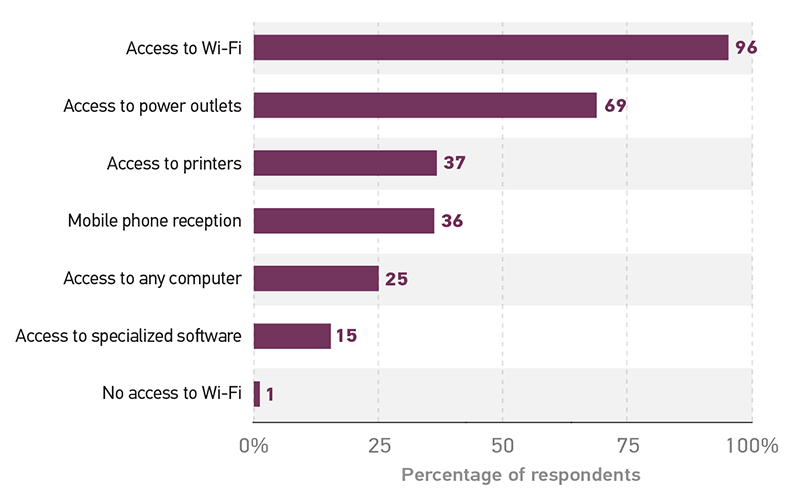
No technology is more important to students when studying than Wi-Fi. Although digital devices are completely useless without power, access to power outlets comes in a distant second-place technology need for students. Actual devices—printers, phones, computers—are significantly less important for students when getting down to the business of studying. The clear pre-pandemic importance of Wi-Fi for students to access the internet has become universal with the emergency move to remote instruction in spring 2020; that importance is unlikely to subside in the 2020–21 academic year as students continue to navigate courses of study that include at least some online learning components.
Mixed Messages
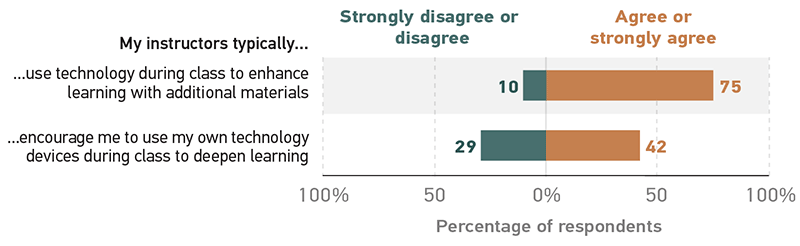
Faculty increasingly use technology themselves during class to enhance learning but balk at student use of devices to deepen learning. A strong majority of students said that their instructors employ technology to enhance student learning experiences with additional materials, an eight percentage-point increase from just a year ago.5 But less than half of students reported that their instructors encourage them to use their own technology during class to deepen their learning. More AA students (46%) reported that their instructors encourage them to use their own technology for learning than students at other institutions. Overall, these findings support previous findings suggesting that instructors are failing to leverage students' mobile devices for learning as much as they could or as much as students would like.6 The emergency pivot to remote learning may have highlighted the importance of students' own digital devices to learning and may have helped instructors think about creative and effective ways to leverage student devices in their teaching.
Notes
-
Susan Grajek, "EDUCAUSE COVID-19 QuickPoll Results: Help for Students," EDUCAUSE Review, April 3, 2020.
↩︎ -
Joseph D. Galanek, Dana C. Gierdowski, and D. Christopher Brooks, ECAR Study of Undergraduate Students and Information Technology, 2018, research report (Louisville, CO: ECAR, October 2018); and Dana C. Gierdowski, ECAR Study of Undergraduate Students and Information Technology, 2019, research report (Louisville, CO: ECAR, October 2019).
↩︎ -
Dana C. Gierdowski and D. Christopher Brooks, "Whatever It Takes," EDUCAUSE Review, Data Bytes blog, October 15, 2019.
↩︎ -
Barbara Means, Yukie Toyama, Robert Murphy, Marianne Bakia, and Karla Jones, Evaluation of Evidence-Based Practices in Online Learning: A Meta-Analysis and Review of Online-Learning Studies (Washington, DC: US Department of Education, 2009); and Barbara Means, Yukie Toyama, Robert Murphy, and Marianne Bakia, "The Effectiveness of Online and Blended Learning: A Meta-Analysis of the Empirical Literature," Teachers College Record 115, no. 3 (March 1, 2013): 1–47.
↩︎ -
Gierdowski, ECAR Study of Undergraduate Students and Information Technology, 2019.
↩︎ -
Joseph D. Galanek and Dana C. Gierdowski, ECAR Study of Faculty and Information Technology, 2019, research report (Louisville, CO: ECAR, December 2019); Gierdowski, ECAR Study of Undergraduate Students and Information Technology, 2019; and Dana C. Gierdowski and Joseph D. Galanek, ECAR Study of the Technology Needs of Students with Disabilities, 2020, research report (Louisville, CO: ECAR, June 2020).
↩︎