CHLOE Conversations: AI

A Collaboration with Quality Matters and Encoura Eduventures Research
What Are the Report Highlights?
- Online learning leaders are helping coordinate campus AI efforts, often serving as collaborators and drivers of innovation.
- Online learning teams are supporting faculty as they move beyond simple AI implementation and into responsible and effective use.
- The expanding use of AI is raising questions about assessment practices and prompting institutions to reconsider what human instructors should uniquely contribute to online learning.
- Instructional designers are becoming key partners to faculty across stages of AI adoption and implementation.
- AI strategy remains mostly decentralized, but online learning leaders see this "productive struggle" as an opportunity to experiment and build strategy based on practice.
- Although institutions are tracking AI adoption as well as faculty and student perceptions of AI, efforts to measure these tools' impact remain limited due to a lack of baseline data.
This is one of a series of four CHLOE Conversations reports, which are based on a set of focus groups conducted by Quality Matters, Encoura Eduventures Research, and EDUCAUSE. Participants included chief online learning officers as well as mid-level leaders of online learning, representing institutions of different sizes, sectors, and structures. For more information about this project and links to the other reports in the series, please visit the 2026 CHLOE Conversations Report Series Hub.
Overview
Released in 2025, the CHLOE 10 Report introduced new questions about generative AI, reflecting its growing strategic importance for online learning. These questions explored institutional AI strategy, investments in AI-related initiatives and tools, and the goals and functions those investments were intended to support. Building on those findings, this CHLOE Conversations report examines how online learning leaders and their teams are helping institutions respond to AI's rapid emergence. Specifically, the report examines the roles online learning leaders play in campus AI initiatives, how AI is impacting their work, and how they are developing AI strategy and measuring the impact of the tools. At its core, this report poses a key question: How can online learning leaders help shape and support AI adoption so it strengthens online learning rather than undermining the human expertise and student-centered practices that make online learning effective?
The Bottom Line
Online learning leaders and their teams are playing a central role in AI adoption and implementation, serving as drivers of innovation, cross-campus connectors, and faculty support partners while also helping institutions grapple with difficult questions surrounding AI's role in teaching and learning. Yet institutional AI adoption is advancing faster than many institutions' ability to evaluate its impact. To make informed decisions about future investments and AI strategy, institutions need stronger benchmarks and clearer evidence of how AI affects learning outcomes, operational efficiency, and ROI. Overall, focus group participants expressed optimism about AI's potential to streamline workflows and catalyze innovation.
KEY FINDING: Online learning programs are serving as institutional hubs for AI collaboration, innovation, and faculty support.
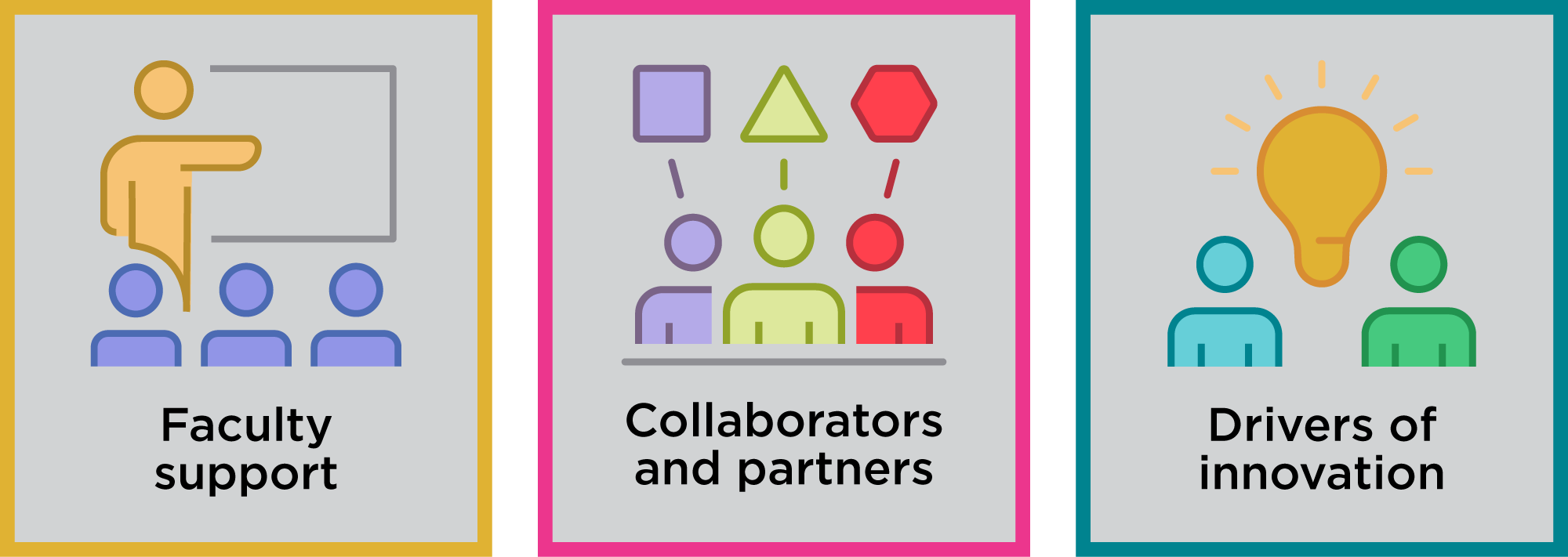
Online learning leaders have a meaningful seat at the table. When asked about their role in shaping institutional policy and guidance around AI, many focus group participants pointed to their role as collaborators and partners with other departments and colleges (see figure 1). Focus group participants described contributing to AI-related work through partnerships spanning course design and delivery, faculty development, technology adoption, and institutional policy. These collaborative efforts range from very informal activities (e.g., resource sharing and checking in) to more formal committee work:
- "Everything we do is in partnership with academic colleges."
- "We collaborate closely with our Center for Teaching Innovation, which thinks a little bit more about pedagogy for on-campus or residential programs. We try to share what we're doing."
- "I'm on a central committee with the chief technology officer, also including our Center for Teaching and Learning and so forth, to make the Artificial Intelligence Resource Center, trying to make a centralized repository to keep track of who's doing what, resources we have at the university…that kind of thing. That's fairly new."
- "A couple of years ago, the president asked me to pull together a team to look at AI around teaching and learning. That group has continued to do work even though we have a larger AI initiative happening institutionally at the moment. But this group has really focused on a couple of things that are directly related to online learning."
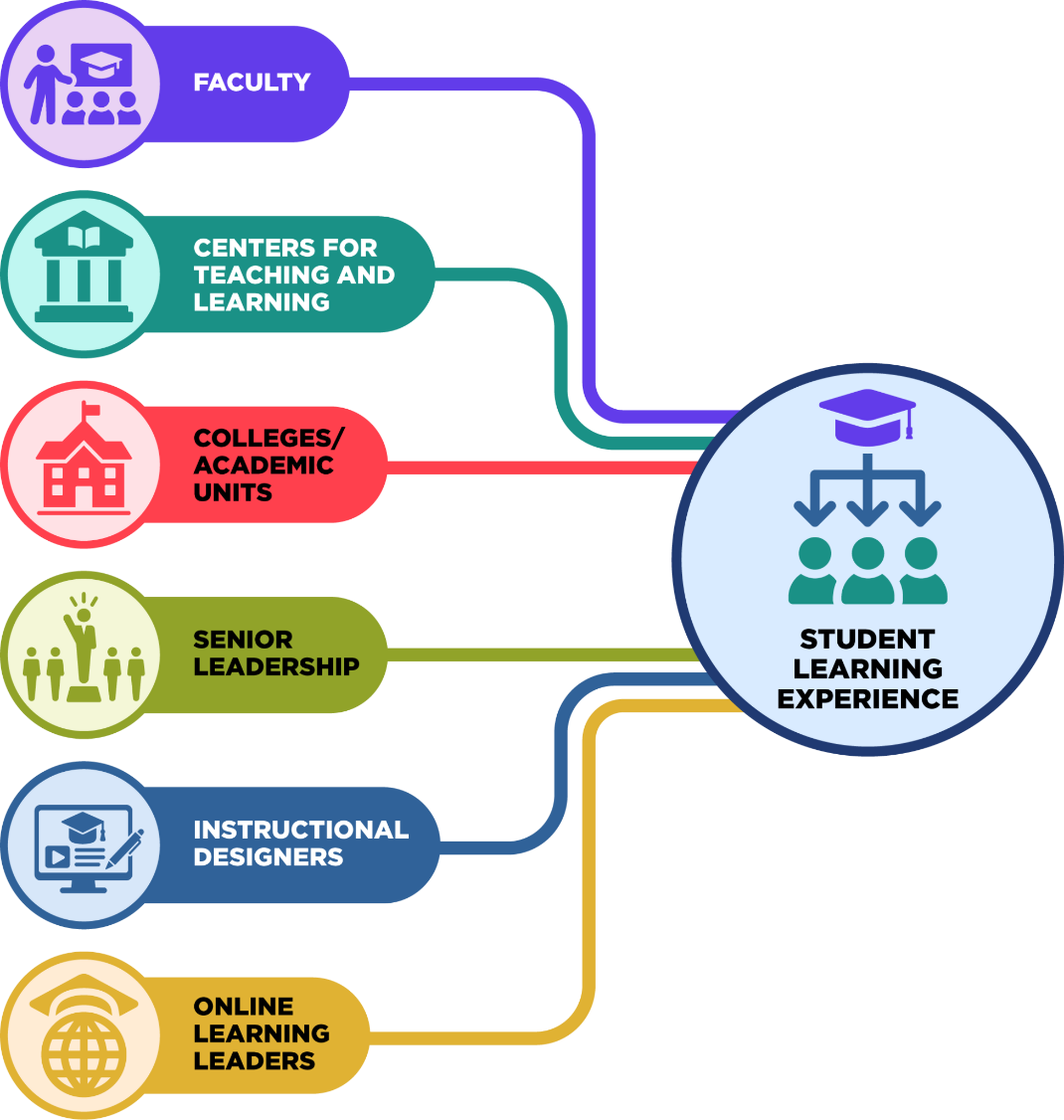
The most commonly referenced collaborators for online learning leaders working on AI initiatives included faculty, leaders of Centers for Teaching and Learning, colleges and academic units, senior leadership, and instructional designers (see figure 2). These partnerships indicate a growing recognition that AI strategy and implementation cannot be the sole responsibility of any one unit. Instead, participants described this as cross-functional work oriented around the shared goal of enhancing student learning experiences.
Online learning leaders are helping drive AI innovation. Beyond their role in forging institutional partnerships around AI, focus group participants also emphasized their role as drivers of innovation. As one participant explained, this work is often facilitated by pointing to trends in the job market: "We're often the drivers of innovation, highlighting the changing job market around AI and tying that to curricular reform." Participants also connected online learning's role in AI innovation to their ability to move quickly, collaborate across units, and serve as information brokers for senior leadership:
- "We are a driver of innovation and we've been able to move […] maybe faster than other institutional departments."
- "We've been able to take two initiatives [AI and digital accessibility] and really work in a collaborative format to push them across the institution. We're making waves."
- "We're basically doing a lot with the innovation side of things, keeping people informed, and keeping senior administration informed."
Participants also emphasized their roles as creative problem solvers using AI, for instance by developing an AI chatbot to provide 24/7 LMS support in the absence of additional funding. These examples suggest that, at some institutions, online learning units are not merely responding to AI adoption but actively shaping how their institutions operationalize it.
Online learning leaders play a crucial role in faculty support around AI. Online learning leaders are also serving as a key resource for faculty as they navigate uneven readiness around AI and consider responsible and effective uses. Participants described this support as including professional development on "what AI is, what are the ins and outs of it, what are the tools, how to apply it," as well as guidance on "the ethics behind it" and "how to have the sticky conversations with your students." They also pointed to training sessions, learning circles, and workshops designed to help faculty build AI literacies and consider AI's implications for pedagogy and assessment.
Faculty responses to AI remain mixed, with some seeing it as "an important new tool" while others "have been really struggling with trying to figure out how to incorporate the reality of generative AI into our curriculum." One participant noted that mixed faculty views on AI in assessment have led to the development of a flexible framework "that would help faculty either integrate AI into their curriculum if that's what they're wanting to do and/or develop assessments and rubrics that are more AI-resilient." Another participant noted that they were connecting AI-related curricular change to broader workforce needs by identifying which programs might be most urgent to update and working with faculty to redesign online courses accordingly. In this sense, online learning leaders are not simply introducing faculty to new tools but are helping them determine what AI means for teaching, learning, and student workforce preparedness.
KEY FINDING: AI is reshaping assessment, instructional designer roles, and instructor presence.
AI is prompting a reexamination of assessment. In the focus groups, assessment repeatedly emerged as one of the most critical pressure points related to online strategy and AI. Online learning leaders not only are drivers of innovation at their institutions but are at the forefront of a larger evolution of teaching and learning in higher education. Participants described AI implementation as being in a "messy middle space," which is an uncomfortable period for some educators. As one participant explained, "Teaching and learning and assessment are going to fundamentally change. It's going to look different, and faculty aren't really ready to accept that yet." In part, this hesitancy may reflect concern not only about AI use itself but about how AI-powered feedback and assessments could reshape the instructor's role. As one participant asked, if AI can provide some of the core feedback and assessment functions that a human instructor would normally provide, "What does it mean to actually have a human instructor?" On the other hand, another participant emphasized AI's role in taking on the least rewarding parts of the job: "Our faculty do not get into education because they really want to test students. That's not the fun part. I hold a lot of optimism that AI can help us do assessment much better than we have been doing and that it can help streamline some of the parts of our jobs that are least rewarding and most time-consuming." This range of views regarding AI and assessment may reflect broader uncertainties surrounding AI in higher education. For some, AI might facilitate a reexamination of long-standing assessment practices, but important questions remain about its impact on the instructor's role, student outcomes, and accuracy.
AI is expanding the roles of instructional designers in online learning. In describing AI's impact across online learning roles, focus group participants most often emphasized the implications for instructional designers. In particular, instructional designers are functioning as key partners and consultants who help faculty make pedagogically sound decisions about when and how they should use AI. Participants emphasized several ways in which instructional designers are contributing to AI-related initiatives:
- Piloting tools: "Our instructional designers also play a role in reviewing the different technologies that are using AI. We try to pilot tests, talk to some of the vendors, and get some feedback there."
- Tool selection: "My instructional designers help folks with selecting appropriate tools and applying them pedagogically in online courses."
- Faculty training: "Through the Center for Teaching and Learning, the instructional designers are responsible for teaching faculty how to capitalize and optimize AI to enhance their teaching."
- Assessment: "[Because of AI's impact on assessment], faculty start to realize the importance of instructional designers as partners in brainstorming and coming up with instructional strategies. They see instructional designers as important not just for the design aspect but also for the delivery and overall quality of the course design."
These examples suggest that instructional designers' expertise is being implemented across stages of AI adoption and implementation, extending their role beyond course design to include tool evaluation, faculty support, and pedagogical strategy. As the responsibilities of instructional designers expand, however, institutions may need to more clearly define instructional designers' roles and ensure that they have the bandwidth to take on this evolving work.
Instructor presence still matters—maybe more than ever. Focus group participants emphasized the importance of defining and preserving the uniquely human role of instructors as AI assumes a larger role in online course design, instruction, and delivery. This is especially salient in online courses, with participants noting that AI can support course development but should not replace instructor presence, faculty expertise, or meaningful engagement with students. As one participant explained, "It is very tempting to have a generative AI software create the entire course. All you need is a description and those course outcomes, and you can create a course, endless modules, etc. It's really the involvement of the faculty piece that we are continuing to hold onto." The same participant also described efforts to help faculty make courses more robust while ensuring that AI remains aligned with course design principles and subject-matter expertise. Other participants highlighted what might be at stake when instructor presence becomes less visible because of technology:
- "Students are contacting me to complain that they feel like their course is just AI. There's an opportunity to work with faculty on instructor presence and what teaching looks like in this new situation that we find ourselves in."
- "And the other thing, for me, continues to be instructor presence. I just had a comment yesterday from a department that they had received student feedback that they were being taught by 'Professor Pearson.' And, obviously, that's not the ideal situation. We want to make the instructor prime in that equation. That means quality to me. Quality still means student-to-student, instructor-to-student interaction."
Together, these comments suggest that as AI becomes more widely used in online course development, instructor presence—a long-standing marker of quality in online learning—might require renewed attention.
KEY FINDING: AI strategy is evolving more rapidly than institutions' ability to measure its impact.
AI is creating a productive struggle rather than a centralized strategy. Many participants expressed excitement about AI's potential to transform both online learning and higher education. As one participant explained, "Our thought is that AI is going to fundamentally shift online learning. It's probably as big a change as online learning itself, honestly, in ways that are probably hard to entirely predict right now. Certainly, the exciting part of it is that it allows us to do things pedagogically that really can improve learning outcomes." Participants also acknowledged that institutional strategy is still emerging. Rather than viewing the absence of a centralized strategy as a significant problem, participants instead framed this moment as a necessary period of experimentation. One participant argued that online learning leaders need to "be comfortable in the productive struggle" of AI strategy: "I think it's a little unrealistic to expect [an institution-wide strategy] at this stage. We are all really in the hard part of learning about AI right now, and it's changing, which makes that even more complicated." Other participants emphasized that AI strategy is largely decentralized and "more ground-up than top-down at this point" but they remained hopeful that "we're going to meet in the middle in the near future." Participants suggested that the path forward may depend on translating ground-up experimentation into institutional strategy without losing sight of student success as the central goal. As one participant explained, the guiding question should be "How do we best serve students and keep them at the center of this instead of letting the technology drive it?"
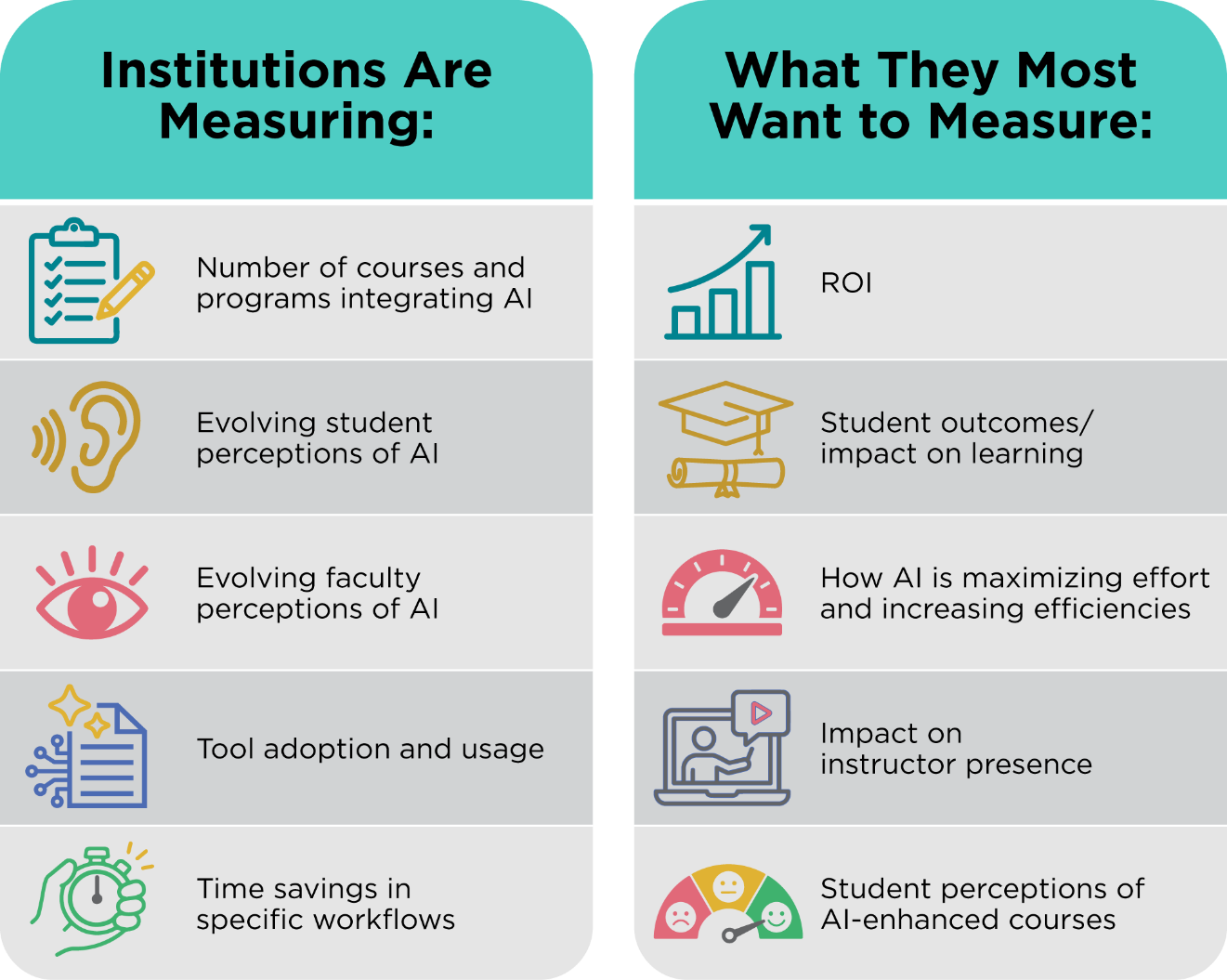
Institutions are investing in AI, but measuring impact lags. When asked about AI investments at their institutions, participants noted several areas where they are currently measuring impact, particularly around tracking courses and programs that are integrating AI, faculty and student perceptions of AI, and adoption and usage (see figure 3). Yet these measures primarily capture usage and sentiment rather than impact. Participants identified several areas they would like to assess more directly, including ROI, student learning outcomes, workflow efficiencies, and instructor presence. In part, these gaps stem from the rapid pace of AI implementation, which has made it difficult to establish baseline data. As one participant explained:
We had some data that we thought would be really interesting and helpful. The problem is, when you have a new technology like this, you can't always go back and collect benchmark data. We're thinking, "AI is improving our efficiencies." But then they say, "Well, did you track how much time these tasks took before to compare to how much time they're taking now?" We don't have the benchmark data to say exactly how much time we're saving.
Although institutions might not be able to recover pre-AI baseline data, establishing current-state benchmarks might help them move beyond documenting AI adoption to demonstrate its impact and value.
Conclusion
Overall, focus group discussions emphasized that online learning leaders are not peripheral to AI strategy and implementation on their campuses; rather, they are helping coordinate and, in many cases, drive it. Online learning leaders are already well situated with the needed relationships and experience with novel modalities to support responsible AI adoption at their institutions. As AI adoption raises questions about established teaching and learning practices, including assessment and instructor presence, and as faculty buy-in remains uneven, participants framed the lack of coordinated strategy as an opportunity for experimentation. Moving forward, however, institutions will need to ground this experimentation in stronger evidence by supplementing data about use and perceptions of tools with data about their impact. Establishing benchmarks will also help online learning leaders make critical decisions about AI adoption, implementation, and ROI. Even in uncertain and rapidly evolving contexts, online learning leaders are approaching AI not merely as a technical disruption but as an opportunity to strengthen collaboration, clarify the human dimensions of online learning, and keep student success at the center of institutional change.
Methodology and Acknowledgments
Methodology
The 2026 CHLOE Conversations project drew on data from six focus groups conducted in two rounds from April 20 to May 21, 2026. Participants were recruited through CHLOE marketing emails and webinar announcements. Those invited to participate were selected to represent specific sectors or provide expertise on critical topics. The first round consisted of three focus groups, each dedicated to one topic central to online learning strategy: online learning quality, market strategy, and AI. The CHLOE authors selected these topics based on recurring themes in prior CHLOE reports, current issues facing online learning leaders, and input from the CHLOE Advisory Panel. The second round explored questions from the first three focus groups but were organized by sector (community colleges, private four-year institutions, and public four-year institutions). In total, 30 participants took part in the focus groups.
The CHLOE authors manually coded the focus group data and reviewed key findings collaboratively to align on key themes. The authors also developed reports in conversation with one another to ensure alignment. Participant quotations in these reports were lightly edited for readability.
Acknowledgments
The CHLOE authors are deeply grateful to the focus group participants who generously shared their time, experiences, and insights. Their contributions provided a richer understanding of the opportunities and challenges facing online learning leaders today. We also thank the CHLOE Advisory Panel for its guidance in shaping the project.
We are equally grateful to our colleagues across EDUCAUSE whose expertise and support brought this report to fruition, including contributions to project strategy, data visualization, marketing, project management, and editing.
Thank You


CHLOE 2026–27 Sponsors
Platinum Sponsors


Gold Sponsors

Silver Sponsors



Kristen Gay. CHLOE Conversations: AI. Research report. Boulder, CO: Quality Matters, Encoura Eduventures Research, and EDUCAUSE, August 2026.
© 2026 Quality Matters, Encoura Eduventures Research, and EDUCAUSE. The content of this work is licensed under a Creative Commons BY-NC-ND 4.0 International License.