CHLOE Conversations: Institutional Sector Summary

A Collaboration with Quality Matters and Encoura Eduventures Research
What Are the Report Highlights?
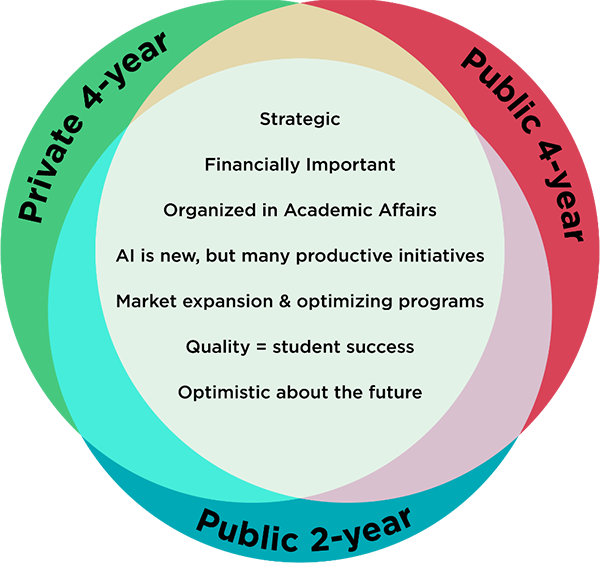
- Online learning is strategic, financially important, and organizationally led through Academic Affairs.
- Although AI efforts across higher education remain in the beginning stages, chief online learning officers (COLOs) have witnessed the implementation of many productive initiatives and applications.
- Higher education institutions want to expand into new markets while optimizing their current offerings, with community colleges focused on workforce development and four-year institutions pursuing growth in online graduate programs.
- COLOs equate institutional efforts on quality with a focus on student success, highlighting all the activities that influence it.
- COLOs are optimistic and excited about the future.
This is one of a series of four CHLOE Conversations reports, which are based on a set of focus groups conducted by Quality Matters, Encoura Eduventures Research, and EDUCAUSE. Participants included chief online learning officers as well as mid-level leaders of online learning, representing institutions of different sizes, sectors, and structures. For more information about this project and links to the other reports in the series, please visit the 2026 CHLOE Conversations Report Series Hub.
Overview
If you have spent time in higher education and are working on a new project or initiative, you know that the question that always gets asked is "What are our peers doing?" Sharing information with colleagues is common in higher education and, one might argue, is a strength of the academy. The ability to understand what is working well and why, as well as what the issues are and how to deal with them, can save an institution a lot of time (months or years) and resources (funding and staff time). We learn effective approaches from each other, and we tend to replicate them. This tendency for institutions to respond to new challenges or opportunities in a similar way or even develop similar organizations is a recognized phenomenon referred to as institutional isomorphism.1
It is with that spirit that we approached the sector focus groups for CHLOE Conversations 2026. We know that sharing information is valued more when the context is a similar college or university, so we facilitated three sector-based focus groups: community colleges, private four-year institutions, and public four-year institutions. Colleagues across those three sectors were kind and generous with their time, providing important insights into key topics and issues. We gratefully captured those views and shared them below, noting the perspectives that sectors had in common and, occasionally, where they differed.
The Bottom Line
On the basis of the feedback and comments from the COLOs across all three sectors, one thing is clear. Although some differences appear across sectors, those working in online learning share a set of foundational views, irrespective of the type of institution where they work (see figure 1). Similarities emerge related to how colleges and universities are organized, how they are approaching AI, how institutional leaders are balancing opportunities for enrollments from new markets against managing current program portfolios, how online learning leaders are focusing on quality through the lens of student success, and how enthusiastic focus group participants are about the field and how excited they are about the future.
KEY FINDING: Online learning leadership structures and program organizations are relatively consistent.
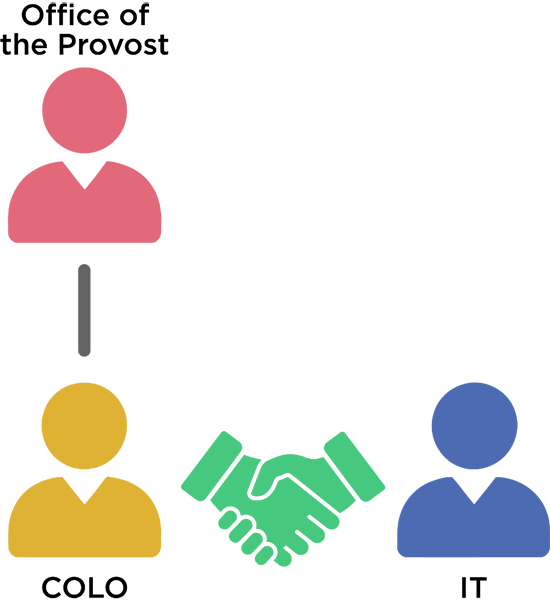
Titles vary, but online learning organizations are most often aligned with the provost. Across the three sectors, COLOs hold numerous titles, including director, dean, associate vice president, and associate vice chancellor. Whereas their activities were not identical, every participant reported directly or indirectly to the provost or chief academic officer (CAO), and this was consistent across all sectors. It is also consistent with prior CHLOE reports and the 2024 COLO Profile study. Participants also emphasized that institutional support from senior leadership was essential to advancing the quality and innovation of online learning.
Centralized or decentralized approach? Participants in the focus groups often described a mixed or blended approach to this question, regardless of sector. While not identical, operational functions were frequently mentioned as part of the COLO's domain, including instructional design, course development, and faculty support. This confirms what the authors of CHLOE have reported in the past—that institutions have been aligning certain resources with the COLO while leaving more academic functions with schools and departments. The importance of collaboration with IT was also noted (see figure 2). COLOs stated that their activities were in-house and not outsourced to an online program management (OPM) company. Lastly, organizational structures are not set in stone, as many participants mentioned recent adjustments related to new demands and expectations.
Online learning is important, strategically and financially. All COLOs in this project indicated that online learning is strategic to the institution, which might be evident through executive attention or visibility in institutional strategic plans. All participants said that online learning was financially important to their college or university, which has crystallized institutional support and has been a catalyst for collaboration across the institution. COLOs from all sectors shared efforts to expand markets and spoke proudly about new programs. Community college COLOs emphasized competitive pressures, while the COLOs at four-year institutions highlighted growth in online graduate programs. When asked about trends, COLOs situated their comments in terms of pre-pandemic and post-pandemic worlds. Some spoke about movements for a blended experience and an emphasis on quality, and others remarked about more respect within higher education generally since the pandemic for the rigor of online education.
For a long time it was an "us versus them"—traditional versus online. And now, post-pandemic, we've seen more of "How can online complement our traditional programs, and how can [we] work together in different ways?
KEY FINDING: AI activity is increasing.
COLOs are just getting started with AI, but there is significant activity. COLOs were asked about their AI priorities and whether they were leading to concrete action. Many of these leaders described their institution as being in the early stages while at the same time highlighting several productive activities that are creating direct, first-hand experiences for faculty and staff, indicating that many institutions are in the thick of it and learning a lot. Some of the early efforts involve developing campus policies and AI-related syllabus statements for faculty to consider and use. However, a few of the COLOs indicated that they currently do not have a plan for AI. Community college COLOs seemed to express the most cautious approach to AI, commenting about the value of enhancing learning experiences and retaining the primary role of faculty, rather than a chatbot, interacting with students.
Faculty efforts in AI are focused on early adopters. COLOs across all sectors reported that their faculty had differing levels of enthusiasm for AI. Some are early adopters, some are resistant, and many are somewhere in the middle. Not surprisingly, many of the participants portrayed their approach as enabling AI capabilities and leaving adoption up to the faculty. One COLO explained that they are evaluating efforts based on whether the faculty are making complaints. Many participants noted variations in the embrace of AI, depending on whether it was applied to the design and development of content versus teaching and interacting with students. One COLO specifically summarized their assessment of faculty adoption as a bell curve, leading to a variety of professional development and support opportunities. The same COLO expressed the conviction that teaching, learning, and assessment would fundamentally change as a result of the use of AI.
Various opportunities for AI are on the horizon. Interestingly, COLOs cited many applications for AI beyond those related to teaching and learning. One participant said, "We have an LMS, then we have a SIS, then we have a different CRM, making visibility into the entire student experience very difficult. Agentic AI is able to draw those systems together and give us a very clear picture of overall student performance and allow us to be able to flag risk a little bit earlier." Using AI as glue between existing disjointed application systems can help identify student performance issues. Another mentioned using AI to help synthesize documents and responses for the accreditation process. A very interesting project at one of the four-year public institutions involved using AI to conduct periodic mental health checks with students. Another COLO shared information about an AI project related to accessibility, where faculty are using it to remediate their content. These examples reflect creative and valuable ways to apply AI in higher education.
KEY FINDING: A market-growth strategy and program-planning optimization are not mutually exclusive.
Expansion and optimization. When asked about program and market strategies and the choice between growth and optimizing their program portfolio, COLOs said yes to both. Across all sectors, there was feedback on efforts to review current programs while also trying to boost enrollments. Even as COLOs and their institutions are developing new programs, they also noted how difficult it can be to sunset programs, regardless of modality—as one participant noted, "It's really challenging for us, being really decentralized, to do sunsetting.... We suggest and help bring up new degrees, but the sunsetting happens through our normal campus processes, and that is a major challenge for us."
Community colleges focus on workforce development. While there was thoughtful feedback across all sectors on being responsive to the market, the community college COLOs stood out for their strong emphasis on workforce development. Every participant in that sector discussed their efforts to align program planning with workforce needs. They felt it was a key factor in market expansion and highlighted a diversified approach that included degree programs, technical certificates, and microcredentials. They also recognized the need to ensure their students have a great online experience, as word of mouth can lead friends and family to take courses.
Four-year institutions are concentrating on growth at the graduate level. COLOs from both public and private four-year institutions enthusiastically shared stories about new markets and opportunities to grow their online enrollments. This is consistent with prior CHLOE studies. Comments from these two sectors stressed growth in online graduate programs while maintaining stable undergraduate programs. Four-year COLOs even acknowledged that online graduate programs were more profitable for their institution, with a higher ROI.
KEY FINDING: Program quality covers several dimensions.
Program quality is about student success. We asked what "program quality" means to their institution, and the responses from the community colleges and the four-year private COLOs centered on an expansive view of student success. Participants quickly noted, however, that many dimensions lead to student success, including academic integrity, online course quality, course design, faculty development, teaching quality, faculty presence and engagement, and student support resources. Because student success is influenced by many factors, the broader context is the program, not just a course. Participants did not discuss quality as a compliance exercise; instead, they framed quality as a holistic strategy for student success.
The discussion with the public four-year COLOs was more focused on course and program design. Those leaders commented on the importance of backward design, using rubrics for course design, promoting student–student and student–instructor interaction, encouraging teacher presence, reducing unnecessary cognitive load for students, and creating a seamless and robust learning experience at both the course and program levels.
If students have a great experience, they tell two friends, and they tell two friends, and so on. And if they're not having a great experience, they tell even more friends. And so our reputation is really based upon quality.
Faculty development and support impact quality. Many COLOs used the topic of program quality to discuss their efforts to collaborate with faculty. If one believes that course design, faculty engagement and presence, and student–faculty interaction are key factors that enhance quality, efforts to develop and support faculty are essential. Many of the COLOs also noted institutional investments in instructional designers and the training they receive. One of the COLOs stressed teacher presence and making the instructor primary in the equation as a sign of quality.
Quality is promoted by communicating about Quality Matters to current and prospective students. In the discussions about quality, we asked COLOs if they share information with students—prospective and current—about efforts to improve quality. Community college COLOs stated that Quality Matters is at the forefront of their communication and how faculty are prepared to develop and teach online. Institutions are adding notations in their catalogs about courses that meet Quality Matters standards to help students understand that it represents a different and objective level of quality.
We do mention Quality Matters quite a bit, and we educate our constituent groups about Quality Matters. Most of them don't even know what it is until they hear about it. And then the way we create that analogy is it's like a gold stamp. If your course has Quality Matters certification, then you have that gold stamp of approval.
Conclusion
We ended the sessions with a chance for COLOs to express what they felt was exciting about the future. This allowed COLOs to reflect on where they have been and where they hope to be. While it is understandable that many of the COLOs acknowledged the impact of the pandemic, they all had a "glass is half full" attitude about the field. The community college COLOs noted their faculty's receptivity to considering and applying best practices in online education, eventually applying what they learned about highly effective teaching methods to all modalities, including in-person classes. COLOs appreciated broader institutional support that followed the offering of online courses and programs during and after the pandemic. Looking ahead, these COLOs discussed that validation from senior leadership would help facilitate more consistency and enhanced learning, regardless of modality.
That initial institutional support has allowed us to be innovative about the different things that we've presented as ways to engage our faculty, and allow them to enhance their teaching no matter the modality.
Four-year private COLOs were optimistic about the potential of AI and other new technologies to have a positive influence on online learning and benefit students. Some of the COLOs even pointed to excitement about what would be coming after AI, because there is always something new. These COLOs noted a need to remain vigilant in preserving educational quality amid rapid changes, as well as larger concerns about perceptions of the value of higher education.
Our conversations have changed from pre-pandemic times, where we were trying to justify that online learning was a viable way to learn and that there was quality in it, to we're not having those conversations anymore, and that's super exciting that we can have other conversations and grow and do all kinds of other things. So that's just super exciting.
Four-year public COLOs were also upbeat about the potential of AI and other new technologies to enhance learning, not replace educators. Many comments focused on the need to remain grounded in foundational theories of teaching and learning and to keep students—not technology—at the center of change. Other remarks from these COLOs centered on how online education has become mainstream and a driving force in expanding access and reshaping higher education.
I think my biggest excitement is thinking about what our portfolios are going to look like in the future, related to the mix of for-credit, noncredit, and interdisciplinary [programs]. I think online education has the ability—because we straddle multiple worlds—to be the connective tissue that really starts to set the trajectory for higher education.
Methodology and Acknowledgments
Methodology
The 2026 CHLOE Conversations project drew on data from six focus groups conducted in two rounds from April 20 to May 21, 2026. Participants were recruited through CHLOE marketing emails and webinar announcements. Those invited to participate were selected to represent specific sectors or provide expertise on critical topics. The first round consisted of three focus groups, each dedicated to one topic central to online learning strategy: online learning quality, market strategy, and AI. The CHLOE authors selected these topics based on recurring themes in prior CHLOE reports, current issues facing online learning leaders, and input from the CHLOE Advisory Panel. The second round explored questions from the first three focus groups but were organized by sector (community colleges, private four-year institutions, and public four-year institutions). In total, 30 participants took part in the focus groups.
The CHLOE authors manually coded the focus group data and reviewed key findings collaboratively to align on key themes. The authors also developed reports in conversation with one another to ensure alignment. Participant quotations in these reports were lightly edited for readability.
Acknowledgments
The CHLOE authors are deeply grateful to the focus group participants who generously shared their time, experiences, and insights. Their contributions provided a richer understanding of the opportunities and challenges facing online learning leaders today. We also thank the CHLOE Advisory Panel for its guidance in shaping the project.
We are equally grateful to our colleagues across EDUCAUSE whose expertise and support brought this report to fruition, including contributions to project strategy, data visualization, marketing, project management, and editing.
Thank You


CHLOE 2026–27 Sponsors
Platinum Sponsors


Gold Sponsors

Silver Sponsors


Eric E. Fredericksen. CHLOE Conversations: Institutional Sector Summary. Research report. Boulder, CO: Quality Matters, Encoura Eduventures Research, and EDUCAUSE, August 2026.
© 2026 Quality Matters, Encoura Eduventures Research, and EDUCAUSE. The content of this work is licensed under a Creative Commons BY-NC-ND 4.0 International License.
Note
-
Paul J. DiMaggio and Walter W. Powell, "The Iron Cage Revisited: Institutional Isomorphism and Collective Rationality in Organizational Fields," American Sociological Review 48, no. 2 (1983): 147–160.
↩︎