CHLOE Conversations: Online Program Strategy

A Collaboration with Quality Matters and Encoura Eduventures Research
What Are the Report Highlights?
- Plenty of options are still available for colleges and universities to grow online enrollment, even now that fields of study most amendable to the modality have no shortage of online options.
- Beyond field of study, rethinking assumptions about student type, the student experience, and student outcomes can be an enrollment growth driver.
- Convenience is in tension with pedagogic variety: The former is central to the online learning brand, but the latter (which can undermine convenience) may be essential if the modality is to widen its appeal and deepen its impact.
- AI has the potential to transform the online student experience by affordably scaling up personalized tutors and simulations. AI is also a competitive threat to conventional online learning insofar as the technology challenges norms of academic integrity.
- Colleges and universities are coming under growing pressure to demonstrate the value of online learning in terms of cost efficiency and student employment outcomes.
This is one of a series of four CHLOE Conversations reports, which are based on a set of focus groups conducted by Quality Matters, Encoura Eduventures Research, and EDUCAUSE. Participants included chief online learning officers as well as mid-level leaders of online learning, representing institutions of different sizes, sectors, and structures. For more information about this project and links to the other reports in the series, please visit the 2026 CHLOE Conversations Report Series Hub.
Overview
This report considers the findings of the CHLOE Conversations focus group on online program strategy. As online learning continues to grow in scale across U.S. higher education, online leaders and other institutional leaders face questions of maturity, value, and significance. Can online learning keep growing? What is the value of online beyond convenience and enrollment? What might a future-oriented online learning strategy look like?
Six online learning leaders took part in this focus group: two from public research universities, one from a public HBCU, and three from large community colleges or community college systems. The focus group considered three subthemes:
- Online Program Expansion Potential and Portfolio Health
- Online Pedagogic Innovation
- The Cost Variable in Online Learning
The Bottom Line
Online learning is a proven engine of enrollment growth but online leaders must be prepared for stiffer competition, commoditization of the standard online student experience, the promise and of perils of artificial intelligence, and pressure from lawmakers for the modality to demonstrate cost efficiency and strong student outcomes.
KEY FINDING: The market still has room for colleges and universities to grow online program portfolios, but the pressure to prune and focus is rising.
Lots of growth opportunities remain. Participants began with the question of whether online higher education in the United States has reached a level of maturity that limits significant additional enrollment growth. Are there simply too few larger fields of study that make sense online but are not already online-centric or headed in that direction? Participants acknowledged the maturity in the market but still see opportunities for enrollment growth (see table 1).
| Online Enrollment Growth Strategy | Opportunity |
|---|---|
| Geography | Institutions in geographic locations with populations growing faster-than average (e.g., Texas). |
| Undersupply A: Capacity Expansion | Fields in which the supply of graduates struggles to keep pace with employer demand (e.g., registered nursing, for which online can add capacity beyond the physical constraints of in-person programs, such as the growing number of bachelor of science in nursing (BSN) programs for which classes are online and clinicals are in-person or even simulation of some clinical components). |
| Undersupply B: Demand Stimulation | Online as a way to grow demand in domains where employer interest is strong but consumer appetite is weak (e.g., teacher preparation). |
| Transfer | Online bachelor's completion offerings to grow transfer pipelines from two-year institutions or credit conversion of noncredit programs. |
| Niche | Specialized extensions of mainstream programs (e.g., health systems engineering or aerospace management). |
| Catch-Up | Fields of study that are commonplace online and for which a specific institution lacks an offering but has a competitive in-person program. |
| Overlooked Opportunities | Taking a second look at fields assumed to be a poor fit for fully online study (e.g., one participant cited biosciences and engineering at bachelor's level, both of which Arizona State University was said to have launched with great success despite market research that recommended against it). |
| Collaboration | Employing institutional consortia to develop programs too difficult for an institution to launch solo, boosting investment, quality, and visibility (acknowledged as logistically and politically challenging). |
| Differentiation | Taking market share by competing on price or aspects of the student experience. |
| Hybridization | Steady growth in interest in online courses among in-person students (which could stimulate dedicated hybrid degree programs, foster later interest in fully online programs, and use institutional online capacity to also serve traditional students). |
The starting point for an institution, its current online program range, and institutional objectives all play into growth opportunities.
Not just what but who, how, and why. The focus group then turned to online market differentiation more broadly, discussing not only program type or rationale but also student type, the online experience, and program outcomes—the who, how, what, and why of online program and market expansion and differentiation (see figure 1). Long-term growth for online programs will require transcending conventional practices and assumptions.
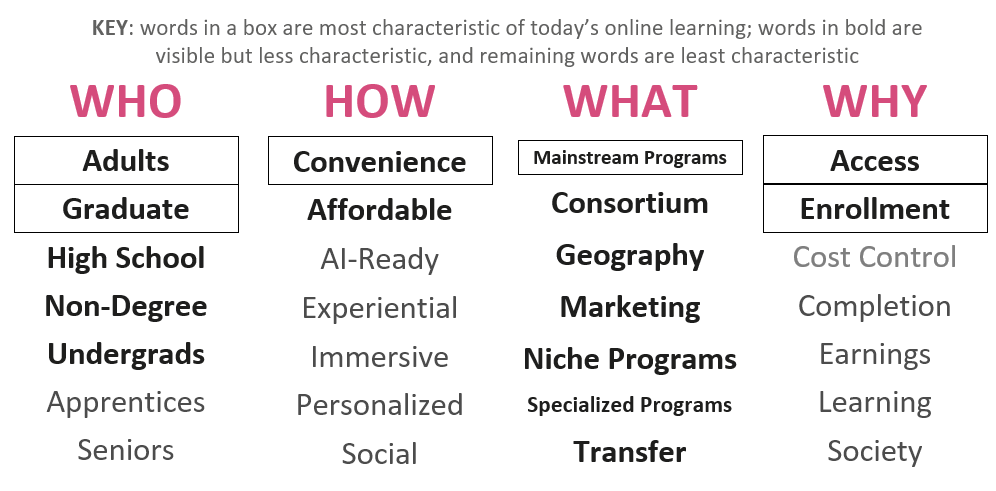
Considering the "who" column, conventional online learning today cannot accommodate the fundamentally on-site nature of apprenticeship programs and is a poor fit for many seniors eager for live socialization. But if advances in technology could make the fully online student experience more interactive, immersive, and personalized, such assumptions might change.
The "what" column is all bold, which speaks to the array of ways online can be aligned to institutional assets or market circumstances to create an edge.
The "how" and "why" columns are least bold, highlighting the limitations of conventional online learning: convenient, yes, but typically not as social or experiential as in-person modalities. The latest AI can create a 24/7 customized, personal tutor for each online student; make course material more interactive and engaging; and even simulate workplace situations and other virtual practice-based settings. Leading online colleges and universities have yet to roll out AI-centric versions of online learning, but a reimagining of the modality is more realistic than ever.
The outcomes of online programs are still imperfectly understood. Online programs are associated with widened access by student type and enrollment gains, but the data is inadequate at best when trying to understand how modality impacts student retention and completion, as well as initial and long-term earnings. Measurement of student learning online (learning is not necessarily the same as completion rates) is impossible in a large, decentralized higher education system with few standard metrics and little cross-institutional data reporting. Disentangling modality from student and institutional type, and the impact on outcomes of different variables, is imperative but difficult.
Focus group participants discussed online program portfolio health in the terms of the model depicted in figure 1, agreeing that there are no simple answers because so much depends on context, starting point, and goals. AI presents an opportunity to rethink what online learning can accomplish, but it is also a competitive threat. AI pushes the convenience of online learning to another level— prospective students might see AI-driven personalized tutors, simulated practice, and even virtual socialization as even more convenient than conventional online learning, undermining institution-led programs and student enrollment.
One participant underscored that at most institutions modality remains a matter for individual faculty. This inhibits an institutional, college, or departmental approach to the online program portfolio, resulting in an uneven student experience, a mix of better- and worse-fit programs, and fragmented innovation. How the online learning variable interacts with institutional culture is a key dynamic.
KEY FINDING: Optimizing what is best taught or experienced in-person versus online, and whether solo or as a cohort, should be the pedagogic lodestar.
The dominance of asynchronous. A participant from a community college system was "shocked" that pandemic-era investments in synchronous online classes did not thrive past the crisis. The synchronous classes were designed to compensate for the loss of the in-person classroom and complemented the 100% asynchronous norm of conventional online classes. But once normality resumed, traditional students eagerly returned to brick-and-mortar classrooms (with, yes, a greater openness to online courses), and online students re-embraced asynchronous. Innovation to counter COVID-19 was just that, not a new and lasting pedagogic synthesis. (Asynchronous dominance is not true of every institution but is a good description of online learning among the institutions represented by focus group participants).
Participants agreed that instructional diversity aids learning. A combination of synchronous and asynchronous sessions and activities, or a mix of in-person and online experiences, widens scope for students to engage with material in new ways through different media and settings. Of course instructional design must be thoughtful and intentional if affordances are to be drawn out. Pedagogic variety can also help institutions comply with federal "regular and substantive" requirements for student–faculty interaction.
Participants also recognized that time and cost barriers are formidable. Hybrid modalities undermine the fundamental convenience appeal of asynchronous online courses and programs. Students can express interest in combined modalities and see the potential, but other considerations often win out. Sticking to a single modality tends to be simpler for institutions to operationalize as well as to market. Hybrid can add cost, putting more burden on advocates to show strong return on investment (which may take years to materialize).
The added complexity of hybrid models contradicts the decentralized, faculty-led norm of course and program development. At most institutions it is unrealistic to imagine faculty reaching consensus on pedagogic best practices and then operationalizing them. But without such standardization, the student experience may be too uneven to convince students (and faculty skeptics) that the additional friction is worth the effort. Poorly considered in-person or synchronous requirements for online students can suggest that policies are merely traditionalism, faculty preference, or busywork to justify conventional tuition.
Definitions and data are additional inhibitors. Federal enrollment reporting distinguishes between fully distance and in-person-only students. But hybrid enrollment reporting is limited to "some distance" enrollment (i.e., used to classify students enrolled in at least one online course but not a fully online program). Wide-ranging pedagogic variety is obscured in this definition, making it impossible to tally practice on the ground and impact on enrollment and student outcomes. The same limitations play out at the institutional level, with types of hybrid enrollment rarely broken out with little consistency between institutions. Pedagogic instincts are in tension with institutional practicalities, data inadequacies, and consumer time constraints. Figure 2 sets out four quadrants of online pedagogic possibility and complementarity.
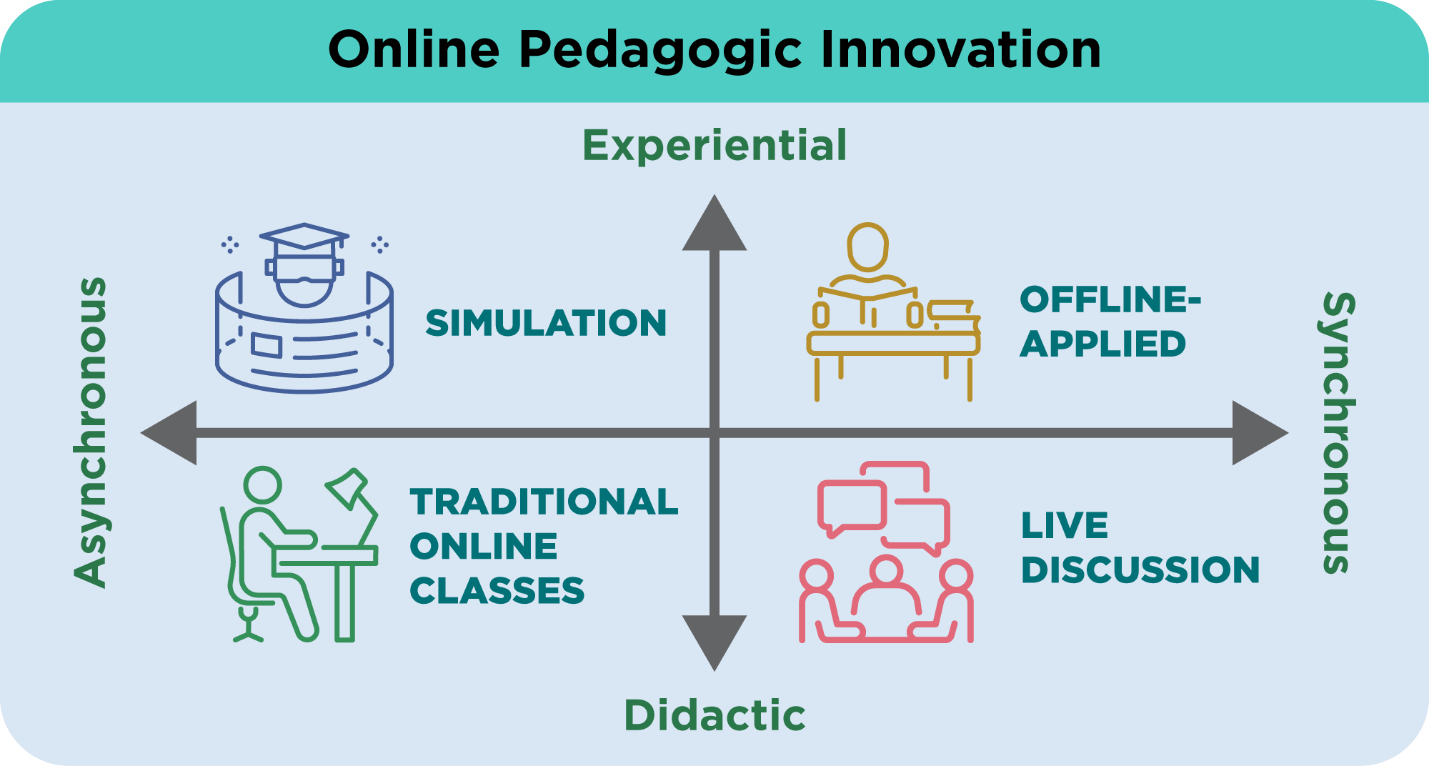
Most online courses and program are largely confined to the bottom left quadrant. Live discussions (bottom right) are typically optional at best. Simulations (top left), if included, tend to be simple and discrete rather than complex and immersive. Opportunities to apply learning in the real world (top right) are often left to individual students to facilitate through their employment, with little or no institutional oversight. This can be a strength if most students are employed in relevant settings (e.g., an RN-BSN program) but a weakness if students are seeking a career change.
One of the focus group participants cited Campus.edu (formerly MTI College in California) as an illustration of an attempt to transcend ordinary online learning. Campus.edu is dedicated to a pre-bachelor's online pedagogy that prioritizes synchronous sessions and live one-to-one coaching (as well as asynchronous components). The theory is that conventional online learning is a poor fit for the target students (adults seeking a certificate or associate degree later in life), who are underprepared and need additional support to boost chances of completion. The institution also trades on working with instructors employed at brand-name colleges and universities, signaling a superior teaching and learning experience.
The institution recently acquired Sizzle, a start-up using AI to ingest raw content and produce personalized, interactive learning materials. This is how Campus.edu seeks to occupy the upper-left quadrant of figure 2 (as well as bottom-left and bottom-right). Campus.edu's goal—to have its graduates transfer into a bachelor's degree program at a conventional institution—obviates the need to invest in the upper-right quadrant, although Campus.edu also runs an institution in Sacramento that offers some in-person programs such as phlebotomy and cosmetology.
Efforts like those at Campus.edu to broaden online pedagogy are ones to watch, not least because some similar prior initiatives (e.g., Foundry College) failed to gain traction. Next-generation AI may prove pivotal.
The search for balance continues. Going forward, a balanced student experience might be regarded as a program establishing coordinates in all four quadrants of figure 2. Online students need real-world practice, and campus-based students would benefit from exposure to asynchronous and synchronous online settings that mimic the contemporary workplace. Legacy distinctions between campus and online learning may increasingly be regarded as anachronistic.
Affordable, turnkey virtual workplace simulations across multiple disciplines and settings might be needed to render such balance feasible. Only then can experiential learning at scale match the convenience of the conventional online modality. Linking online students to remote real-world projects is another approach, avoiding the friction of travel by leveraging the geographical flexibility of a virtual student body. Expecting all online students to engage in in-person practicum-type experiences may be beyond the capabilities of most institutions and impractical for many online students.
Movement in the other direction, from a campus-centric norm to forms of hybrid may be more promising. As traditional students seek more experiential learning opportunities to boost their employability, online classes can help maintain campus connections and aid time to graduation. Synchronous online sessions may be more palatable to students familiar with in-person classes. Simulated workplaces can fill the gap where in-person options are unavailable or too expensive. Synchronous or asynchronous, whether online or in-person, are not inherently better or worse.
KEY FINDING: Greater clarity about the costs of online learning and associated institutional strategy will help institutions thrive in an era when the modality is "mature."
The third sub-theme cuts across the other two and highlights an ambiguity integral to online learning: the modality does not have its story straight on cost.
Hesitation about discussing the cost of online learning complicates progress. Online learning is viewed as affordable insofar as it helps students manage work, family, and study and save on commuting. But most institutions charge the same tuition regardless of modality, to emphasize comparable quality. CHLOE survey data demonstrates that at the margins some institutions routinely charge less for online programs than on-campus ones, while other institutions charge more. Whether online learning is more or less expensive to develop and deliver than campus equivalents is unresolved, bogged down in institution-by-institution inconsistencies, varying definitions, limited tracking, and mixed motivations and politics. There is no pat answer: It depends on course or program features, what is counted, and user perspectives (e.g., administration, faculty, students).
This ambiguity coexists with sustained public and lawmaker disquiet about rising college costs. Online technology has helped many other sectors lower costs, but in higher education it is not clear whether or to what extent online learning has changed institutional cost dynamics.
Two focus group participants highlighted interesting perspectives:
- Online Is Underappreciated as an Engine of Efficiency: A participant from a four-year public institution pointed to the context of low public tuition by national standards and the fact that the institution has been committed to growth and access but has not raised tuition in almost two decades. The mainstreaming of online learning has been essential to achieving significant enrollment growth without commensurate investment in bricks and mortar, but its importance is often underappreciated.
- Online Must Align with Outcomes Focus: A participant from a two-year institution noted their state's shift to outcomes-based funding. This has helped institutions focus on program alignment but may have had unexpected consequences for some online programs. If an online program frames value in career terms but the student experience is too narrow to ensure adequate preparation, the program may fall afoul of outcomes thresholds. If the modality becomes associated with weaker results, lawmakers may ask tougher questions about online learning.
Limited lawmaker understanding of online learning and the cost variable presents a challenge. Now that online learning is mainstream in higher education, the modality will play a more important role in state budget discussions. But there is often a big gap between lawmaker and institutional understanding of online learning dynamics. Online learning fees are one example. One participant mentioned that public institutions in their state charge inconsistent per-credit distance learning fees to students. Some institutions charge no fee. The variation in part reflects different models and stages of online learning development, but it confuses lawmakers. Within institutions there can be a lack of consensus about what such fees are for and whether they are needed. Attempts to justify a fee increase can run into assumptions that online costs less and so does not need extra resources.
Georgia lawmakers recently moved to fund online courses at a lower rate per FTE than campus equivalents, arguing that online learning is less expensive to deliver. The bigger goal was to cut costs to fund an investment in need-based aid. After institutions pushed back, the idea was shelved, but a committee is to study online learning costs. This is unlikely to be the last state to consider online learning as fiscal headroom.
Quality online learning can cost money or save money, but there is a lack of clarity about when to make a case for investment and when to strive for savings. Many organizational layers and cost variables are in play, and online leaders would be wise to get their story straight to ensure that online is both reducing expenses where appropriate and investing in quality and insist that lawmakers understand this (see figure 3).
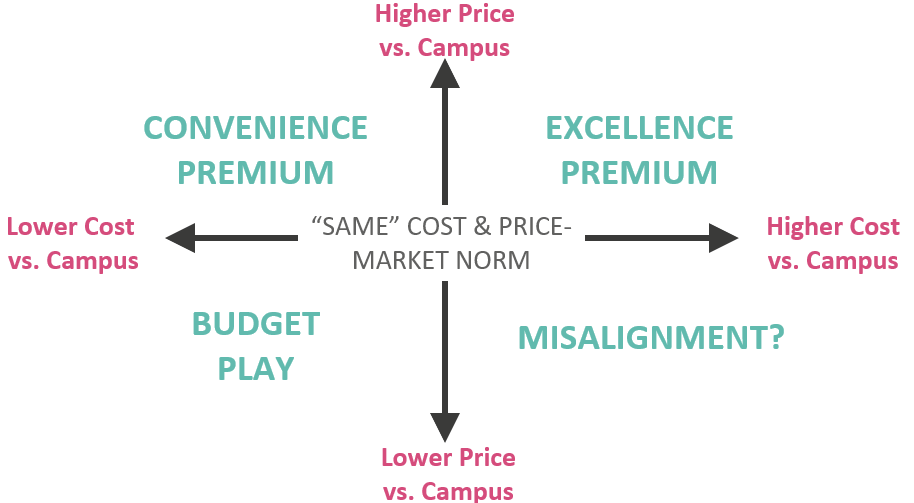
The typical online course or program is placed in the center of figure 3, with no distinction in tuition by modality but unclear evidence on underlying costs. Pricing is driven by strategy (e.g., emphasis on comparable quality), while cost vagueness is a matter of decentralization, course design variation, field of study differences, and the challenge of capturing all costs consistently. The reality of "same" cost is hazy.
Greater strategic attention to the online cost variable is an opportunity. The popular assumption—shared by some lawmakers—is that online must surely be less expensive to deliver. Institutional budgets are under pressure as never before. This makes hesitation or ambiguity about online cost clarity and options seem misguided. If an institution concludes that online cannot be used to lower costs while maintaining quality, leaders need to have compelling evidence at hand.
Conclusion
Online learning is approaching its fourth decade. Focus group participants are proud of their institution's online portfolios and see multiple opportunities for expansion. The strategic importance of online learning is increasingly recognized within institutional priorities and hierarchies, but there is vagueness (internally and externally) on fundamental questions of cost and value. Finding ways for online to contribute beyond access and enrollment—on pedagogy, outcomes, and cost—must be the goal for online leaders if the modality is to consolidate its gains and chart new ambitions.
Methodology and Acknowledgments
Methodology
The 2026 CHLOE Conversations project drew on data from six focus groups conducted in two rounds from April 20 to May 21, 2026. Participants were recruited through CHLOE marketing emails and webinar announcements. Those invited to participate were selected to represent specific sectors or provide expertise on critical topics. The first round consisted of three focus groups, each dedicated to one topic central to online learning strategy: online learning quality, market strategy, and AI. The CHLOE authors selected these topics based on recurring themes in prior CHLOE reports, current issues facing online learning leaders, and input from the CHLOE Advisory Panel. The second round explored questions from the first three focus groups but were organized by sector (community colleges, private four-year institutions, and public four-year institutions). In total, 30 participants took part in the focus groups.
The CHLOE authors manually coded the focus group data and reviewed key findings collaboratively to align on key themes. The authors also developed reports in conversation with one another to ensure alignment. Participant quotations in these reports were lightly edited for readability.
Acknowledgments
The CHLOE authors are deeply grateful to the focus group participants who generously shared their time, experiences, and insights. Their contributions provided a richer understanding of the opportunities and challenges facing online learning leaders today. We also thank the CHLOE Advisory Panel for its guidance in shaping the project.
We are equally grateful to our colleagues across EDUCAUSE whose expertise and support brought this report to fruition, including contributions to project strategy, data visualization, marketing, project management, and editing.
Thank You


CHLOE 2026–27 Sponsors
Platinum Sponsors


Gold Sponsors

Silver Sponsors


Richard Garrett. CHLOE Conversations: Online Program Strategy. Research report. Boulder, CO: Quality Matters, Encoura Eduventures Research, and EDUCAUSE, August 2026.
© 2026 Quality Matters, Encoura Eduventures Research, and EDUCAUSE. The content of this work is licensed under a Creative Commons BY-NC-ND 4.0 International License.