CHLOE Conversations: Online Quality, Support, and Data

A Collaboration with Quality Matters and Encoura Eduventures Research
What Are the Report Highlights?
- Online learning is increasingly central to enrollment, access, revenue, and student success, but many institutions still manage it reactively rather than strategically.
- Focus group participants identified three gaps that limit effective online learning: a strategy gap, a support gap, and a data gap.
- Faculty preparation, institutional capacity for instructional design, accessibility work, and student support are deeply connected; when one area is under-resourced, the broader ecosystem feels the strain.
- Institutions need stronger evidence and improvement processes to move from effort to measurable impact and demonstrable quality.
This is one of a series of four CHLOE Conversations reports, which are based on a set of focus groups conducted by Quality Matters, Encoura Eduventures Research, and EDUCAUSE. Participants included chief online learning officers as well as mid-level leaders of online learning, representing institutions of different sizes, sectors, and structures. For more information about this project and links to the other reports in the series, please visit the 2026 CHLOE Conversations Report Series Hub.
Overview
For many institutions, online learning has moved from the margins to the center of institutional goals. It is no longer seen as a set of emergency options, a convenience for adult learners, or a small collection of programs managed at the edge of the institution. Instead, online offerings are now part of how institutions grow, compete, serve students, and fulfill their missions. But when online learning becomes central without being managed as a coordinated ecosystem, institutional work can remain reactive.
The ecosystem framing matters because effective online learning is not produced by a single course review, faculty workshop, or technology tool. It depends on how the pieces work together: who leads and coordinates the work, how courses are designed and reviewed, how faculty are prepared and supported, how students access help, how accessibility is built into workflows, and how data is used for evaluation and improvement. When those elements are not connected, online learning leaders often spend more time solving immediate problems than shaping sustainable strategy.
A common theme emerged from this work: Online learning leaders and faculty are working hard but often without a shared strategy, sufficient support, or the infrastructure needed to sustain and improve effective online learning at scale.
The Bottom Line
Online learning has become too important to be managed as an add-on, and online quality is too important to be left to individual effort. Institutions that want online learning to support enrollment, access, revenue, and student success need to build the ecosystem around it: shared strategy, clear leadership, faculty and instructional design support, accessibility workflows, and evidence structures for continuous improvement. The next phase of online learning leadership is not simply about adding more online programs or improving individual courses; it is about building an online-focused ecosystem that can sustain quality at scale and align online learning with institutional goals.
KEY FINDING: Online learning is central but often still managed reactively.
Online learning is increasingly central to institutional goals, yet too often it is still managed as though it were peripheral. Focus group participants described online learning as central to enrollment growth, revenue generation, student access, flexibility, and long-term institutional positioning. One senior online leader at a community college connected online learning's value to affordability, transfer pathways, quality course development, subject-matter expertise, and "all of the support services that go with that." Another described online learning as a primary growth opportunity at an institution facing physical space constraints.
But participants also described a mismatch between online learning's strategic importance and the structures available to manage it. Strategy, support, and evidence systems don't always keep pace with online learning's expanded role. As one mid-level online leader at a public four-year institution put it, "If we want [new online programs] to be revenue generating, they have to be really high quality…. [I]f we're going to strategically invest in these spaces, how do we shift things operationally?"
Prior CHLOE work has shown that many institutions operate in a hybrid space, with some online learning functions centralized and others distributed across academic units or support offices. That structure can support collaboration, but when authority, expectations, data access, and responsibility for quality are uneven, distributed responsibility can become fragmentation. In the focus group, participants described situations in which online learning touched academic units, instructional design teams, faculty, accessibility support, student support, and institutional data offices, but no single structure consistently connected the pieces.
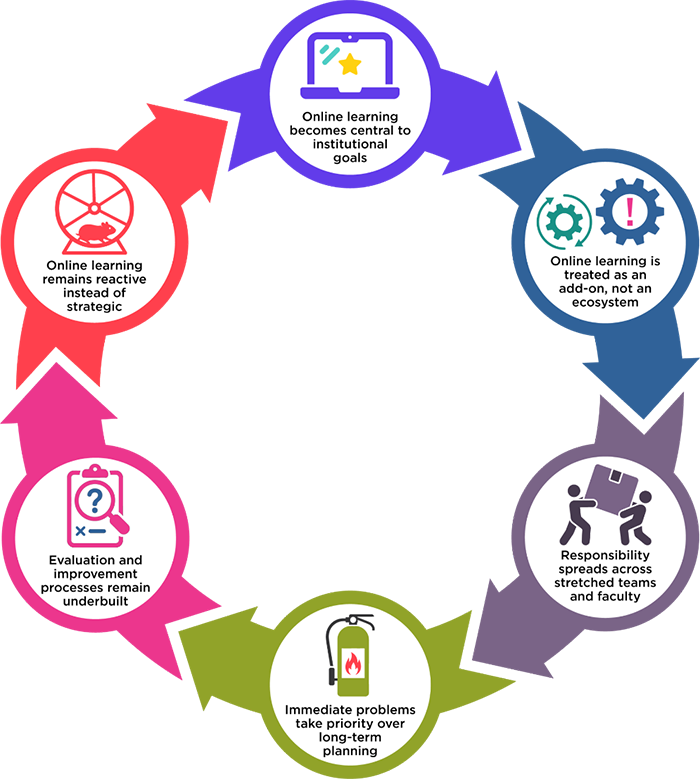
That fragmentation can create a reactive pattern: Institutions respond when problems become visible but might lack the structures needed to guide improvement before problems become urgent. One participant described how a decline in online math success drew senior-level attention and prompted intensive analysis and intervention. That response appeared to generate meaningful collaboration, but it also illustrated how often strategic attention emerges only after a problem has already affected students. This mismatch creates the reactive cycle shown in Figure 1: Online learning becomes central to institutional goals, but when it is still managed as an add-on rather than an ecosystem, responsibility spreads across stretched teams and faculty, immediate problems take priority over long-term planning, and evaluation and improvement processes remain underbuilt.
Meanwhile, many institutions are still patching online learning systems built for a different moment. Courses may have been moved online quickly, programs may have been added by individual departments or local champions, and faculty or student supports may have been created in response to the pandemic or to localized needs. Quality practices may live in one college, one program, or one motivated team without extending across the institution. The problem extends to data as well: One participant noted that a big reason the institution had not been collecting necessary data for online management and improvement was that, for far too long, the focus had been "on the traditional side of college."
We keep trying to fix something that's broken. Let's just build a new house. —Mid-level online leader, private four-year institution
KEY FINDING: Three broad gaps are limiting online quality.
Throughout the focus group, participants surfaced three broad gaps that help explain why effective online learning can be difficult to sustain at scale: a strategy gap, a support gap, and a data gap (see figure 2).
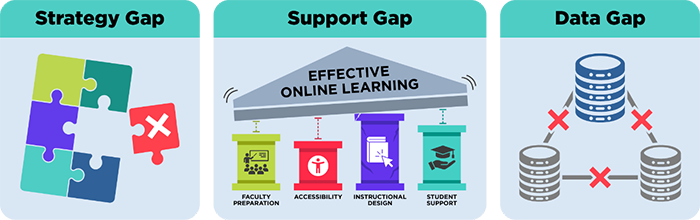
The strategy gap is not simply about whether an institution has an online learning plan. It is about whether online learning is understood and managed as a coordinated institutional ecosystem.
At some institutions, quality-assurance practices related to course design, online teaching, and learner support exist but are uneven across programs. This challenge is not unique to online learning; colleges and universities are often decentralized by design. But online learning can make the costs of weak coordination more visible because the student experience depends on how well course design, faculty support, technology, accessibility, advising, and data work together. One mid-level online leader at a public four-year institution described a distributed model in which the online learning unit supports departments and instructors but noted that "we don't have a compliance model that says if you're teaching online, you have to go through a certain process." The result is that "some programs have widespread adoption, some don't." She added that if a program wants to tell prospective students, "come to this program, it's awesome," the institution needs to "be able to say that that's true." Yet uneven adoption means not every program can make that claim with confidence.
That unevenness is not only a marketing problem. It is also an equity problem, with consequences for student experience, institutional reputation, and enrollment. Students do not experience online quality at the level of institutional intention. They experience it in courses, programs, advising interactions, technology support, accessibility of materials, faculty presence, and the clarity of expectations. Uneven quality assurance can mean that students in one program encounter well-designed, accessible, consistently supported online learning, while students in another program encounter a much less coherent experience. The larger issue is whether institutions have defined and supported the baseline conditions that every online learner should be able to expect.
The support gap encompasses several related issues: faculty preparation, instructional design capacity, accessibility support, and the unique supports that online learners need to succeed.
Instructional design emerged as one of the clearest examples of this gap. Participants described a familiar tension: Faculty are expected to design and teach high-quality online courses, but they may not have the specialized design expertise, time, or support needed to do that work effectively. One participant put it plainly: "Instructional design is an entire career." That statement illustrates a persistent misconception that effective online learning is something faculty can easily absorb into existing workloads. Faculty are essential partners in online course quality, but they should not be expected to carry the ecosystem alone.
Some participants highlighted the limited availability of instructional designers, whether because of budget constraints, staffing reductions, or a lack of senior-level understanding of the role instructional designers play in effective online learning. Instructional designers do more than design effective learning environments; they also create workflows, templates, reviews, and processes for ongoing improvement. One participant, a senior instructional designer from a private four-year institution, described a shift from "a really large instructional design presence" to "a smaller presence," with responsibility for quality assurance shifting to faculty. Another participant said, "I would just like an instructional designer," framing the issue not as a preference but as a structural need when an institution simply has no instructional designers on staff.
Accessibility surfaced as another support gap. It is based on standards, guided by requirements such as accessible documents, captions, alt text, headings, and structures compatible with screen readers, but it also depends on context because learners' needs and accommodations vary. As one participant put it, accessibility can feel "like an art, not a science," because no automated score or checklist can fully determine whether course materials meet every learner's needs. Tools such as checkers, templates, and tutorials can help, but faculty also need time, training, workflows, remediation support, and clear expectations. As one participant noted, "Faculty members' plates are really full and getting fuller…. [They] just don't have the time to learn how to do accessibility… [they are] spread so thin at this point." As federal accessibility expectations raise the stakes, accessibility must become an integrated part of online learning design and support, not a late-stage fix left for faculty to address individually.
The same point applies to student support, which participants described as part of online quality rather than separate from it. One participant described the challenge of helping prospective students understand what an online course will "look like and act like" and what it will "feel like" to be an online student—a reminder that online learning leaders need more than operational knowledge; they need a student-centered understanding of the online experience. Students might enroll online because they need flexibility, convenience, access, affordability, or a workable path to completion, but their ability to persist often depends on supports they may not know to evaluate in advance, such as academic support, technology support, advising, clear communication, and help navigating the online learning environment. When institutional leaders discuss online quality only in terms of courses, they miss the broader learner experience that shapes persistence, satisfaction, and success.
Taken together, these examples point to the same conclusion: Effective online learning depends on more than standards or good intentions. It depends on whether institutions have built the capacity to support accessible, consistent, and well-supported learning experiences at scale. The achievable goal may not be to centralize every online learning function but instead to establish common expectations, shared supports, and coordinated workflows so that quality does not depend entirely on where a student enrolls, which faculty member teaches the course, or which unit happens to have the strongest local capacity.
The data gap is both a collection problem and a use problem: Institutions might lack the data they need, or they might have data scattered across systems without the access, coordination, or leadership needed to use it for decisions.
Without usable evidence, institutions struggle to know whether their online learning efforts are working, where students are encountering barriers, or which supports are making a difference. Participants wanted better answers to questions central to online learning leadership: Are online students succeeding? Where are they encountering barriers? Which students need outreach, and when? Are course design, accessibility, faculty support, and quality-assurance efforts making a measurable difference over time? Without baseline data, institutions typically cannot determine whether investments in instructional design, faculty development, accessibility, or student support are improving outcomes.
In some cases, participants described promising practices. One institution was bringing course-level data into its revision process so that success rates and specific points of difficulty became part of the design conversation. The same institution was also expanding its focus beyond whether students earned passing grades in individual courses to whether they persisted and continued moving toward a credential or degree. These examples demonstrate what is possible when data is connected to improvement conversations.
Even when data exists, access can be limited by governance rules, technology gaps, or unclear ownership. Participants described fragmented environments in which LMS data, assessment data, student outcomes data, and persistence or retention data lived in separate systems or was managed by different offices. One participant described having LMS data while assessment and student outcomes data lived elsewhere, with no current way to connect them. Another explained that changes to data governance had limited the online learning unit's access to college-level data. In that case, the unit could provide quality-assurance data to colleges but did not receive persistence or course success data in return.
Participants also wanted data that would allow them to be more timely and proactive. One participant described the need for clearer, more comprehensive reporting from LMS activity and assessment data, not just course-by-course information that did not support coordinated outreach. Another wanted to understand whether students experienced clarity and consistency across courses in the same program. A third wanted to measure outcomes after faculty worked one-on-one with an instructional designer, both to understand the impact and to motivate faculty who feel they do not have time for course design support.
The data gap isn't just a technical problem; it is also a strategy and governance problem. Data shapes what institutions can credibly communicate. If an institution has not defined online-specific goals and metrics, leaders cannot easily determine what evidence to collect or how to use it. And if data is not collected, connected, and reviewed in ways that inform decisions, then quality assurance remains a set of activities rather than a continuous improvement system. The point is not to reduce online learning to dashboards but to use evidence to support human judgment, identify uneven student experiences, and guide improvement.
KEY FINDING: Institutions need to move from effort to impact.
Taken together, the strategy, support, and data gaps help explain why online quality can remain difficult to evaluate, sustain, and communicate. Even if meaningful institutional efforts are underway, pockets of strong practice are not the same as a coherent institutional approach. Institutions might have useful data, but siloed or incomplete data cannot easily inform strategy or tell a clear story about impact. This creates a real limitation for using quality as a differentiating factor in an increasingly competitive online marketplace.
One senior online leader at a community college described his institution's communication about online quality as incremental, often tied to certain news releases or rankings. The challenge, he said, was to make that communication more "consolidated and persisting." This communication may be a vital tool for institutions because when online programs look similar from the outside, students are left to compare options largely on price, speed, convenience, and institutional name recognition.
In the CHLOE 8 Report, respondents described a pattern we called "quiet quality" (see figure 3), which illustrates this limitation. Many institutions reported engaging in quality-assurance practices, yet far fewer reported communicating those efforts to current students or using them to recruit prospective students.
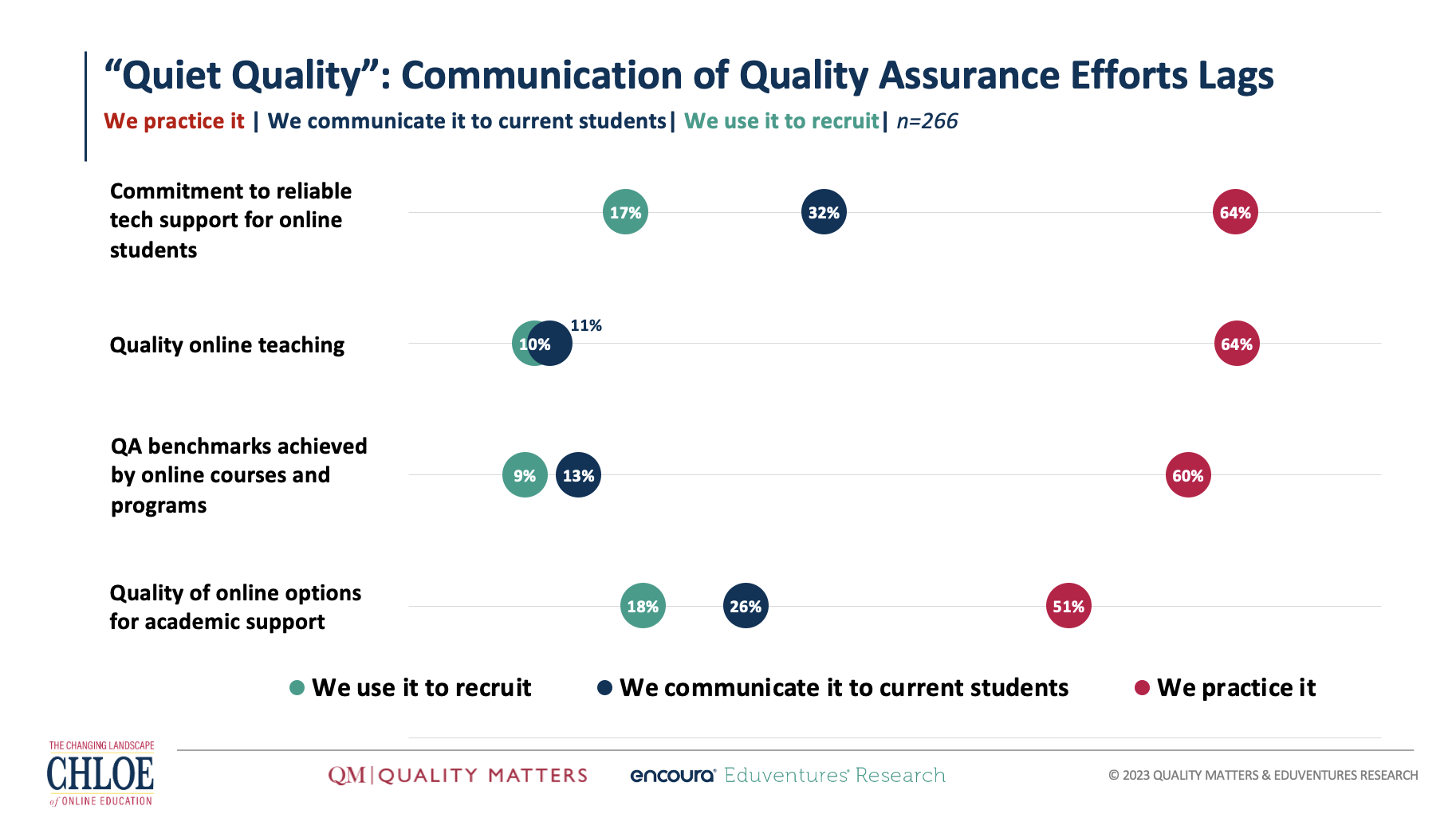
The focus group helped provide a possible explanation. Participants noted that when quality is uneven across courses and programs, it's very difficult to communicate efforts to prospective students. This is not a new problem, but it is becoming an increasingly consequential one as many institutions scale online offerings to attract new enrollments.
When quality-assurance work is coordinated and evidence based, though, it can become part of the enrollment story. One mid-level online leader at a public four-year institution described programs that had partnered with the online learning unit to "really embed" quality practices and were then "putting that in their recruitment data," which she said was "making a huge difference." Institutions do not need to describe online quality in identical ways across every program, but they should be able to name the baseline practices students can expect, explain whether those practices are working, and communicate what they mean for students.
Conclusion
Online learning leaders and units are already doing the work of supporting faculty, reviewing courses, improving accessibility, responding to student needs, analyzing data when they can, and helping institutions meet growing demand. But too often that work depends on local initiative, stretched teams, and reactive problem-solving. That may have been sustainable when online learning was smaller or more peripheral. It is much less sustainable now.
As online learning becomes increasingly central to institutional enrollment, access, revenue, and student success goals, institutions need to build the systems that match that level of importance. That does not mean every online learning function must be centralized. Colleges and universities are often decentralized by design, and online learning has to work within that reality. But decentralized or hybrid structures still need common expectations, shared supports, coordinated workflows, and usable evidence.
The next phase of online learning leadership is not simply about expanding online offerings. It is about building the ecosystem needed to support those offerings, improve them over time, and demonstrate their value. That means closing the strategy gap by clarifying leadership, ownership, goals, and shared expectations for effective online learning. It means closing the support gap by investing in faculty preparation, instructional design capacity, accessibility workflows, and student support. And it means closing the data gap by building evidence structures that help institutions understand what is working, where students encounter barriers, and where improvement is needed.
In today's online marketplace, offering online learning is no longer enough; institutions must be able to show students what to expect, how they will be supported, and how the institution delivers on its online learning promise.
Methodology and Acknowledgments
Methodology
The 2026 CHLOE Conversations project drew on data from six focus groups conducted in two rounds from April 20 to May 21, 2026. Participants were recruited through CHLOE marketing emails and webinar announcements. Those invited to participate were selected to represent specific sectors or provide expertise on critical topics. The first round consisted of three focus groups, each dedicated to one topic central to online learning strategy: online learning quality, market strategy, and AI. The CHLOE authors selected these topics based on recurring themes in prior CHLOE reports, current issues facing online learning leaders, and input from the CHLOE Advisory Panel. The second round explored questions from the first three focus groups but were organized by sector (community colleges, private four-year institutions, and public four-year institutions). In total, 30 participants took part in the focus groups.
The CHLOE authors manually coded the focus group data and reviewed key findings collaboratively to align on key themes. The authors also developed reports in conversation with one another to ensure alignment. Participant quotations in these reports were lightly edited for readability.
Acknowledgments
The CHLOE authors are deeply grateful to the focus group participants who generously shared their time, experiences, and insights. Their contributions provided a richer understanding of the opportunities and challenges facing online learning leaders today. We also thank the CHLOE Advisory Panel for its guidance in shaping the project.
We are equally grateful to our colleagues across EDUCAUSE whose expertise and support brought this report to fruition, including contributions to project strategy, data visualization, marketing, project management, and editing.
Thank You


CHLOE 2026–27 Sponsors
Platinum Sponsors


Gold Sponsors

Silver Sponsors



Bethany Simunich. CHLOE Conversations: Online Quality, Support, and Data. Research report. Boulder, CO: Quality Matters, Encoura Eduventures Research, and EDUCAUSE, August 2026.
© 2026 Quality Matters, Encoura Eduventures Research, and EDUCAUSE. The content of this work is licensed under a Creative Commons BY-NC-ND 4.0 International License.