Data-Intensive Research
While most faculty engage in some form of scholarship related to their discipline, a subset of faculty engage in data-intensive research. Such research generates and/or uses vast quantities of data and requires extraordinary computing power to analyze those data.1 In 2017, a quarter of our faculty respondents said that they conduct what they consider to be data-intensive research.2 As one might expect, institution type is strongly associated with faculty engagement in such research. Sixty-eight percent of faculty who conduct data-intensive research are at DR institutions, 21% are at MA institutions, 5% are at BA institutions, and 3% are at AA institutions. Nearly half (46%) of the faculty doing data-intensive research generate less than a terabyte of data per year; 36% of faculty produce between 1 and 10 TB of data each year as part of their research programs. To gauge how well higher education IT is serving data-intensive research faculty, we asked faculty to tell us about their institution's support for their projects (see figure 3).
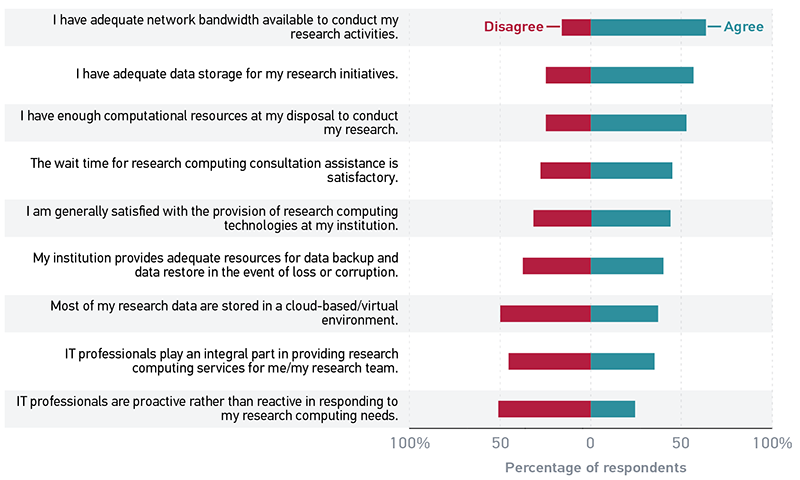
The items we asked about fall into one of two broad categories:
- The provision of research computing technologies
- The support of IT professionals to research computing needs
On the former, a plurality of faculty (45%) are generally satisfied with the provision of research computing technologies at their respective institutions. With the exception of having research data stored in a cloud-based or virtual environment, which is more a statement of practice than one of satisfaction, faculty evaluation of the provision of research computing technologies is more positive than negative. Indeed, a majority of faculty agreed or strongly agreed that they have adequate bandwidth available to conduct their research activities (65%), adequate data storage for their research initiatives (58%), and enough computational resources at their disposal to conduct their research (54%). On average, faculty who are engaged in data-intensive research appear to have the technologies they require to perform their research.
Unfortunately, faculty do not feel as positive about the support they receive from IT professionals for data-intensive research projects. Although a plurality of faculty said that the wait time for research computing consultation assistance is satisfactory (46%), faculty are otherwise dissatisfied with the data-intensive research computing support they are receiving. A majority (51%) of faculty disagreed that IT professionals are proactive rather than reactive in responding to their research computing needs; nearly half (46%) of faculty disagreed that IT professionals are playing an integral part in providing research computing services for them and their research teams.
Breaking down this latter finding by Carnegie class, we note again the familiar pattern of MA research faculty having more negative experiences with IT research computing support than faculty from other institution types. Significantly more data-intensive research faculty from MA institutions (55%) disagreed that IT professionals play an integral part in providing research computing services than faculty at DR (45%), BA (31%), and AA (28%) institutions. The moderate levels of disagreement with this statement at DR institutions are likely the result of having more faculty engaged in data-intensive research than there are IT support staff for said research; the lower levels of disagreement at BA and AA institutions are likely due to the fact that so few faculty are engaged in data-intensive research at their institutions that IT units can simply be more engaged and responsive. MA institutions, however, appear to be caught betwixt, with more faculty engaged in data-intensive research than at BA and AA institutions but with fewer resources available than at DR institutions.
It is also noteworthy that while IT staff are rated positively for general research support, faculty engaged in data-intensive research projects do not rate IT staff as highly. Indeed, on the adequacy and appropriateness of IT staff support, the availability of IT staff with specialized knowledge about research computing, and the timeliness of IT support, regular research faculty rate IT professionals significantly higher than do data-intensive research faculty.
Notes
-
For more information on "big data" in the higher education context, see the collection of ECAR Working Group papers "Big Data in the Campus Landscape."
↩︎ -
We asked respondents, "Do you conduct what you consider to be data-intensive research?" and left what constitutes "data-intensive research" up to the individual faculty members responding.
↩︎