Institutional Support for Research
In 2017, we asked faculty to tell us about their levels of agreement with various statements about the technology support they receive for their research. Broadly speaking, the items on which we collected data were grouped into the following categories:
- Support for data management, use, and storage services provided by the institution for research
- Support from IT staff for research
- Support for specialized computational resources
While a majority (53%) of faculty said they are generally satisfied with their institution's support for their research needs, the levels of satisfaction with individual items in each category vary, suggesting that there is plenty of room for improvement (see figure 1). For example, on the items asking about support of faculty data and computing needs, a plurality of respondents agreed or strongly agreed that their institution made adequate technology support provisions for putting materials in institutional repositories (45%), for grant-funded projects (44%), for research during the promotion and tenure process (41%), for data curation (40%), and for cross-institutional research collaborations (37%). The one exception from this group is that more faculty (45%) disagreed than agreed (27%) that their institutions made electronic laboratory notebooks (ELNs) available to those whose projects require them.
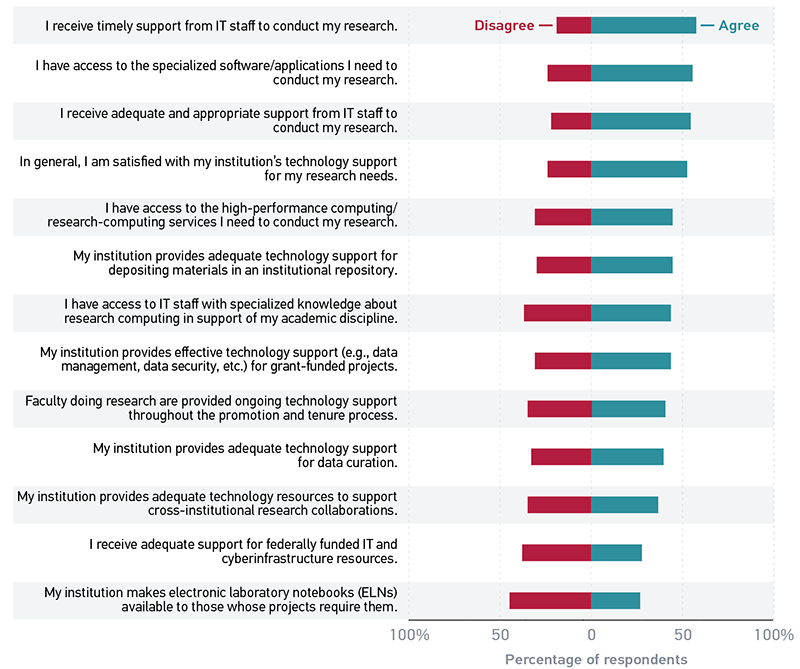
Generally, faculty offered more favorable evaluations of their experiences involving support from IT staff. Indeed, a majority of faculty told us they receive timely (58%) and adequate and appropriate (55%) support from IT staff to conduct their research. And, a plurality of faculty reported having access to IT staff with specialized knowledge about research computing in support of their academic discipline (44%). These results are even more impressive given that, according to 2017 CDS data, the typical institution has zero FTE dedicated to central IT research computing services.1
For the two items forming the specialized computational resources category, the results are divided between locally provided generic supercomputers and clusters on the one hand, and highly specific, offsite resources on the other. For the former, 45% of faculty reported having access to high-performance computing and research-computing services for their research; for the latter, only 28% reported having adequate support for federally funded IT and cyberinfrastructure resources (e.g., Open Science Grid, XSEDE, iPlant, EarthCube, and NCBI).
As one might expect, for most of the statements about IT research support there is significant variation in levels of faculty agreement by institution type. The patterns, however, do not conform to the general expectation that institutions emphasizing research (e.g., DR, MA) would better meet IT research needs than institutions where the primary emphasis is on teaching (e.g., BA, AA). Faculty from DR, BA, and AA institutions tend to evaluate their institutional IT support similarly, but faculty from MA institutions have a tendency to rate IT research support significantly lower, especially compared with faculty from DR institutions. For a couple of items (access to staff with specialized knowledge in specific disciplines, and adequate support for data curation), faculty at AA institutions rated IT research support higher than MA faculty did, while BA faculty reported greater support during the tenure and promotion process than MA faculty. Given that these findings do not confirm what we would generally assume about which faculty are receiving adequate support, what else might explain the observed institutional variation(s)?
One possible explanation—for which we have data—relates to the institutional resources available to support faculty research. The CHEITA Global Complexity Index2 is a measure of institutional complexity comprising weighted index measures of student enrollment, institutional staff, and research income. The Complexity Index strongly predicts an institution's overall IT expenditure (measured in US dollars) and serves well as a proxy for the IT resources available to support faculty research. Indeed, controlling for institution type, we find that the more complex the institution, the larger its IT budget and the better the support for faculty IT research needs. In this way, the Complexity Index may offer an alternative explanation for the institutional variation we are observing in faculty evaluation of research support; however, further research would be required to establish the contributions of the Complexity Index vis-a-vis Carnegie classifications.
Regardless, our data suggest colleges and universities are doing an "OK" job with regard to meeting faculty technology research demands but that there is significant room for improvement across the board, especially at MA institutions. Given this, IT organizations need to spend more time understanding how and where improvements can be made to support faculty research more broadly and consider increasing the meager central IT spending on research computing services such as high-performance computing (HPC).3 To help determine where the pain points are, we asked faculty to tell us what their institution can do with technology to better facilitate or support their research role. In the following section, we unpack the results of this open-ended question. Depending on the institutional resources available, these results may reveal opportunities for some quick wins that support faculty in their research and serve well the institutional research mission.
Notes
-
The median of central IT research computing services FTEs is zero across all types of institutions, with 98% of institutions reporting 0–1 research computing services FTE per 1,000 institutional FTEs. One reason for these positive ratings may simply be that the few central IT research computing experts are very good at meeting the needs of the faculty who request their services. It is also possible that many of the research technology needs faculty have are such that IT staff not explicitly designated as research computing services are able to support their needs well.
↩︎ -
Johan Bergström, Eden Dahlstrom, Pekka Kähkipuro, Anne Kealley, Leah Lang, Lori MacMullen, Michele Mennielli, Paul Sherlock, and Peter Tinson, Benchmarking IT: A Global Approach (Louisville, CO: ECAR, July 15, 2015).
↩︎ -
According to 2016 CDS data, the median central IT spending on research computing services as a percentage of total central IT spending was only 2% for all US institutions.
↩︎