Faculty Research Needs (In Their Own Words)
To execute their roles as researchers, higher education faculty need to be able to access and effectively use current, reliable, and powerful computing technologies. They also need to be aware of what technologies are available to them for their research. There may be considerable variation across higher education institutions, however, in the depth of IT support provided to faculty, or in faculty's access to needed resources such as analytic software. For example, institutional IT staff might not offer individualized research computing consultation for a wide range of faculty. Faculty who are not intensive, traditional users of high-performance computing or digital technology need help in using advanced technologies to support their research and scholarship. That creates an opportunity for IT organizations to meet these needs through IT staff with specialized research consultant roles.1
Additionally, at DR or MA institutions, for example, statistical analysis software (such as SAS or SPSS) might be already loaded onto a new faculty's laptop, which might also have been provided by their department. At BA or AA institutions, labor-saving citation software or access to journal databases might not be readily available. Or, in worst-case scenarios, faculty must use their own funds to make purchases. Furthermore, faculty vary in number, extent, type, and amount of grant awards, which subsequently affects their reliance on institutional technology resources to conduct research. Fully funded faculty might rely less on institutional resources such as laptops or analytic software than faculty who are only partially funded or funded through their institution rather than extramural grants.
To better assess faculty's needs, we asked them to elaborate with open-ended text responses. Responses (n = 1,169) on what their institution could do to support their research role were categorized into themes across all classes of institutions and faculty types. The six most prevalent themes from faculty's open-ended responses were
- Making specialized research software available
- Live support from their institution’s IT department (i.e., real-time support from staff)
- Access to cloud storage
- Institutional training and workshops to facilitate the use of technology for research
- Access to online, peer-reviewed journal databases
- Access to hardware, such as computational resources
Overall Results
The themes identified in faculty open-ended responses can be organized into two larger domains. First, faculty identified technology needs that were specific to institutional services, i.e., IT staff support, data management/storage, and institutional training/workshops. The remaining themes reflect specific tools necessary to conduct research: access to analytic software and computational resources (e.g., hardware), and access to journal database(s).
These findings suggest that faculty need not only software, hardware, and access to research literature but also access to IT staff familiar with their research computing needs to facilitate the use of these research tools. Figure 2 presents faculty respondents' most frequently reported "one thing" that their institution could do with technology to better facilitate or support their research role.2 Fourteen percent of faculty didn't answer, reported that they did not know, or said that the question was not applicable to their role (e.g., nonresearch role). Rather than reporting on what their institution could positively do to improve their research experience, faculty pointed to institutional factors, policies, and processes that they felt were not supportive. For example, faculty identified institutional factors that inhibited research, such as the limited capacity of their IT department to assist with discipline-specific technology needs for research, and lack of cloud-based data storage. These responses reflect key needs in technology service delivery—increased staff capacity, processes, and policies—rather than solely access to technology.
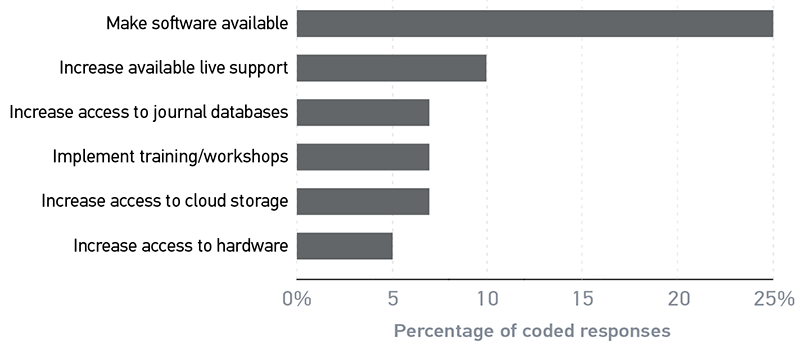
Make Software for Research More Available
The most frequent response from faculty on how their institution could support them in their research role centered on increased accessibility to software for conducting research. Faculty reported that they want their institutions to provide
- Funding to purchase analytic software or provide site licenses for software
- Remote access to analytic software
- Administrative rights to university hardware (e.g., laptops) to make updates or install analytic software
- Simple availability of discipline-specific software from their institution (e.g., qualitative analysis software)
Faculty raised concerns about how lack of funding or lack of access to software necessary to conduct research impedes research progress. Software included analytic packages such as SPSS or data management software such as EndNote. One faculty member reported, "Actually offer some means of purchasing some of the software that I need instead of me purchasing it out of pocket." Another respondent stated, "Ask me what I need and help me get it. I applied for one grant and received it, but that only bought the software for one year. I don't know how or who to ask in order to continue the software license agreement." These statements suggests that faculty need institutional support to fund their software purchases, but it also reflects the need for institutions to sustain faculty's access to analytic software once it is acquired. Faculty may not be aware of the availability of analytic software or how their institution can facilitate extension of software licenses. Even if such licenses are available at an institution, the latter quote reflects a lack of knowledge about which institutional departments (e.g., IT department or academic department) can license software.
This suggests the need not only for software but also for specific communication to ensure faculty are aware of the potential licensing limits and the resources they need to continue using it for their research. One respondent told us that adopting site licenses might be a solution to the expense of single licensing for their institution. This recommendation reflects a sustainability strategy used by institutions to increase access to software. Decreased availability was also linked to wait times for software. A faculty member comment summarized issues of access and cost as creating barriers to conducting research: "Be more responsive. Understand that waiting weeks or even months for essential technology items means researchers can't work for weeks or months. Provide services and equipment at least as rapidly and at costs competitive with local electronic/computer stores."
The lack of remote access to software was also identified as an obstacle to research. One respondent commented, "Have reliable and universal access to data analysis and citation software that can be used on campus and off campus—SPSS, NVivo, SAS, EndNote, etc. The current 'apps anywhere' system is not reliable and is extremely slow, and, of those software packages mentioned above, [the institution] only offers SPSS." This quote reflects a deficit in this particular institution's remote access infrastructure that consequently limits faculty's access to analytic software.
Additionally, a small percentage of faculty respondents (2%) reported needing more control or administrative rights on university computing hardware. A respondent reported, "The concern about security is hypersensitive to the point it hinders productivity." Another stated, "The biggest negative issue I have is that because we do not have administrative control over our computers, when I am traveling and need to install a program vital to my research or to my collaboration, I am unable to do so." Another respondent described the challenges of using university-provided hardware whose use was hampered by institutional security procedures:
I am very seriously considering "opting out" of owning and using a university laptop and purchasing my own to avoid staggering, archaic and never-ending security updates. I have administrative access, and it's still nearly impossible to get my work done. I can't imagine what a pain it is for those poor people who have to call in every time Adobe needs an update.
This quote reflects how institutional security practices or policies may be perceived as unwieldy when they require IT staff to intervene frequently to update software. This impedes progress on projects and was further identified as a probable drain on IT staff resources.
Faculty who cannot afford software or extended software licenses need institutional support. Among impediments to research, respondents identified a lack of institutional resources to supply SPSS to all faculty or to acquire site licenses for software. Additionally, faculty reported that discipline-specific software was often not available (e.g., qualitative analysis software). Given that grant funds are often a source for acquiring software and associated licenses, many faculty without these funds reported purchasing the software themselves or simply not having access.
Access to Support Staff
Respondents also reported that having access to IT staff to meet their technology needs is crucial for their research role. Many responses solely focused on the need for responsive, rapid, appropriate, and knowledgeable IT support. One faculty member reported that her institution needed more IT staff to address institutional needs: "The institution should hire more individuals to actually provide this support; too many support staff are spread thin for helping faculty." Another response reflected frustration with the perceived limitations of what the IT department could do for faculty: "I can't overstate how terrible IT support is. The only thing they do well is send emergency people to fix internet connections at teacher stations."
Many faculty recommended having IT staff trained or experienced in specific disciplines to assist with issues related to faculty's research and their disciplines' IT needs. A respondent suggested, "Have a dedicated research-focused IT staff. College IT staff are too focused on administrative computing, advising, and basics to develop knowledge, experience, and values needed to support research." These comments describe IT departments with broad capacity to aid general campus needs but limited capacity to aid faculty in specific research computational needs. These suggestions reflect a staffing need that has also been acknowledged by the IT community: research computing (RC) facilitators.
RC facilitators are specialized, collaborative IT staff who can translate and tailor computational options for researchers across a range of disciplines.3 This specialized IT staff role is based on an NSF-funded approach implemented at a small number of institutions through the staffing of Advanced CyberInfrastructure–Research and Education (ACI-Ref) Facilitators.4 As this grant ends, ACI-Ref efforts are continuing—for example, in the Campus Research Computing Consortium (CaRC), which seeks to identify how to maintain and sustain these specialized roles.5 The RC facilitator role in IT departments has gained traction across campuses. IT's role as an agent of institutional transformation and innovation is reflected in RC facilitators' outreach strategies, collaboration, and education activities to increase faculty research capacity (see the "Research Computing Facilitators" sidebar).6
Research Computing Facilitators
Research computing (RC) facilitators provide personalized, domain-specific computational options for individual researchers. They are complementary to existing research computing staffing models and are expected to have research experience with integrating applicable computational tools and systems. Rather than a one-size-fits-all approach, RC facilitators use a bottom-up, needs-based approach that provides multiple, adaptive computing solutions. This needs-based approach also enables engagement with nontraditional users of a strategic technology such as high-performance computing configurations (HPC).* By engaging with life and social science researchers, RC facilitators can contribute to methodological innovation, research transformation, and increased research productivity. Their activities include outreach to promote awareness and point out the impact of resources; engagement, support, and education of researchers; liaising research connections; and advocating for the needs of researchers to inform research IT design and institutional support. Learn more in this Research Bulletin.
* For more on the strategic position of HPC among research and scholarship technologies, see "Higher Education's 2018 Trend Watch and Top 10 Strategic Technologies."
Faculty comments reflect a deficiency of university resources to provide intensive, discipline-specific IT support for faculty's research. A respondent reported that having increased dialogue with the IT department staff, combined with IT staff's deeper understanding of their technological needs, could be a valuable starting point toward ensuring successful partnerships that meet faculty's research needs: "I would love to have people that I take ideas to, and then they tell me how it will get done and the time frame for the project to get done." Although a majority of faculty reported that they receive adequate and timely support from their IT department, and 44% reported having access to IT staff with specialized research computing knowledge, 10% of the open-ended responses indicated that the limited capacity of their institutional IT department restricted their ability to do research.
Accessing Databases/Peer-Reviewed Journals
Faculty respondents also reported that institutional access to online databases of peer-reviewed journal articles and faculty research repositories could facilitate their research role. In regard to online databases, a respondent commented, "I can typically find the books or articles I am looking for in the databases, but the problem is actually getting the articles or books [i.e., electronic or hardcopies]. The library is horrible at getting what I need. Sure, the technology is there, but it is quite pointless when I can't actually get the resources I need." This suggests that although institutions have access to sources for research, significant limits remain on what is actually available for faculty to use. Along with their recommendation of prioritizing institutional resources to increase access to software, faculty also suggested increasing institutional resources to enhance the library's function as a research hub. A respondent observed, "The library budget is abysmal. The university absolutely needs to invest in the library, where they should make available collaborative space, grant specialists to help with deliverables, and spaces to collect, preserve, and share faculty research." This comment reflects a perceived larger institutional need for increasing investments in the library. As a conduit for faculty research, an institution's library should be more strategically leveraged via partnerships or collaborative initiatives to enable rapid access to resources.
Other Areas of Support for Research
Faculty also reported that receiving training or attending workshops, addressing issues with cloud storage, and having access to hardware are all crucial to supporting their research. Faculty said that training opportunities or workshops could focus on what institutions provide in terms of technological support for research, or for training on specific software. As one respondent suggested, "Inform and provide training on the resources available considering the field (i.e., social studies, education). Provide training to use specific tools such as Qualtrics (online survey software)."
Faculty also reported that they need data storage capabilities at their institution or an improved data storage infrastructure. A respondent reported, "I have inquired about faculty access to server space for data storage/backup and have been told that this is not something my college supports. This is a huge need. I have been using other tools such as Dropbox and Google Drive on my own, but this is not sufficient." However, having access to a university's cloud storage does not necessarily facilitate ease of research, either, as this respondent reported: "Find ways to allow us to store information locally that may be sensitive. As it is now, all [data] must be stored in the cloud, which is inconvenient since editing an Excel file online is highly limited." This reflects the often challenging task of editing and using software to analyze data on a network.7 Hanging software, disconnection from the server, storage limitations, or inconsistent access to the server can be confounding for faculty researchers and their collaborators when attempting to access, share, and analyze large data sets from cloud storage.
These challenges can be addressed, for example, with institutional investments and implementation of appropriate infrastructure solutions such as the strategic technology ScienceDMZ8 for high volumes of data transfer. Or institutions can use a hybrid cloud, which utilizes both private and commercial cloud services for periods of high demand.9 When using cloud services, faculty and research administration should also be cognizant of whether data will be adequately safeguarded by commercial cloud vendors or other nonacademic partners via institutional contracts and agreements. Faculty should also be aware that cloud computing effectively supports some types of computational research, such as Monte Carlo simulations. However, challenges remain in cloud computing, specifically for computing requiring large storage capacity (above 6 terabytes, TB) and transport of large or big data between institutional partners. The most prominent trends in strategic technology, as it relates to research and scholarship, indicate that in 2018 institutions are planning to deploy and maintain institutional support for public-cloud storage, and institution-wide data management and integration is taking hold.10 This may increase faculty capacity for leveraging cloud storage or computing and decrease private use of personal cloud storage for data archiving.
Finally, faculty also reported that they need access to hardware, such as laptops, or improved hardware, such as monitors. A respondent reported that "budgets for regular computer upgrades for all university researchers" is a key institutional support requirement to meet their research needs. Faculty also reported that their research could be facilitated by having access to hardware outside their institutional setting. A respondent suggested, "Offer laptops or tablets that can be borrowed to take into the field, so we can implement electronic, rather than paper-based, recording procedures." BYOE (bring your own everything) mobile data collection (MDC) strategies that leverage mobile devices may offer some solutions for faculty who prefer field-based electronic data collection.11 For example, crowdsourcing is a data collection strategy that leverages large numbers of general public or online community members to contribute (without compensation) small amounts of collected data. This type of strategy may be particularly salient for faculty or staff conducting institutional research, for example, because of students' familiarity and comfort with sharing their daily activities. Moreover, crowdsourcing has also been used for environmental studies aimed at identifying invasive species, which demonstrates MDC's utility beyond research that relies on student contributions.
Summary of Faculty Open-Ended Responses
Faculty expressed hope that their institution would increase IT support for and access to software and online databases to facilitate their research role. A majority of faculty pointed out that analytic software and peer-reviewed journal articles (or other databases) are crucial to university researchers but that often these tools are not available to them. Humanities faculty also identified these necessities for research, which reflects IT's increasing role in humanities research. For example, digital humanities (DH) refers to a broad array of research practices that harness digital resources and tools to enable researchers to perform novel types of analyses in the humanities disciplines.12 These analyses may include data visualization, text mining, statistical analysis of humanities data, and analysis of large data sets and digitized content. However, DH technology needs may be diverging from the campus IT research computing services that are typically available. Libraries may offer the majority of DH services and tools, with IT departments providing technology infrastructure. In the absence of intentional coordination across areas that support researchers, this siloing of services may contribute to a lack of awareness of these digital tools or hamper faculty's recognition of the applicability of digital tools to humanities research. Institutions can effectively address faculty's DH needs by using software licensing purchases to leverage bulk discounts or by identifying digital tools that may be applicable to humanities research. Building capacity for DH relies on interdisciplinary collaborations, leveraging institutional library resources, and IT infrastructure.
Additionally, faculty said they need responsive, live IT support to help them in their research role, including assistance in using research software. In particular, many faculty respondents highlighted the need for IT staff familiar with and responsive to specific disciplinary research needs. These faculty responses reflect a need for RC facilitator staff who can offer collaborative solutions to a broad range of faculty computational research needs. Faculty reported that institutional resources are also needed for workshops that could focus on software training as well as provide information on what technology is available for research. They also viewed access to hardware as important, and responses appeared to reflect a scarcity of up-to-date and reliable computers and laptops on campus to conduct research. Most, if not all, of these needs identified by faculty appear to be linked to allocating resources to support research. Without adequate budgets for software licensing, hardware, increased IT staff capacity, increased access to databases, or implementation of data management infrastructure, faculty (at any institution) will continue to face substantial barriers to implementing, conducting, and completing research.
Notes
-
XSDE Champions are examples of long-standing institutional staff who assist with computing-intensive and data-intensive research, education, scholarship and/or creative activity. See a description of XSDE Champions.
↩︎ -
A total of 1,169 coded segments of data were derived from 1,100 open-ended faculty responses. Responses often had co-occurrence of codes and were not limited to single codes. The denominator to calculate percentages was based on total number of coded segments rather than total responses. We present the top 6 codes within these responses, which represent 61% of all faculty coded responses (or segments of coded data). For complete frequencies for this coded response, see the appendix.
↩︎ -
Lauren Michael and Bruce Maas, "Research Computing Facilitators: The Missing Human Link in Needs-Based Research Cyberinfrastructure," research bulletin (Louisville, CO: ECAR, May 16, 2016).
↩︎ -
Advanced CyberInfrastructure–Research and Education Facilitators (ACI-REF ) is a consortium of six institutions (Clemson University, Harvard University, the University of Wisconsin at Madison, the University of Southern California, the University of Utah, and the University of Hawaii) that embrace a condominium computing model and "are dedicated to forging a nationwide alliance of educators to empower local campus researchers to be more effective users of advanced cyberinfrastructure." These efforts support building best practices and a network of facilitators to support research computing on six campuses.
↩︎ -
CaRC is a group of approximately 35 campuses whose goal is to identify how to sustain and maintain the incredible increases in demand for campus research computing by sharing, collaborating, and developing best practices.
↩︎ -
Joanna Lyn Grama and D. Christopher Brooks, 2018 Trends and Technologies: Domain Reports, research report (Louisville, CO: ECAR, March 30, 2018).
↩︎ -
For more information on the utilization of networks computing for data analysis, see Mark Berman et al., Networking to Support Data-Intensive Research: A View from the Campus, working group paper (Louisville, CO: EDUCAUSE, May 2018).
↩︎ -
For more details about how EDUCAUSE defines ScienceDMZ, see Susan Grajek and Joanna Lyn Grama, Higher Education's 2018 Trend Watch and Top 10 Strategic Technologies, research report (Louisville, CO: ECAR, February 2018).
↩︎ -
ECAR-CCI Working Group, Research Computing in the Cloud: Functional Considerations for Research, research bulletin (Louisville, CO: ECAR, July 15, 2015).
↩︎ -
A majority (51%) of institutions reported institution-wide deployment of institutional support for public-cloud storage (28%) or plans to move to broad or institution-wide deployment (23%) in 2018. Institution-wide data management and integrations is a strategic trend that is incorporated at 11% of institutions and is a major influence at another 49% of institutions. See the "Research and Scholarship" tab at Grama and Brooks, 2018 Trends and Technologies: Domain Reports.
↩︎ -
Rosemary A. Rocchio, An Introduction to BYOE Mobile Data Collection, working group paper (Louisville, CO: ECAR, April 2014).
↩︎ -
Building Capacity for Digital Humanities: A Framework for Institutional Planning, working group paper (Louisville, CO: ECAR, May 31, 2017).
↩︎