Advancement
Development organizations use both the personal touch and data to help institutions identify, develop, and sustain strong support connections. Advancement systems help development organizations bridge these two dimensions with functionalities such as customer relationship management (CRM) to target and engage donors, electronics records management to retain donor information, and analytics to track fundraising efforts and identify new opportunities. The results are more effective and efficient fundraising planning and execution.
The Market
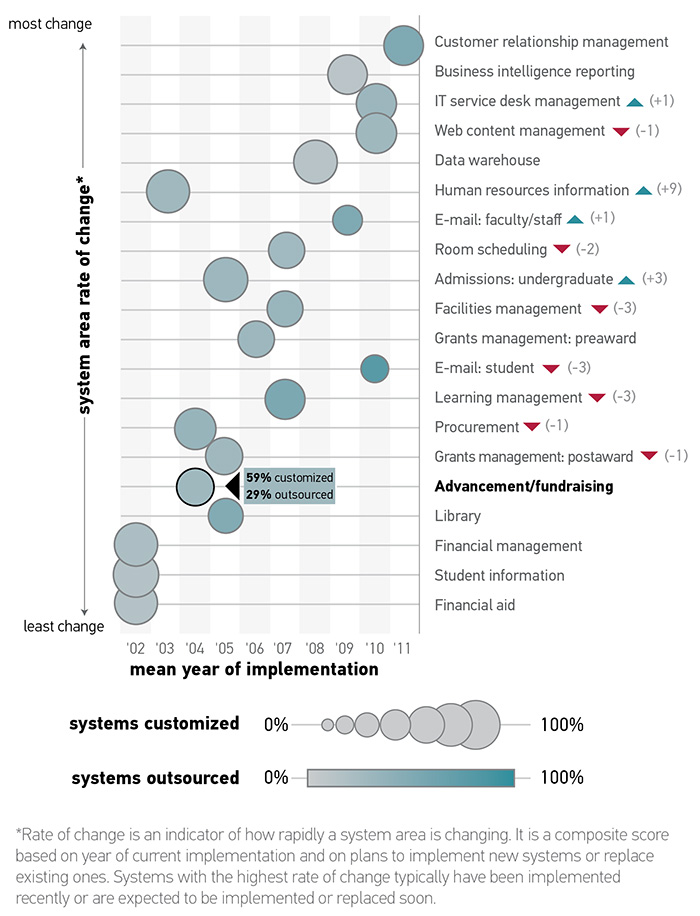
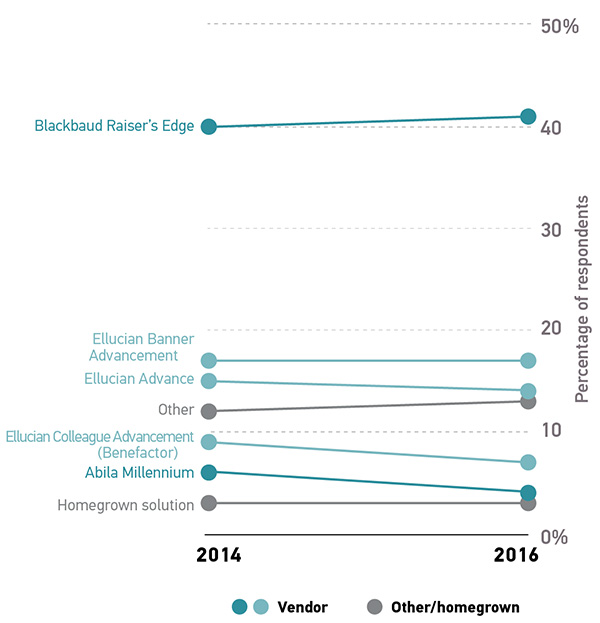
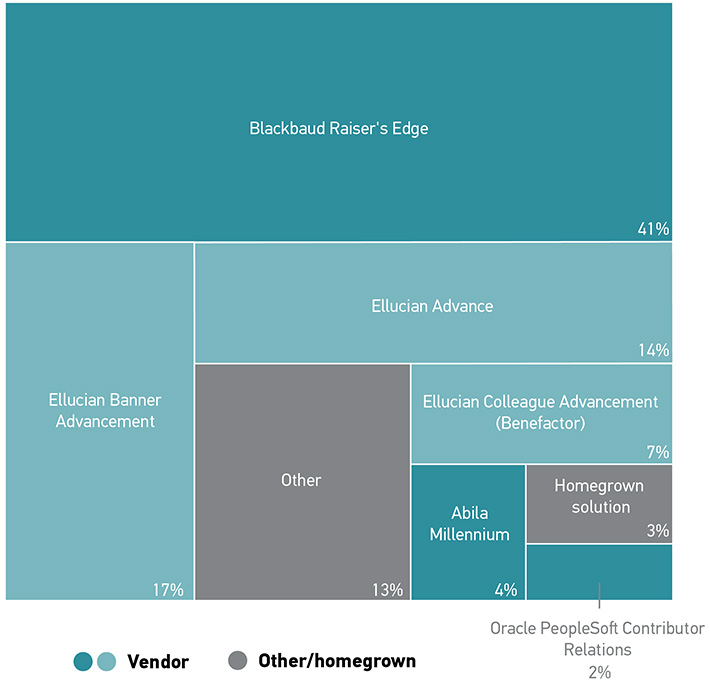
In 2016, the advancement/fundraising system market remains in the bottom fourth of our system area rate-of-change ranking (figure 24). This stable market reveals only slight shifts in market share between 2014 and 2016 (figure 25). Institutions continue to prefer market leader Blackbaud Raiser's Edge (41%), followed by a variety of Ellucian solutions—Banner Advancement, 17%; Advance, 14%; and Colleague Advancement, (Benefactor), 7% (figure 26).
Case Study: ITS as a Business Partner in Advancement System Replacement at The University of Tampa
Current generation advancement systems use state-of-the-art capabilities and native cloud functionality—such as customer relationship management (CRM), electronics records management, and analytics—to help institutions identify, develop, and sustain strong supporter connections. Over time, The University of Tampa (UT) recognized the need to update traditional methods of managing donor and prospective records. "We have a system that was most likely fine in its day," explained Keith Todd, Vice President, Development and University Relations. "With newer and more advanced technologies that are available today, we'd like to create a user-friendly portal for our development office, especially for our front-line officers. Primarily, we have no accurate modeling or analytics functions. Fundraising truly is a balance of art and science, but our current system makes the science part very cumbersome."
Indeed, the Office of Development and University Relations often uses shadow systems—a mélange of spreadsheets, Word documents, data pulled from the university's legacy ERP system, and/or manual processes—to conduct advancement activities. For example, UT's current capital campaign is tracked in a separate database. "That is clearly not ideal because it means we have double entry," explained Todd. "There is so much concern about our current system's data accuracy that we feel more comfortable with a shadow system we can absolutely control."
Luckily, UT's Student Information Systems (SIS) replacement in progress has provided an opportunity to rectify the situation, folding a new advancement system into overall SIS project plans. "When we started the legacy SIS replacement process, it was a natural decision to also focus on the Development Office," stated Tammy Clark, Chief Information Officer, Information Technology and Security (ITS). UT's new SIS is a software-as-a-service (SaaS) cloud solution, and it's anticipated the new advancement system will follow suit. UT plans to go live with both systems before mid-2019.
Preparations for the new advancement system are already under way. For example, the Office of Development and University Relations is laying the data migration groundwork by creating any new shadow system with a SaaS system in mind. "Several staff members have worked on a leading SaaS advancement system, and we're modeling any new data gathering in a way that supports a potential new system as much as possible," explained Todd. "Even if data elements are not directly importable, it will allow for better ease of uploading important information, as for example, constructing our prospect portfolio in the new system."
ITS is lending a hand in a number of ways, too. The unit is handling the traditional data integration duties between the new SIS and advancement systems, but interestingly, ITS's involvement also includes strategic activities:
- Strategic institutional partnerships: UT's president (who is involved in fundraising), Clark, and Todd are working together to create common understanding of how a SaaS advancement solution works and to evaluate SaaS vendors' ability to support UT's fundraising activities and goals.
- Contract negotiations: Clark's experience with SaaS system acquisition and management comes into play when negotiating the new advancement system contract, evaluating and negotiating important items such as UT/vendor roles and implementation plans/timelines, first-year and annual subscription pricing, vendor data-security practices, and UT's data-risk and data-retrieval options if a vendor problem arises or UT decides to change vendors.
- Functionality assessment: An ITS business analyst will be assisting the Office of Development and University Relations with an examination of existing business processes to identify reengineering opportunities that will best achieve desired results from the new system. In addition, this exercise helps scope essential features to implement initially, as well as identifying additional capabilities to build into future implementation phases, which in turn lowers UT's initial financial investment in the system.
- Optimize ancillary systems: ITS's institutional perspective also helps integrate any potential ancillary system purchases—e.g., a document-imaging system—with the UT technology environment in a way that optimally benefits the university and avoids redundancies.
ITS's broader involvement reflects the organization's evolution as an institutional business partner, supporting technology's overall institutional strategic value and sharing extensive project planning and vendor management experience. "I want to build critical business relationships, and that is why I look at projects such as the new advancement system as an opportunity for myself and my other ITS leaders to interface with the business and academic sides of the campus," stated Clark. "I want to be involved from the start as a partner so we can help nurture initiatives along to make sure UT achieves the desired end results."