Web Content Management
An institution's website is a vital marketing and information hub, engaging many different audiences—prospective and current students, faculty, staff, alumni, and visitors. It's imperative to implement institution-level website design and management to ensure a consistent, compelling user experience backed by accurate, timely, and navigable content and features. However, this can be difficult in a decentralized university environment, where individual websites can sprout without rhyme or reason. The result is an uneven web presence: One area's website may have cutting-edge design, whereas another area's may be woefully out of date. A web content management system (WCMS) can help rectify this situation.
The Market
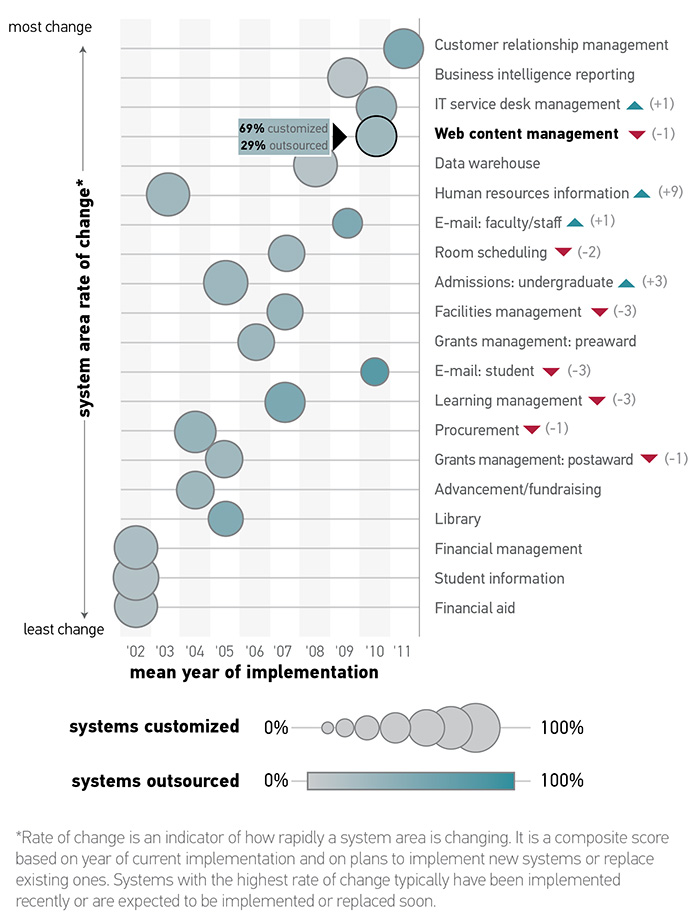
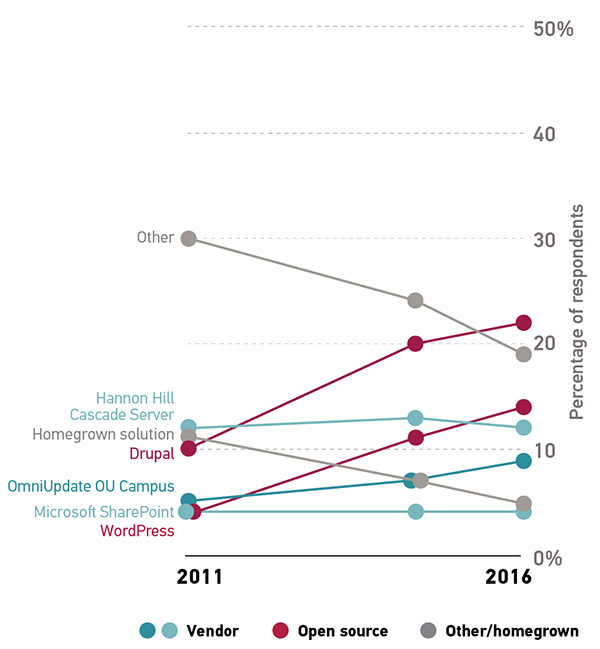
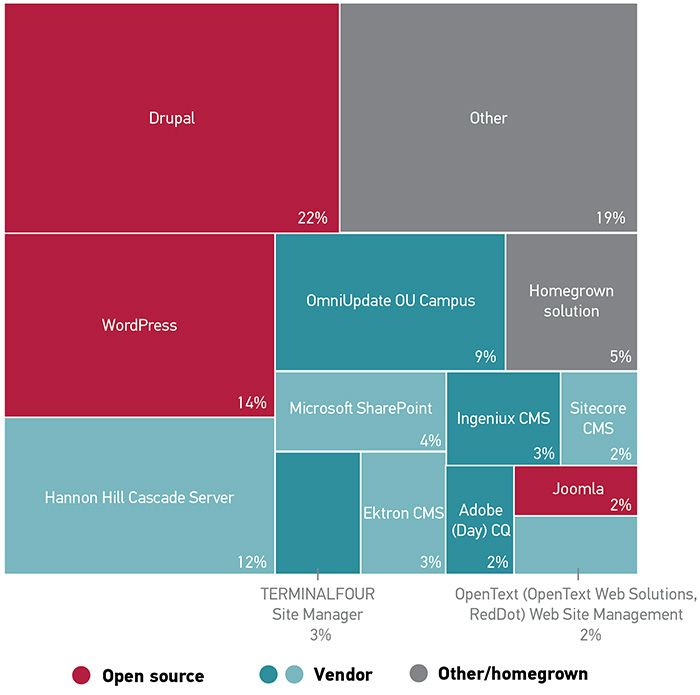
The heterogeneous web content management system market was the fourth fastest-changing system area of 20 areas analyzed in CDS 2016 (figure 5). Major shifts in the market shares for Drupal (10% in 2011 versus 22% in 2016) and WordPress (4% in 2011 and 14% in 2016) have contributed to the change from 2011 to 2016 (figure 6). Drupal and WordPress are the current web content management system market leaders (figure 7).
Case Study: Modernizing and Unifying California State University, San Bernardino’s Web Presence
When Samuel Sudhakar, vice president for Information Technology Services (ITS) and CIO, arrived at California State University, San Bernardino (CSUSB) in 2013, he found "an eclectic collection of over 300 web sites, maintained by many individuals across campus. There were servers in closets, and each department and college had their own look-and-feel." The situation presented potential problems:
- Lack of a unified university web presence and brand
- Inability to monitor for inaccurate and out-of-date content
- Inaccessible content for people with disabilities, as mandated by CSU's Accessible Technology Initiative (ATI)
- No disaster recovery if a website went down
- Security vulnerabilities resulting from poorly designed websites
In addition, CSUSB's single top-level site web structure served all constituencies, making it hard to target user experiences. The absence of a web content curation policy resulted in a hodgepodge of web links on CSUSB's home page.
CSUSB needed a cohesive website strategy, and as a first step, ITS partnered with the Office of Strategic Communication, which oversees CSUSB's external-facing websites to implement a WCMS. ITS would manage the website architecture as well as build accessible and secure templates for local managers to create and maintain their web content. Another transition goal was to simplify website management by moving hosting to an off-campus cloud provider.
CSUSB evaluated several WCMS options. User-friendliness was a selection driver: It had to be easy for local website administrators to contribute content and for ITS web programmers to maintain website architecture and templates. Ultimately ITS chose to implement Drupal, an open-source WCMS, for these reasons, as well as for its ability to organize website structure and content and to create scalable, customizable websites. Also, ITS could tap into Drupal's active worldwide support community as needed. Sudhakar was familiar with Drupal, having managed a Drupal migration at his previous institution.
ITS used its Drupal WCMS to reorganize CSUSB's website structure, segmenting the former single website into two top-level websites: an external-facing, CSUSB.edu website for prospective students and others not associated with the university and an internal-facing portal, called MyCoyote, to serve students, faculty, staff, and alumni. This distinction made it easier to create uniformed branding and user experiences geared toward each website's audience. In addition, ITS eliminated all independent, local website domains, transitioning them to department or subsites that are nested under the top-level CSUSB.edu websites. Nesting sites enables web programmers to replicate web content and design changes more easily, reducing administrative burdens and providing more time for creative and innovative web design.
Culture was as important as technology in CSUSB's website transition, given CSUSB's relatively large populations of website managers and users, and steps were taken to include the community in the project. Sudhakar and Ron Fremont, CSUSB's vice president for advancement (whose division manages the Office of Strategic Communication), formed a university-wide web steering committee. The committee's membership aligns with CSUSB's IT governance executive committee to ensure university-wide representation in planning. The web steering committee involved the university by hosting informational forums and using a campus-wide popular vote to pick the web template designs for the new CSUSB.edu website.
The university is in year two of a three-year Drupal migration timeline. Student-facing websites went first, followed by administrative sites; 45% of all administrative websites have been migrated. The home page and five other websites launched in January 2016. ITS devised an incentive to solicit local support: Areas that dedicate a resource to work with ITS on their website migration get a higher slot in the queue. Before assuming responsibility for their websites, all local managers receive several hours of training on the Drupal website templates as well as ATI-compliant content creation and management.
Sudhakar offered these lessons from his experience:
- Your institution's web site is unique: This is important to keep in mind when reviewing other institutions' websites for inspiration. "Never assume anything," advised Sudhakar. "Another institution's website design, structure, or strategy is never going to totally transfer to yours because each institution's culture and circumstances are different from your campus community." You have to make allowances for these differences in your institution's website planning.
- Communicate widely and frequently: All technology projects require communications, but it is especially important with website redesign because it involves so many stakeholders. ITS especially tried to involve students because they are avid users of online resources. "Opinions are going to be different," stated Sudhakar. "So communicate, communicate, communicate and incorporate everyone's input as you go through the website redesign." He believes the low number of complaints about CSUSB's new website is testament to the project's communication efforts.
- Simplify website structure: Sudhakar recommended using a single website structure for the entire institution whenever possible. This helps the website work better—for example, through faster loading—and, as noted previously, simplification reduces routine maintenance tasks and increases time for creative web design.
Today's CSUSB's web presence is more visual, engaging, secure, and accessible—its WCMS is key to this transition. "With our WCMS, we can distribute content creation, maintenance, and updates to local areas while controlling our website architecture and the templates," stated Sudhakar. "There is little chance that people will post something that causes an accessibility or security concern. And our web design is innovative in ways that weren't possible previously."