Room Scheduling
Room scheduling may sound like a routine institutional activity, but room scheduling systems benefit institutions in numerous ways. By matching instructor’s needs to properly sized and equipped learning spaces, as well as ensuring space availability, these systems help manage learning spaces more effectively; this optimization is especially important for peak demand periods. Room scheduling systems also can facilitate event function scheduling by reserving appropriate event spaces, managing approval processes via workflow, and arranging catering and media support as needed. In a strategic capacity, room scheduling systems with room demand and utilization analytics support facility construction and renovation decisions. Institutions can also foster student success by integrating data from room scheduling and student information systems to project long-term room demand for specialized courses required for degree completion.
The Market
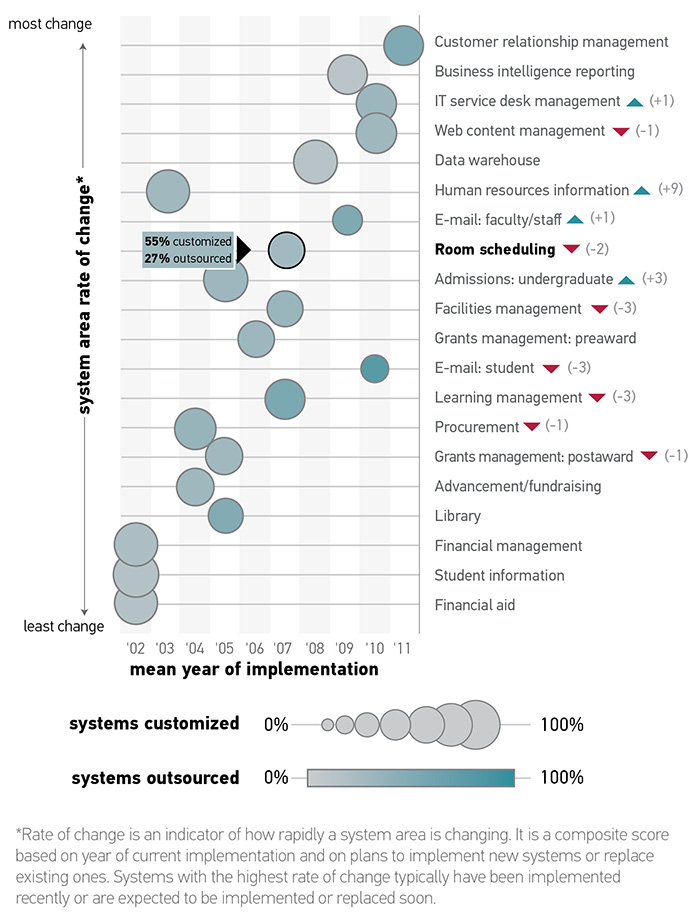
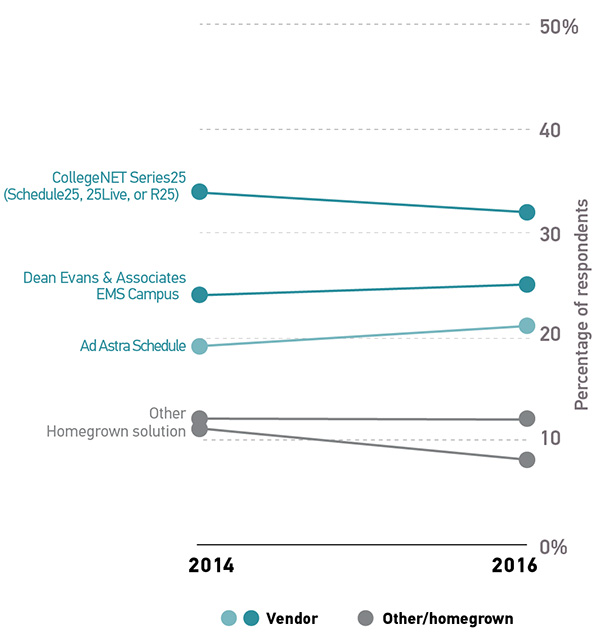
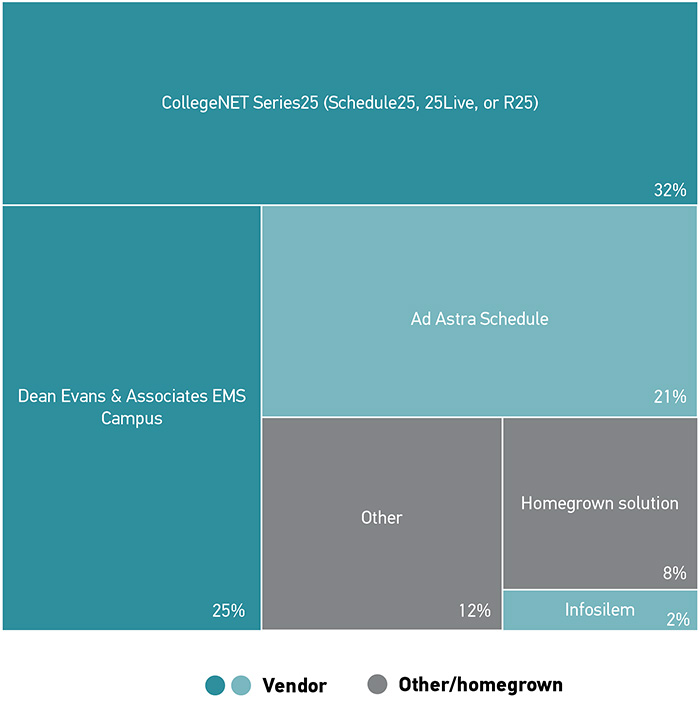
With relatively few new implementations and few plans to replace these systems, the room scheduling system area has fallen two slots in terms of system area rate of change in 2016 (figure 16). The homogeneous market has remained relatively stable from 2014 to 2016 (figure 17). CollegeNET Series25 (32%) remains the market leader, and Dean Evans & Associates (25%) follows at a close second (figure 18).
Case Study: Room Scheduling in Virginia Tech’s Distributed Environment
Implemented in summer 2015, Virginia Tech's CollegeNet 25Live room scheduling system performs double—even triple—duty. The system optimizes utilization of the university's general assignment classrooms, but it also provides a central campus event information resource—listing event name, attendee numbers, event local contact, university sponsor, and other relevant information—in a cloud-based database that campus police and emergency responders can easily access remotely. For strategic planning, the 25Live system's analytics will contribute to Virginia Tech administrators' long-term planning efforts, helping to optimally locate classroom buildings, laboratories, dining halls, and other facilities across campus in support of student activity patterns and anticipated enrollment growth.
When selecting its new room scheduling system, the Division of Information Technology conducted a four-month information-gathering process with various university areas—including the Student Engagement and Campus Life's Event Planning Office, Department of Athletics, Office of the University Registrar, the Office Emergency Management, and the Police Department—that scheduled or supported campus events to determine system needs, such as remote system access and analytics capabilities. These discussions, combined with Virginia Tech's long-term vendor relationship with CollegeNet, persuaded the Division of IT to upgrade its CollegeNet Schedule25 system to the cloud-based 25Live system and to purchase CollegeNet's X25 data analytics module.
A major part of the 25Live transition was the synchronization with HokieServ (Virginia Tech's branded name for its AssetWorks AiM System), the Facilities Department database of Virginia Tech's facilities, to create a single source of schedulable spaces. Steps included:
- An outside consultant helped develop a common set of compatible values—e.g., event types, equipment, and room features—for the two systems.
- The Office of the University Registrar and the Facilities Department worked together to sync classroom seat numbers and other characteristics between Virginia Tech's ERP Banner System by Ellucian and HokieServ and thus ensure accurate information for the 25Live System.
- The Division of IT and Facilities Department culled through HokieServ's approximately 72,000 locations to identify schedulable spaces such as classrooms and more importantly, to eliminate unschedulable locations such as showers and closets from the 25Live/HokieServ synchronization.
- The Facilities Department added potential outdoor event venues such as recreation fields to HokieServ.
Today, Virginia Tech's 25Live System manages approximately 7,000 HokieServ locations. The two systems sync up daily to keep location information up-to-date.
The Division of IT cited many advantages to its new room scheduling solution. The system's Event Wizards make it easier for event organizers to find appropriate venues and complete the information sharing/approval process with relevant Virginia Tech organizations—e.g., the Police Department, Parking Services—depending on the type of event. For example, an outdoor event serving alcohol has a different event approval workflow from that of a 20-person after-hours classroom discussion. The system's reporting function supports university operational and strategic activities, such as daily event rosters for Virginia Tech's police department, room optimization reports for senior administrators' planning activities, and information collection for Commonwealth of Virginia reports. The Division of IT is intrigued by potential system enhancements, for example, integrating complementary systems such as remotely programmable HVAC, light, lock, and electronic signs into its 25Live System.
Although the Division of IT implemented 25Live three years ago, Virginia Tech's decentralized culture presents an adoption challenge. University policy allows administrative and academic departments to use their preferred solution locally—such as Outlook Calendar or another room scheduling system—for day-to-day scheduling of their locally controlled spaces, and many areas are hesitant to tinker with their current process. For example, one roadblock is the inability to access 25Live from Microsoft Outlook desktop's client, though it is accessible via Microsoft Outlook Web Application.
But alternative ways exist for 25Live to gather information from around campus for centralized room scheduling and analytics purposes without local areas sacrificing their preferred scheduling solution. For example, Virginia Tech's Policy 5000 for planning university facilities and events does require every area to record its scheduled events in the 25Live System for emergency management purposes. And the Division of IT is working with Student Engagement and Campus Life's Event Planning Office—the area that schedules the most campus events—to directly pull data from their local scheduling system into 25Live via a CollegeNet-provided utility.
When reflecting on lessons learned, Janet Linkous, former Director, Academic Applications (retired), noted the importance of a central institutional focal point to manage room scheduling policy and utilization. "It can be a disadvantage to be extremely decentralized when implementing a room scheduling system," she explained. "You need to have a central entity or gatekeeper, or your room scheduling system will not be as effective as it could be." Over time, Policy 5000 and its governance committee of Virginia Tech senior administrators assumed that gatekeeper role.