Library
College and university libraries continue to evolve in tandem with today’s increasingly technology-driven educational environment. A library management system enables this transition. For example, today's library collection includes a diverse portfolio of resources such as e-books, electronic journals, databases, and discovery frameworks, as well as traditional paper-based collections. Librarians can manage these various resources effectively with a single library management system, and system features such as acquisition, cataloging, and workflow functionality reduce resource processing and administrative burdens. In addition, a library system's online and mobile capabilities support patrons' expectations of anytime, anywhere search and access to library materials.
The Market
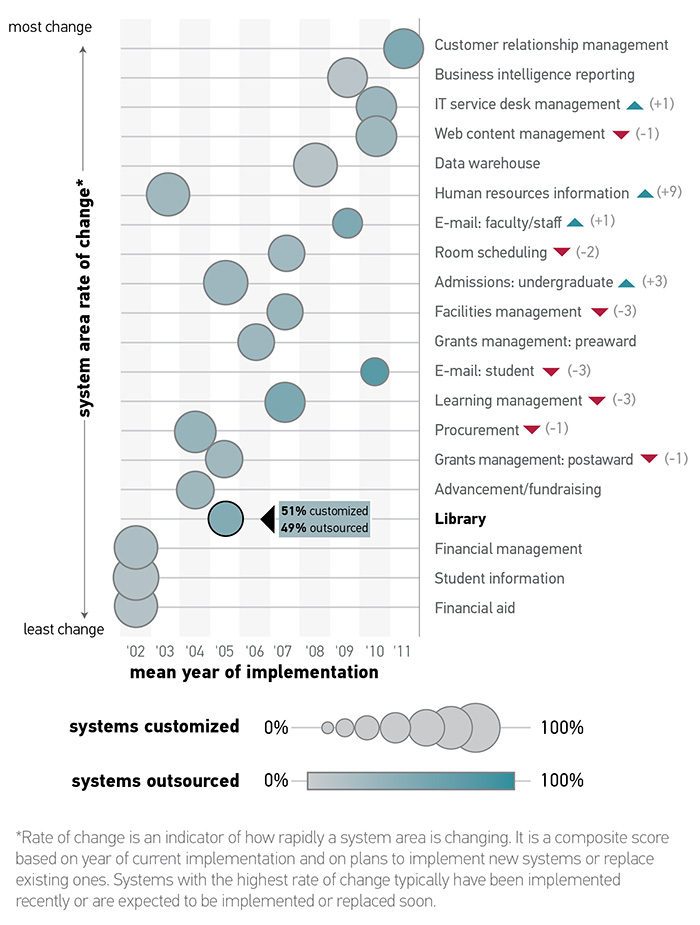
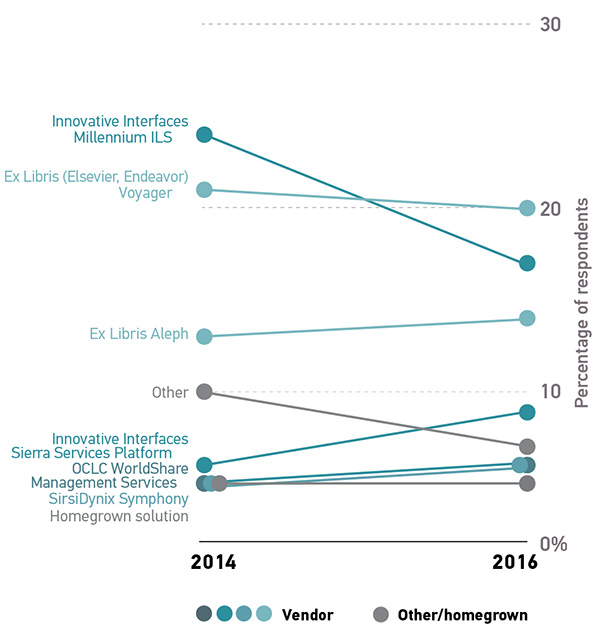
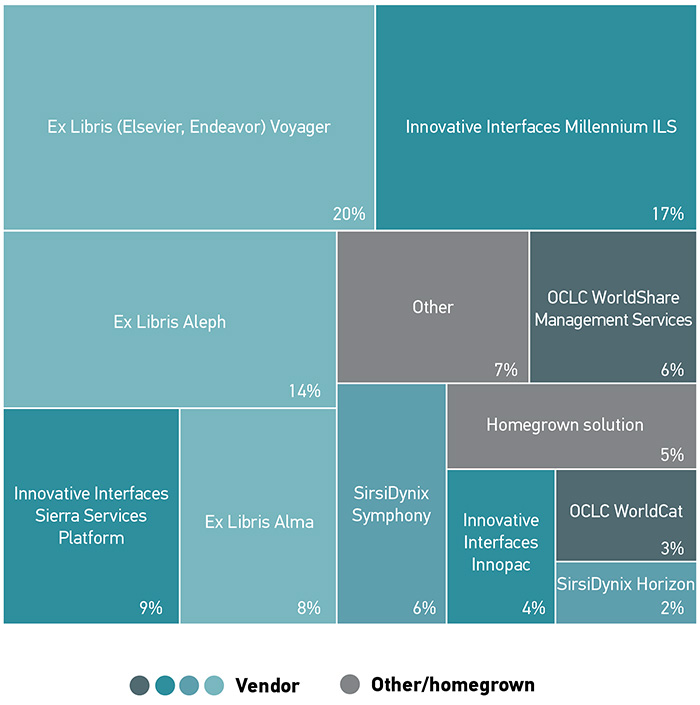
The library system market remains among the slower-changing markets in 2016 (figure 27). Market shifts that did occur between 2014 and 2016 reveal changes in implemented solutions, not vendor preference (figure 28). For example, market share for Ex Libris (Elsevier, Endeavor) Voyager decreased (21% in 2014 to 20% in 2016), while market share for Ex Libris Aleph increased (13% in 2014 to 14% in 2016). Although most of the market (89%) is owned by only four vendors, each provider maintains multiple solutions, and in 2016, 10 different solutions were implemented in at least 2% or more of institutions (figure 29).
Case Study: Strong Collaboration between Carleton College and St. Olaf College for Multi-Organizational Library System Implementation
Enterprise system implementations can be a complex proposition, coordinating needs, cultures, and project activities between IT and various institutional areas. But what happens when you add another institution to the project? That's the case with St. Olaf College and Carleton College libraries. The Andrew W. Mellon Foundation awarded them a grant in 2003 to merge the colleges' library catalogs and library management systems, also known as the Bridge Consortium. In 2013, a subsequent Mellon Foundation grant supported the two college libraries' continued collaboration, most notably funding replacement of its aging cross-institution library management system and development of a shared research portal.
The grant's timing was auspicious in that the colleges' legacy library system dated from the early 2000s and had reached its end of life. Replacement options included a current system upgrade, but the colleges opted to purchase a new system that better supported their current and future needs. Those needs included electronic and print collection management, system flexibility with APIs, and, most importantly, support of the colleges' deep collaboration principles, which include shared vision, engagement and goal alignment, and shared information resources, staff expertise, and decision making. "Deep collaboration drove many higher-level decisions because staff members handle duties for the other college's libraries as well as their home campus," explained Roberta Lembke, Chief Information Officer for Libraries and IT at St. Olaf College. "For example, we needed a system that worked from wherever a staff person is located." Over the course of 2015, the staff at college libraries and Information Technology (IT) offices evaluated several options through vendor demonstrations and onsite evaluations and in the end chose the Ex Libris Alma software as a service (SaaS) library services platform and Primo discovery framework.
The next step was system implementation, and the colleges took several steps early in the project to ensure all parties—both colleges' IT and library staffs—were all on the same page, especially since "the new system would impact day-to-day practices that people were very wedded to," stated Sarah Johnston, Head of Library Technology and Web Services at St. Olaf College. Actions included:
- Change management training: An outside consultant talked with staff before the project commenced about the different phases of change and how to deal with change's stress and anxiety. Campus administrators were trained on change management leadership practices—e.g., dealing with resistant staff and how to reach consensus when differences arise.
- Principles of implementation: St Olaf College's and Carleton College's library directors created a contract-like document that outlined implementation ground rules to simplify and align the libraries' work with the new system. For example, the principles state the two libraries will use the same policies, LMS system procedures, and terminology, as well as the same fund code structure, ranking search result algorithm, staff training materials, reports, and analytics. The new library system will not be heavily customized and will remain as standard as possible.
- Governance: The project relied on a four-tier structure to coordinate project actions, communications, and issue resolution:
- At the bottom are granular working groups representing library functions from both colleges—e.g., cataloging and circulation—to work on implementation preparation. For example, the catalogers, who had to migrate the largest amount of data into the new system, worked diligently to align and clean up both colleges' data.
- The next tier was a broader steering group representing different library perspectives—e.g., acquisitions for the financial perspective and reference to provide the patron view. The group met weekly together and with the vendor's project manager.
- Farther up was a small, core project management group that included Johnston and other system functional area representations—the colleges' two technical services heads and a Carleton College circulation librarian.
- At the top were the colleges' library directors.
The colleges' deep collaboration principles drove the implementation, too. Besides ensuring anytime, anywhere system access, the colleges reconciled individual library functions and processes into cross-library solutions as needed. Acquisitions is one example: One college used an online venue, whereas the other relied on a more paper-based process. Now there is an aligned online ordering process, as well as access to both institutions' library financial data so one college's library staff can process acquisitions for the other as required.
IT helped as needed with new library system integration with other institution systems, especially on two fronts—the student information system and, more importantly, patron authentication. Johnston and the project team realized the legacy library system did not offer strong persistent IDs. "There was a lot of data wrangling, given that we did not have the data in our legacy system," stated Johnston. "And making it work seamlessly and painlessly for patrons was one of the more time-consuming and complex parts of the whole system set up."
The new Ex Libris system went live in June 2016, benefiting the libraries in several ways. For example, the new system's API permeability facilitates customization, enabling Johnston to build an acquisition report to keep faculty and students up to date on new resources. This was a cumbersome process in the legacy system, but she used an API to create a web page for the report and a script to update it daily. The system's analytics capabilities generate usage data that enabled the colleges to cull $26,000 of infrequently used print journals subscriptions. Finally the vendor's monthly system updates encourage the library staff to be adaptive and nimble, inspiring them to think about continual improvements.
Going forward, Johnston plans to work with the library staff to better understand Alma's usage pain points and to enhance their awareness of API-enhanced system features. Work on the colleges' shared research portal continues, too. The first steps include enhancing the Primo discovery framework's capabilities. For example, Johnston integrated software platforms and APIs to enhance browsing capabilities of online journals' tables of contents. Longer-term plans include proactively pushing relevant resources to library patrons based on their research needs—e.g., a microeconomics student can review relevant resources when he or she logs onto a research portal.
Given the library system implementation's multiorganizational nature, Lembke and Johnston's lessons learned focus on communication and buy-in across both institutions. "Early on, we explained some of the rationale for the system change," stated Johnston. "The staff viewed the systems under consideration early, and we involved them in the decision-making process as much as possible." This helped the staff see the bigger picture—how a system could benefit both institutions and how an undesirable system feature for one area might outweigh a well-designed feature needed by another department or vice versa. The project's principles of implementation and inclusive governance supported communication and buy-in efforts, too. Lembke described efforts to sprinkle intersections of fun throughout the process—for example, starting and ending the process with a gathering of St. Olaf and Carleton College staff. Senior leadership demonstrated their support, attending project meetings and bestowing the highest college honor on the project leadership. This emphasis on communication, buy-in, and deep collaboration helped the two colleges work together to implement a modern and mutually beneficial library system that serves both institutions' short- and long-term needs.