Grants Management
Research is a strategically important mission at many colleges and universities, but grant application and management complexities can stymie research-funding efforts. Preaward and postaward grant management systems overcome this obstacle in various ways. System functions facilitate the entire process: grant discovery and management, proposal submission, budget planning and management, peer collaboration, and regulatory and conflict-of-interest compliance. System capabilities ease administrative burdens and expedite proposal completion: online access, workflow, and electronic information entry and storage. In addition, automated processes improve data accuracy and eliminate information input replication. Analytics and reporting capabilities help institutions fulfill their research mission, providing insights into research performance and pinpointing potential research opportunities.
The Market
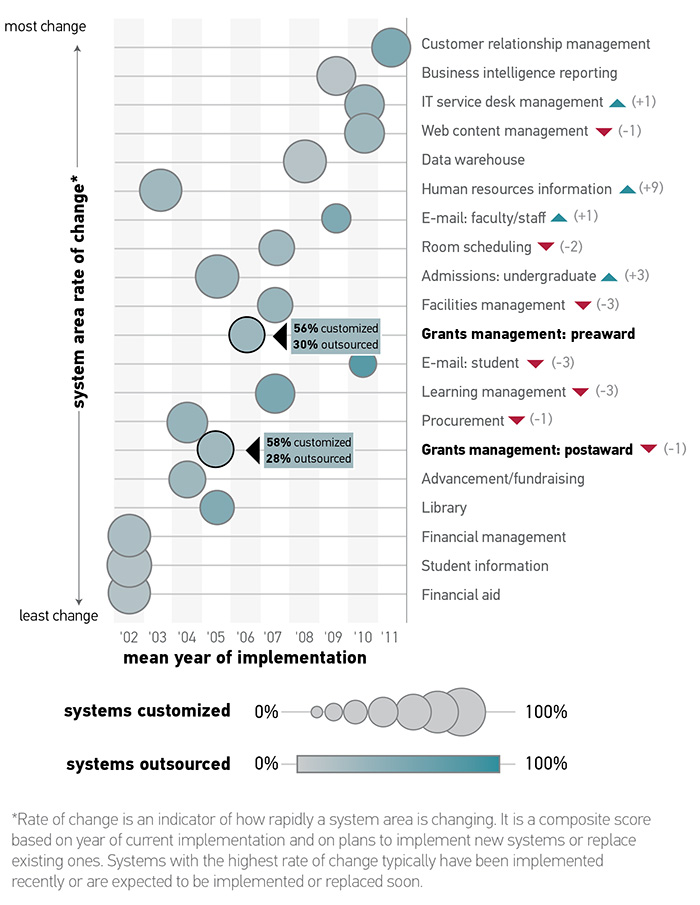
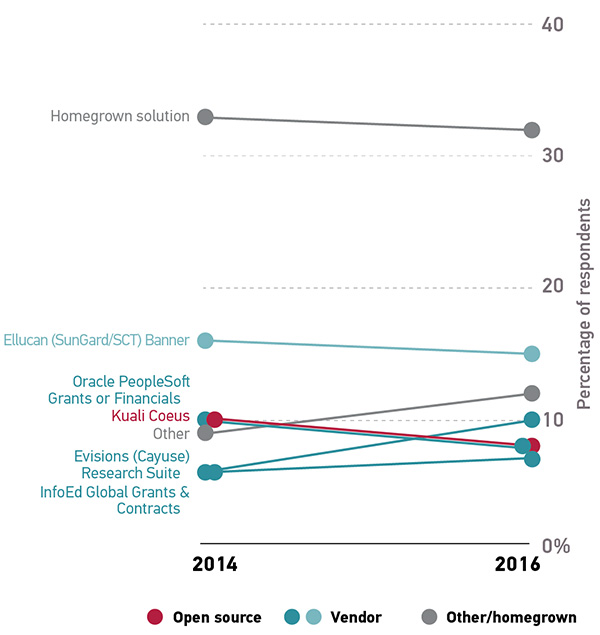
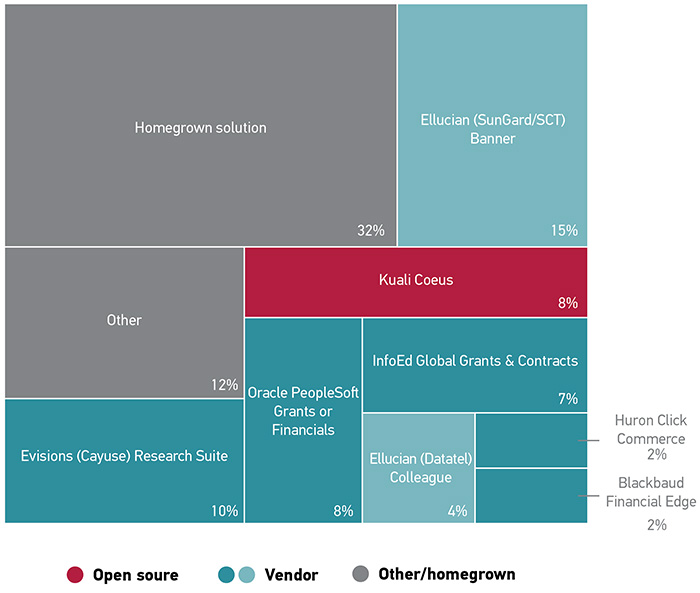
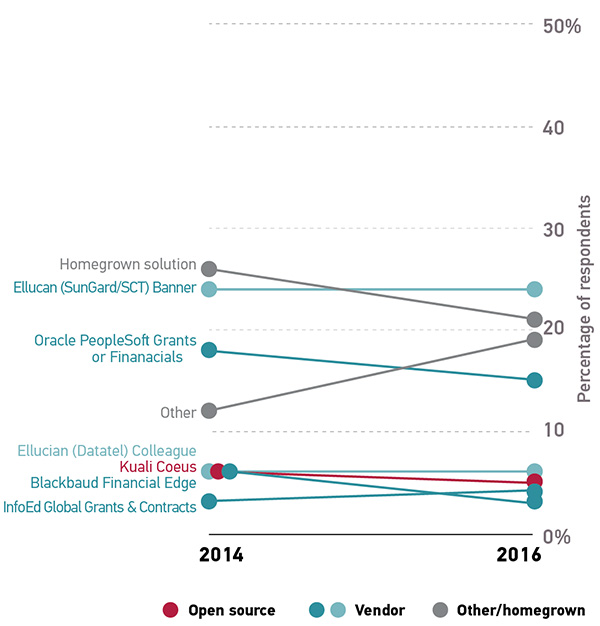
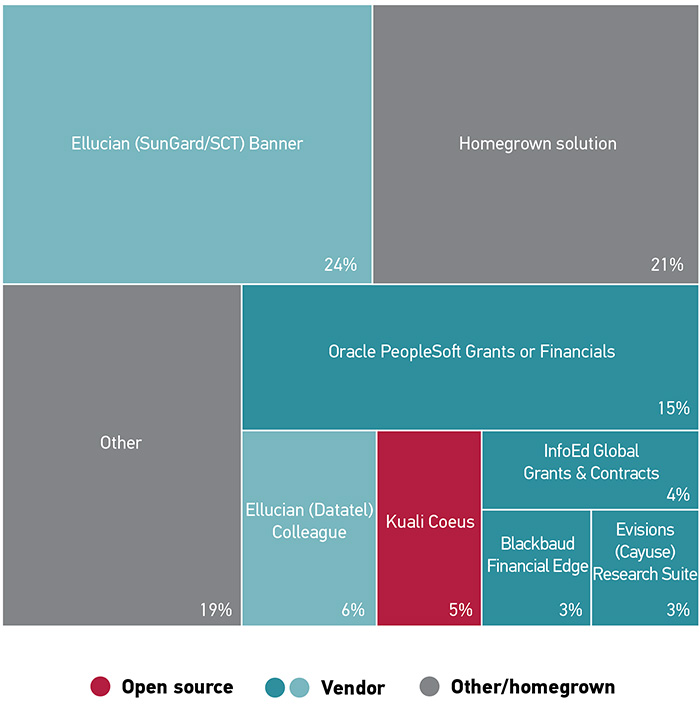
The grants management system market reveals small shifts in 2016; these systems are relatively stable in terms of rate of change compared to other system areas (figure 19). Both preaward and postaward system markets show shifts away from homegrown solutions and increases in uses of “other” solutions, those with less than 2% market share (figures 20 and 22). Increases in uses of other solutions indicates increased diversity in these already heterogeneous markets and creates the potential for new market leaders in future years. In 2016, the preaward market continues to be dominated by homegrown solutions (32%; figure 21), whereas the postaward market is led by Ellucian (SunGard/SCT) Banner (24%; figure 23).
Case Study: Stony Brook University Utilizes Portal Approach to Grants Management
Stony Brook University, a research university in the State University of New York (SUNY) system, utilizes a mix of systems for its research management, including MIT's Coeus system, hosted at SUNY Buffalo, for preaward grant management; IRBNet for research compliance; the Research Foundation for SUNY (RFSUNY)'s Oracle grants management system for postaward financial management; and a system-wide data warehouse for research-related information.
In 2009, incoming President Samuel J. Stanley, Jr. launched Project 50 Forward to position Stony Brook ideally for its next 50 years by optimizing current university operations, resources, and revenue streams. Project findings proposed enhancing university research activities by reducing research management's complexities and administrative burden. Upon further evaluation, the university decided to defer postaward system redesign because the RFSUNY's solution was stable and current and the researchers could access needed information reasonably well. The focus turned to preaward and compliance because in the past individual SUNY schools managed these research functions themselves. Stony Brook's Offices of the Vice President for Research and Division of Information Technology (DoIT) evaluated a few options over several years.
One was to improve the functionality of their current low-cost system (Coeus) as well as its compatibility with other Stony Brook enterprise systems to facilitate identity management, data integration, and other needs. But uncertainty about some systems' long-term direction was a concern, for example, Coeus's transition from its original developer, MIT, to the Kuali Foundation.
Next, DoIT considered a best-of-breed approach, acquiring and integrating data from distinct systems and overlaying them with a portal. The portal was an important component because it would provide a single place where researchers could access key information about all their research aspects—and potentially could tie to related enterprise systems, too. For example, researchers could identify potential colleagues to work on new grant opportunities if integrated with the university's research interests and expertise system. "But when we reached out to the research community, it was really clear this was an unpopular option," stated Adnan Rangwala, Director, Enterprise Applications. "They wanted one system that does everything."
So Stony Brook used researcher feedback to develop a third option—portal access to a single system's various modules. After evaluating several products, Stony Brook decided to implement Huron Click in 2016. The vendor appeared on DoIT's radar while participating in RFSUNY's deployment of a system-wide Pre-Award and Compliance System (PACS) in 2014. Stony Brook liked Huron Click's active user community and the vendor's perceived long-term viability, and the long-term product vision—a portal overlay and data sharing among modules—mirrored the university's. Most important, Stony Brook's research community liked the product.
Today, Stony Brook is building its own version of Huron Click through the SUNY license to meet the university's unique needs. The Click Portal Solutions Implementation Project is a single portal to a suite of six Huron preaward and compliance systems: Conflict of Interest (COI), Institutional Review Board (IRB), Institutional Animal Care and Use Committee (IACUC), Agreements, Grants, and Biosafety/Stem Cells. COI is currently live, with other modules scheduled for completion through 2017–18.
"The typical IT question is how to integrate data between the two different systems, but we soon learned that the user experience takes the higher priority over everything," stated Rangwala. DoIT involved the university research community as much as possible to ensure the Click Portal met their needs. The project team is colocated between DoIT and the Office of Research; team lead Rangwala reports to a senior DoIT director as well as the vice president of research. Two dedicated DoIT programmers work on the project in conjunction with the functional lead, the director of sponsored programs. The research community participated every step of the way—in selection, design, and testing—especially the Departmental Administrators Committee, which represents staff members who support their department's research administration. "We recognized the researchers' busy schedules may limit their participation, but committee members are primary system users, too," explained Rangwala. "Through their involvement we learned that some of our assumptions weren't necessarily true, and they help us to get ahead of potential system rollout problems." For example, IRB system testing revealed that a staff member may sign off on a protocol instead of the department chair, requiring a system process alteration. The next priority is training so researchers and administrators understand the systems' full value.
Only the Click Portal's COI system is live currently, but benefits have emerged already. The transition from PDF forms to electronic entry increased time efficiencies. Disclosures are kept on file, so researchers no longer have to enter the same COI-related information for each proposal. This benefit grows as more systems come online, bringing more electronic information to the researcher's fingertips. There are fewer paper forms to fill out, and relevant information flows more easily from system to system to support research administration. Other anticipated benefits include faster proposal approval, cleaner data capture, and better decision making about research investments.
Stony Brook is now contemplating its research management's next steps. One issue is portal expansion, whether to onboard six additional research-related systems—e.g., Travel and Expense, Recruitment, Lab Services Management, Facilities Management, Post-Award and Financial Reporting—directly into the Click Portal or to integrate just these systems' data. Another is tying together the Click Portal to the SUNY Oracle postaward system to minimize manual information transfer when grants move from preaward to postaward management. A third issue is postaward analytics, infusing the portal's data with analytics tools to track award trends and metrics in order to spot potential opportunities and multidisciplinary research approaches in a predictive fashion. Stony Brook remains involved in SUNY's PACS Click project; serving on the PACS implementation committee and piloting the Click Portal Solution for SUNY since it is built on a newer version than PACS. The Click Portal Solution conforms to relevant SUNY data requirements to support an eventual connection with SUNY's postaward system and a forthcoming SUNY metrics dashboard.
"We're building the Click Portal Solution to remove as many barriers as possible for our researchers," stated Melissa Woo, Senior Vice President, Information Technology and CIO. And Stony Brook is well on its way to achieving this goal.